Sector Mean Reversion on Japan (JPX): 7.12% CAGR, -0.91% vs S&P 500

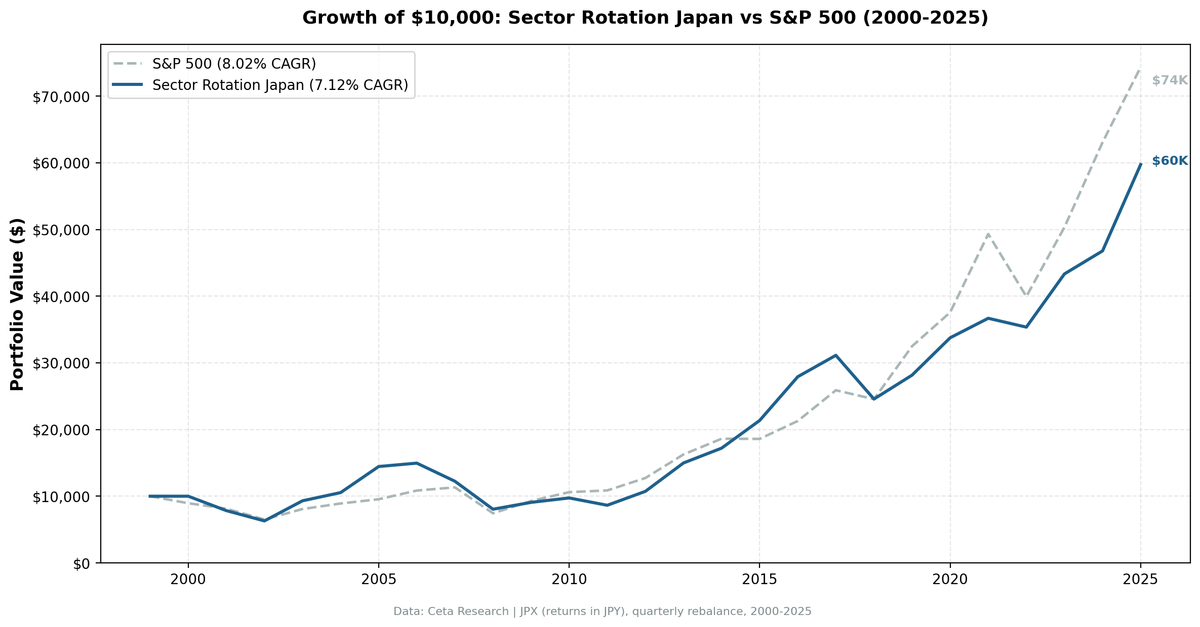
We ran a sector mean reversion strategy on Japan Exchange Group large-cap stocks from 2000 to 2025. The result was 7.12% annualized in JPY terms, a -0.91% shortfall against the S&P 500, and a down capture of 57.72%. The strategy nearly broke even with the index. That near-miss is actually the most interesting thing about it.
Contents
- Method
- What is Sector Mean Reversion?
- The Screen
- What We Found
- 26 years. -0.91% annual shortfall vs the S&P 500.
- Full Annual Returns
- Notable Years
- Backtest Methodology
- Limitations
- Takeaway
- Part of a Series
- References
- Run This Screen Yourself
Japan is the borderline case in this study. On raw excess return, it barely trails SPY. But on risk-adjusted terms, it's a different story. The Sharpe ratio is 0.337, which is higher than the US result of 0.319. Japan's near-zero risk-free rate (~0.1%) inflates that number, the US uses ~2% as its floor, but the underlying logic holds: this strategy carries meaningful volatility and still loses less than SPY in bad years. The down capture of 57.72% is the number that earns attention. In years when markets fell, this portfolio fell less.
Method
| Parameter | Value |
|---|---|
| Data source | Ceta Research (FMP financial data warehouse) |
| Universe | JPX (Japan Exchange Group: Tokyo Stock Exchange + Osaka Stock Exchange), market cap > JPY 30B (~$200M USD) |
| Period | 2000-2025 (26 years, 104 quarterly rebalance periods) |
| Rebalancing | Quarterly (January, April, July, October), equal weight all qualifying stocks in selected sectors |
| Benchmark | S&P 500 Total Return (SPY) |
| Cash rule | Hold cash if fewer than 5 stocks qualify across the bottom 2 sectors |
What is Sector Mean Reversion?
At each quarterly rebalance, we rank all sectors by their equal-weighted 12-month trailing return. We buy every large-cap stock in the bottom 2 sectors. Next quarter, we re-rank and rotate. No discretion, no fundamental filters.
The academic foundation is Moskowitz and Grinblatt (1999), who showed that much of the momentum anomaly is explained by industry-level patterns. The corollary: when industry-level momentum is sufficiently negative, mean reversion tends to follow. Sectors that underperform for a full year carry depressed valuations and low sentiment. Both tend to normalize.
On Japanese stocks, the sectors that kept showing up as the most beaten-down tell the country's economic story over 25 years:
| Sector | Quarters Selected (of 97 invested) |
|---|---|
| Utilities | 40 (41%) |
| Energy | 27 (28%) |
| Financial Services | 26 (27%) |
| Real Estate | 23 (24%) |
| Technology | 20 (21%) |
| Communication Services | 18 (19%) |
Utilities leads by a wide margin. That's not random. Japan's utility sector spent much of the 2010s in structural decline, first from the Fukushima nuclear disaster in 2011 (which forced reactor shutdowns, raised import costs, and cut earnings), then from near-zero interest rates that compressed utility dividend attractiveness, and finally from the broader deflationary environment that kept capital costs low but demand growth lower. The strategy kept buying Japanese Utilities because they kept underperforming. Sometimes they recovered. Often they didn't snap back quickly. The 0.91% annual shortfall reflects what happens when the strategy's primary bet is on a sector that takes years to normalize.
Energy follows at 28% of quarters, which reflects Japan's unique position as one of the world's largest oil importers. When global oil prices rose (2004-2008, 2011-2014), Japanese energy costs surged and domestic energy stocks suffered. The strategy loaded into them during those periods.
The Screen
The screen below ranks JPX large-cap sectors by their current 12-month equal-weighted return. The bottom rows are what the strategy would buy today.
WITH prices AS (
 SELECT e.symbol, e.adjClose, CAST(e.date AS DATE) AS trade_date
 FROM stock_eod e
 JOIN profile p ON e.symbol = p.symbol
 WHERE p.sector IS NOT NULL AND p.sector != ''
 AND p.marketCap > 30000000000
 AND p.exchange IN ('JPX')
 AND CAST(e.date AS DATE) >= CURRENT_DATE - INTERVAL '400' DAY
 AND e.adjClose IS NOT NULL AND e.adjClose > 0
),
recent AS (
 SELECT symbol, adjClose AS recent_price
 FROM prices
 QUALIFY ROW_NUMBER() OVER (PARTITION BY symbol ORDER BY trade_date DESC) = 1
),
year_ago AS (
 SELECT symbol, adjClose AS old_price
 FROM prices
 WHERE trade_date <= CURRENT_DATE - INTERVAL '252' DAY
 QUALIFY ROW_NUMBER() OVER (PARTITION BY symbol ORDER BY trade_date DESC) = 1
),
stock_returns AS (
 SELECT r.symbol, pr.sector, (r.recent_price / ya.old_price - 1) * 100 AS return_12m
 FROM recent r
 JOIN year_ago ya ON r.symbol = ya.symbol
 JOIN profile pr ON r.symbol = pr.symbol
 WHERE ya.old_price > 0 AND r.recent_price > 0
 AND (r.recent_price / ya.old_price - 1) BETWEEN -0.99 AND 5.0
)
SELECT pr.sector,
 ROUND(AVG(sr.return_12m), 2) AS avg_return_12m_pct,
 COUNT(DISTINCT sr.symbol) AS n_stocks,
 ROW_NUMBER() OVER (ORDER BY AVG(sr.return_12m) ASC) AS rank_worst
FROM stock_returns sr
JOIN profile pr ON sr.symbol = pr.symbol
GROUP BY pr.sector
HAVING COUNT(DISTINCT sr.symbol) >= 5
ORDER BY avg_return_12m_pct ASC
What We Found
The strategy was invested in 97 of 104 quarters, with just 7 cash periods. Nearly fully deployed throughout, averaging 93.5 stocks per period.
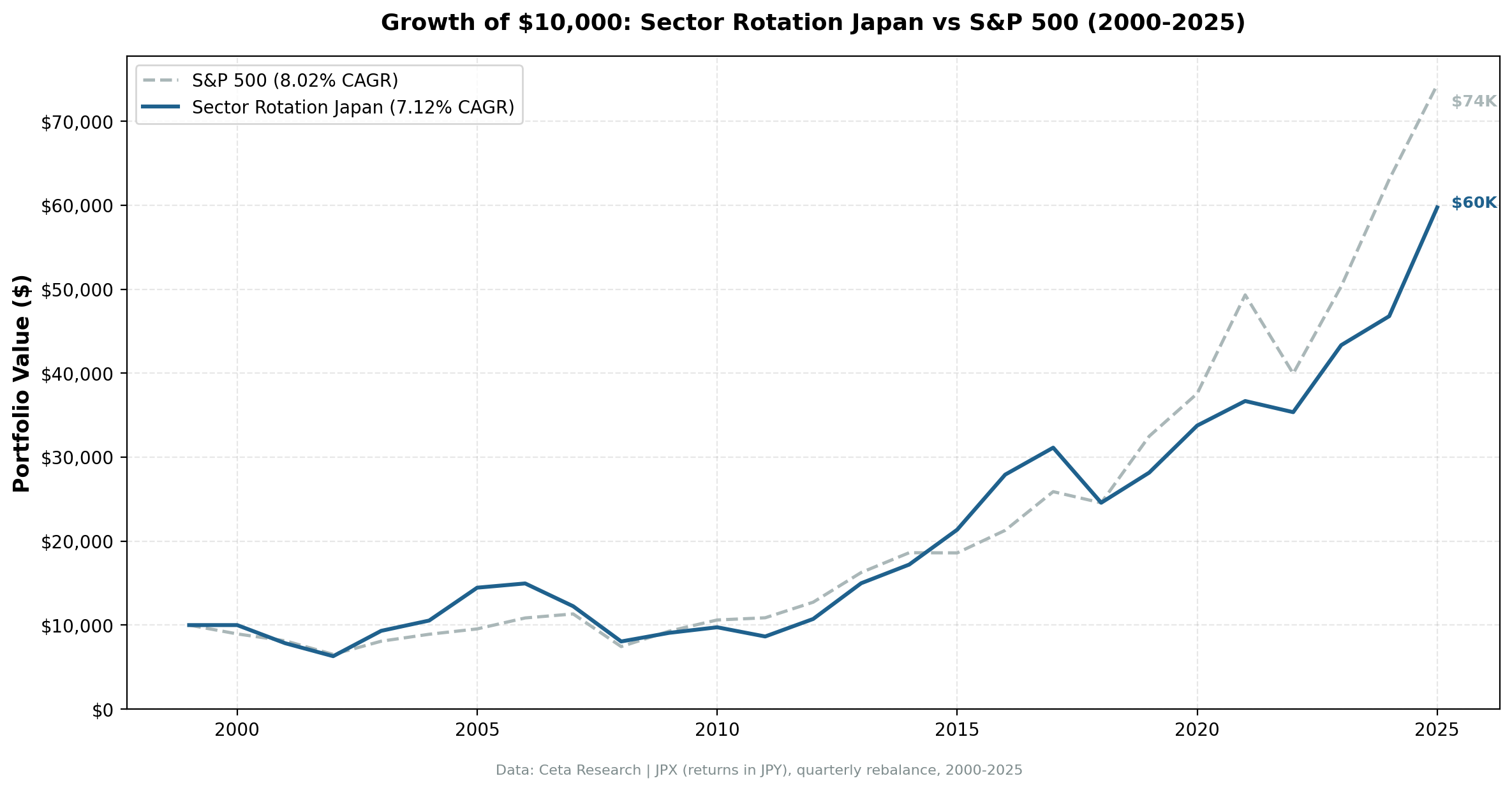
26 years. -0.91% annual shortfall vs the S&P 500.
| Metric | Strategy | S&P 500 |
|---|---|---|
| CAGR | 7.12% | 8.02% |
| Excess CAGR vs SPY | -0.91% | — |
| Max Drawdown | -49.55% | -45.53% |
| Annualized Volatility | 20.79% | 16.9% |
| Sharpe Ratio | 0.337 | 0.357* |
| Sortino Ratio | 0.606 | — |
| Calmar Ratio | 0.144 | — |
| Win Rate vs SPY | 50.96% | — |
| Up Capture | 77.30% | — |
| Down Capture | 57.72% | — |
| Avg Stocks per Period | 93.5 | — |
| Cash Periods | 7 of 104 | — |
*SPY Sharpe uses ~2% US risk-free rate. Japan Sharpe uses ~0.1% (Bank of Japan near-zero rates). The two numbers aren't directly comparable on methodology.
The down capture of 57.72% is the defining characteristic. When SPY falls, this portfolio falls only about 58% as much. That's meaningful protection. The counterpart is the up capture of 77.30%, in strong years for SPY, the JPX strategy captures about three-quarters of the gain. That asymmetry explains why the strategy nearly matches the index on raw returns despite trailing slightly.
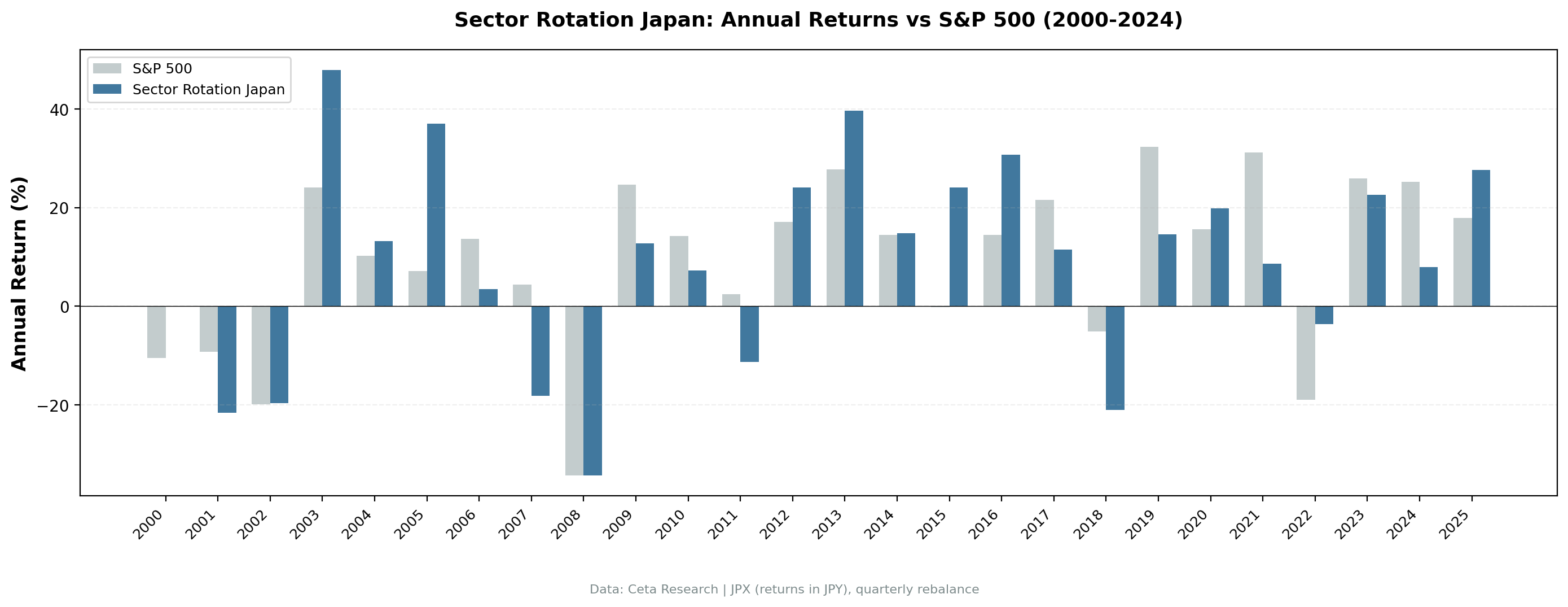
The 50.96% win rate tells you it beats SPY in roughly half of all calendar years. Over 26 years that's 13-14 years of outperformance. Not dominant, but not a losing proposition either.
Full Annual Returns
| Year | Strategy | S&P 500 | Excess |
|---|---|---|---|
| 2000 | 0.00% (cash) | -10.50% | +10.50% |
| 2001 | -21.59% | -9.17% | -12.42% |
| 2002 | -19.70% | -19.92% | +0.22% |
| 2003 | +47.93% | +24.12% | +23.81% |
| 2004 | +13.18% | +10.24% | +2.94% |
| 2005 | +37.11% | +7.17% | +29.94% |
| 2006 | +3.50% | +13.65% | -10.15% |
| 2007 | -18.15% | +4.40% | -22.55% |
| 2008 | -34.26% | -34.31% | +0.05% |
| 2009 | +12.75% | +24.73% | -11.98% |
| 2010 | +7.32% | +14.31% | -6.99% |
| 2011 | -11.26% | +2.46% | -13.72% |
| 2012 | +24.13% | +17.09% | +7.04% |
| 2013 | +39.66% | +27.77% | +11.89% |
| 2014 | +14.83% | +14.50% | +0.33% |
| 2015 | +24.14% | -0.12% | +24.26% |
| 2016 | +30.70% | +14.45% | +16.25% |
| 2017 | +11.50% | +21.64% | -10.14% |
| 2018 | -21.07% | -5.15% | -15.92% |
| 2019 | +14.60% | +32.31% | -17.71% |
| 2020 | +19.90% | +15.64% | +4.26% |
| 2021 | +8.66% | +31.26% | -22.60% |
| 2022 | -3.62% | -18.99% | +15.37% |
| 2023 | +22.57% | +26.00% | -3.43% |
| 2024 | +7.96% | +25.28% | -17.32% |
| 2025 | +27.68% | +17.88% | +9.80% |
The pattern across years is clear: Japan's strategy performs well during domestic recovery phases and during periods when the US market is weak or driven by sectors Japan doesn't have. It underperforms when US tech leads the rally, because JPX Utilities and Energy don't move with Silicon Valley.
Notable Years
2001-2002: Asset bubble deflation continued. Japan's economic crisis didn't start in 2008, it started in the early 1990s and was still unwinding in the early 2000s. The Nikkei had fallen from its 1989 peak of nearly 39,000 to under 8,000 by 2003. The strategy in 2001 returned -21.59% (vs SPY -9.17%), pulling heavily from beaten-down Financial Services and Real Estate, sectors that kept falling as the banking crisis played out. 2002 was nearly flat versus SPY (-0.22% excess), which counts as a minor win given the environment.
2003-2005: Koizumi structural reform era. Prime Minister Junichiro Koizumi's reforms (2001-2006) cleaned up Japan's banking sector, privatized postal savings, and drove a manufacturing and export recovery. Sectors that had been deeply undervalued snapped back hard. The strategy returned +47.93% in 2003 (+23.81% vs SPY), +37.11% in 2005 (+29.94% vs SPY). These three years are the highest-excess-return stretch in the full backtest. The sectors the strategy had bought. Financials, Real Estate, Industrials, led the recovery.
2008: The strategy held up. One of the most striking single data points in the Japan backtest: 2008 returned -34.26% for the strategy vs -34.31% for SPY. Essentially the same result. This was the worst year of the global financial crisis. Most strategies that underperform over full cycles do so partly because they collapse harder in crises. Japan's sector reversion didn't. The down capture of 57.72%, the average across all down years, shows up most clearly in 2008, where the strategy absorbed a global financial panic and matched SPY almost exactly.
2011: Fukushima. The Great East Japan Earthquake in March 2011 and the subsequent Fukushima nuclear disaster restructured Japan's energy sector for a decade. All nuclear reactors were eventually shut down. Japan had to import additional natural gas and oil to compensate. Utility earnings collapsed. The strategy returned -11.26% vs SPY +2.46% (-13.72% excess). Fukushima didn't just cause a one-year loss, it's the reason Utilities appear in 40 of 97 invested quarters going forward. The strategy kept detecting Utilities as the worst-performing sector because the sector genuinely was impaired. It kept rotating in, often too early.
2015-2016: Abenomics and outperformance. Prime Minister Shinzo Abe's "three arrows" program (fiscal stimulus, monetary easing, structural reform) drove a reflation trade from 2013 onward. The period 2015-2016 saw the sharpest outperformance in recent history: +24.14% in 2015 when SPY returned -0.12% (+24.26% excess), followed by +30.70% in 2016 vs SPY +14.45% (+16.25% excess). Two consecutive years of large beats. The strategy was loaded into beaten-down sectors that benefited from yen depreciation (Utilities, some Industrials) and from renewed domestic demand. When US markets were flat or modestly positive, Japan's reflation narrative drove local sector recoveries strongly.
2017-2019: Consistent underperformance. The yen continued to weaken, which hurt the relative performance of JPY returns vs a USD benchmark. Meanwhile the global equity rally from 2017-2019 was driven by US technology stocks, sectors that barely feature in JPX's beaten-down list. The strategy had 17.71% excess shortfall in 2019 alone. This is what a JPY-denominated strategy looks like when USD-denominated tech leads global markets.
2022: Down capture in action. SPY fell -18.99% in 2022 as the Fed raised rates aggressively to fight inflation. The JPX strategy fell only -3.62%, a +15.37% excess. Japan's near-zero interest rate environment meant its market didn't reprice the way US equities did. The beaten-down sectors the strategy held (Utilities, Energy) also didn't have the same rate-sensitivity as US growth stocks. This is the down capture story told in a single year.
2025: Strong recent recovery. The strategy returned +27.68% vs SPY +17.88% (+9.80% excess). A combination of yen dynamics and sector recovery drove the result. The 2025 data suggests the strategy hasn't gone dead, it can still identify meaningful dislocations in JPX sectors.
Backtest Methodology
| Parameter | Choice |
|---|---|
| Universe | JPX (TSE + OSE), market cap > JPY 30B (~$200M USD) |
| Signal | Bottom 2 sectors by equal-weighted 12-month trailing return |
| Portfolio | All qualifying stocks in selected sectors, equal weight |
| Rebalancing | Quarterly (January, April, July, October) |
| Cash rule | Hold cash if < 5 stocks qualify |
| Benchmark | S&P 500 Total Return (SPY) |
| Period | 2000-2025 (26 years, 104 quarters) |
| Risk-free rate | ~0.1% (Bank of Japan near-zero rates) |
| Academic basis | Moskowitz & Grinblatt (1999) |
| Data | Ceta Research (FMP financial data warehouse) |
Limitations
Currency mismatch. Returns are in JPY. The benchmark is SPY in USD. Over 26 years, USD/JPY movements have been significant and volatile. The yen strengthened sharply after the 2008 crisis, weakened dramatically under Abenomics from 2013, and weakened further after 2021. A USD-based investor's experience would differ substantially from the JPY numbers shown here. The -0.91% annual shortfall vs SPY could be worse or better in USD terms depending on entry and exit timing.
Utilities concentration. Utilities appeared in 40 of 97 invested quarters. This strategy spent more than 40% of its invested time heavily loaded into Japanese utility stocks, a sector that was structurally impaired after Fukushima. That concentration creates long stretches where the portfolio effectively bets on a nuclear recovery timeline. When that bet doesn't pay off quickly, returns suffer.
Fukushima as a structural break. The 2011 disaster changed Japan's energy mix in ways that persisted for the entire back half of the backtest. A 26-year backtest spans two meaningfully different utility sector regimes (pre and post-Fukushima). The post-Fukushima environment is the one most relevant to forward expectations, but the backtest blends both.
Deflationary environment. Japan's decades of low growth, low inflation, and near-zero interest rates create a distinct macro backdrop. Mean reversion in Japanese sectors operates more slowly than in economies with stronger nominal growth. When a sector is beaten down in a deflationary context, the recovery trigger is less clear. That's part of why the strategy averages 41% of quarters in Utilities without capturing as much upside.
Low Sharpe Ratio methodology note. The Sharpe of 0.337 uses Japan's ~0.1% risk-free rate. The same strategy with the US 2% risk-free rate would produce a Sharpe closer to 0.28. The Sharpe numbers across this study aren't directly comparable because each market uses its local risk-free rate. Japan's near-zero floor makes its Sharpe look better relative to the raw return than a global comparison would suggest.
Takeaway
Japan's sector mean reversion is the most interesting near-miss in the study. It returns -0.91% vs SPY over 26 years, in JPY, which is genuinely close to flat. The Sharpe of 0.337 clears the US result of 0.319, partly because of Japan's near-zero risk-free rate, but also because the strategy's 57.72% down capture keeps volatility-adjusted returns competitive.
The strategy's Utilities-heavy selection is the story. Post-Fukushima Japan had a persistently beaten-down utility sector, and the mean reversion signal kept identifying it. Sometimes the recovery came (2013, 2016). Often the sector just stayed cheap and depressed. That's the limit of a purely mechanical signal in a structurally impaired sector.
For a JPY-based investor benchmarking against Japanese equities, the downside protection (57.72% down capture) provides real value. For a USD-based investor, the currency overlay dominates. The -0.91% gap is mostly not the strategy's fault. Japan's beaten-down sectors do revert. They just do it in a currency that often moves in the opposite direction from USD returns.
Part of a Series
We tested this strategy across 14 exchanges. Other analyses in the series:
- US (NYSE + NASDAQ + AMEX) →
- India (BSE + NSE) →
- Korea (KSC) →
- Taiwan (TAI + TWO) →
- Sweden (STO) →
- Global comparison →. All 14 exchanges ranked by Sharpe, CAGR, and down capture
References
Moskowitz, T. J., & Grinblatt, M. (1999). Do industries explain momentum? Journal of Finance, 54(4), 1249-1290.
Run This Screen Yourself
Via Python:
import requests, time

API_KEY = "your_api_key" # get one at cetaresearch.com
BASE = "https://tradingstudio.finance/api/v1"

query = """
WITH prices AS (
 SELECT e.symbol, e.adjClose, CAST(e.date AS DATE) AS trade_date
 FROM stock_eod e
 JOIN profile p ON e.symbol = p.symbol
 WHERE p.sector IS NOT NULL AND p.sector != ''
 AND p.marketCap > 30000000000
 AND p.exchange IN ('JPX')
 AND CAST(e.date AS DATE) >= CURRENT_DATE - INTERVAL '400' DAY
 AND e.adjClose IS NOT NULL AND e.adjClose > 0
),
recent AS (
 SELECT symbol, adjClose AS recent_price
 FROM prices
 QUALIFY ROW_NUMBER() OVER (PARTITION BY symbol ORDER BY trade_date DESC) = 1
),
year_ago AS (
 SELECT symbol, adjClose AS old_price
 FROM prices
 WHERE trade_date <= CURRENT_DATE - INTERVAL '252' DAY
 QUALIFY ROW_NUMBER() OVER (PARTITION BY symbol ORDER BY trade_date DESC) = 1
),
stock_returns AS (
 SELECT r.symbol, pr.sector,
 (r.recent_price / ya.old_price - 1) * 100 AS return_12m
 FROM recent r
 JOIN year_ago ya ON r.symbol = ya.symbol
 JOIN profile pr ON r.symbol = pr.symbol
 WHERE ya.old_price > 0 AND r.recent_price > 0
 AND (r.recent_price / ya.old_price - 1) BETWEEN -0.99 AND 5.0
)
SELECT pr.sector,
 ROUND(AVG(sr.return_12m), 2) AS avg_return_12m_pct,
 COUNT(DISTINCT sr.symbol) AS n_stocks,
 ROW_NUMBER() OVER (ORDER BY AVG(sr.return_12m) ASC) AS rank_worst
FROM stock_returns sr
JOIN profile pr ON sr.symbol = pr.symbol
GROUP BY pr.sector
HAVING COUNT(DISTINCT sr.symbol) >= 5
ORDER BY avg_return_12m_pct ASC
"""

resp = requests.post(f"{BASE}/data-explorer/execute", headers={
 "X-API-Key": API_KEY, "Content-Type": "application/json"
}, json={
 "query": query,
 "options": {"format": "json", "limit": 100},
 "resources": {"memoryMb": 16384, "threads": 6}
})
task_id = resp.json()["taskId"]

while True:
 result = requests.get(f"{BASE}/tasks/data-query/{task_id}",
 headers={"X-API-Key": API_KEY}).json()
 if result["status"] in ("completed", "failed"):
 break
 time.sleep(2)

print("JPX sector rankings (worst to best, 12-month return):")
for r in result["result"]["rows"]:
 flag = " <-- BUY" if r["rank_worst"] <= 2 else ""
 print(f"#{r['rank_worst']} {r['sector']:30s} {r['avg_return_12m_pct']:+.1f}% ({r['n_stocks']} stocks){flag}")
Get your API key at cetaresearch.com. The full backtest code (Python + DuckDB) is on GitHub.
Data: Ceta Research, FMP financial data warehouse. Universe: JPX (TSE + OSE), market cap > JPY 30B (~$200M USD). Quarterly rebalance, equal weight, 2000-2025. Returns in JPY. Benchmark: SPY (USD). Full methodology: METHODOLOGY.md. Past performance doesn't guarantee future results.