We Found Analyst Upgrade Drift in Four Markets. Three of Them Were an Artifact.
We measured 180,658 analyst revisions across five markets and found European upgrade drift that looked strong. It was foreign secondary listings scored against a local index: XETRA is 88% US-domiciled, the LSE 86%. The tell was that downgraded stocks also beat the index.

Correction, August 2026. This post previously ranked five markets by analyst upgrade drift and concluded that European markets under-react while the US prices upgrades instantly. The US half stands. The European half doesn't: those universes are dominated by foreign companies' secondary listings scored against a local index. This is the rewritten version.ContentsThe result that made us checkThe universes aren't what the exchange filter impliesWhat the US-domiciled block does in each marketWhere that leaves each marketThe check, and why it's cheapMethodLimitationsTakeaway
We measured 180,658 analyst rating revisions across the US, Germany, the UK, Switzerland and Canada from 2012 to 2025. The first pass produced a tidy story: US upgrades get priced in on announcement day, European upgrades keep drifting for three months. The second pass found that the European drift belonged to Netflix, Apple, Intel and Tesla.
Data: FMP financial data warehouse, 2012–2025. Updated August 2026.
The result that made us check
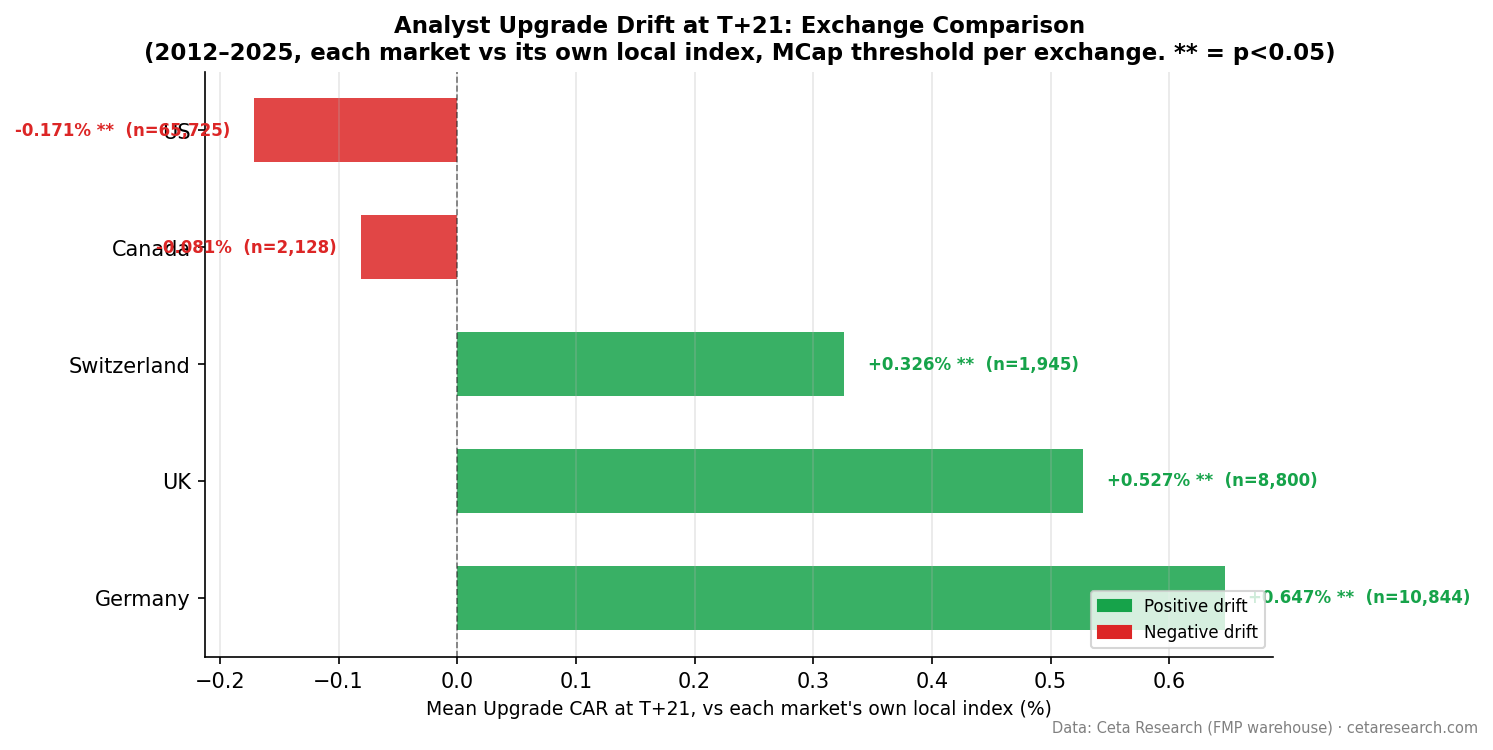
Here's the cross-market table on the same listed universes and the same local benchmarks as the original, rerun on current data. The rerun moved Germany's three-month figure from the published +1.63% to +1.335% and left the shape of the result intact, which is why the error survived it. We have kept every row here as it was computed for that comparison, including the US one, so the five markets stay measured the same way:
| Exchange | Upgrades | Benchmark | T+1 CAR | T+21 CAR | T+63 CAR |
|---|---|---|---|---|---|
| Germany (XETRA) | 10,844 | DAX | +0.080%** | +0.647%** | +1.335%** |
| UK (LSE) | 8,800 | FTSE 100 | +0.099%** | +0.527%** | +1.127%** |
| Switzerland (SIX) | 1,945 | SMI | +0.068% (ns) | +0.326%** | +1.172%** |
| Canada (TSX) | 2,128 | TSX Comp | +0.065% (ns) | -0.081% (ns) | +0.840%** |
| US (NYSE+NASDAQ+AMEX) | 65,725 | S&P 500 | +0.018%** | -0.171%** | -0.496%** |
** = significant at p<0.05. ns = not significant.
Now the same table for downgrades, which is the part we should have looked at first:
| Exchange | Downgrades | T+1 CAR | T+21 CAR | T+63 CAR |
|---|---|---|---|---|
| Germany (XETRA) | 10,695 | -0.083%** | +0.234% | +0.562% |
| UK (LSE) | 8,407 | -0.081%** | +0.249% | +0.290% (ns) |
| Switzerland (SIX) | 1,828 | -0.238%** | -0.455%** | -0.155% (ns) |
| Canada (TSX) | 2,016 | -0.016% (ns) | +0.699% | +1.463% |
| US (NYSE+NASDAQ+AMEX) | 68,270 | -0.027%** | -0.094%** | -0.660%** |
In Germany, the UK and Canada, downgraded stocks beat the local index over the following month, significantly. That's not a subtle anomaly. If analyst upgrades predict outperformance, downgrades have to predict underperformance or nothing at all. A market where both are positive is a market where the benchmark, not the analyst, is producing the number.
The US is the only market where the signs behave: upgrades near zero and falling, downgrades negative and getting more negative.
The universes aren't what the exchange filter implies
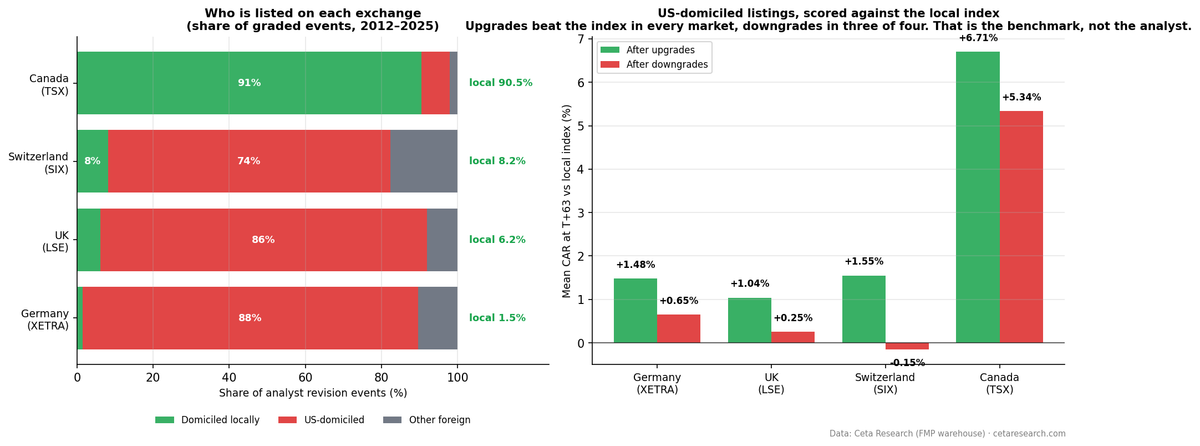
Every non-US study here selected companies with WHERE exchange = X. That returns everything listed on the venue, which outside the US is mostly foreign companies' secondary lines.
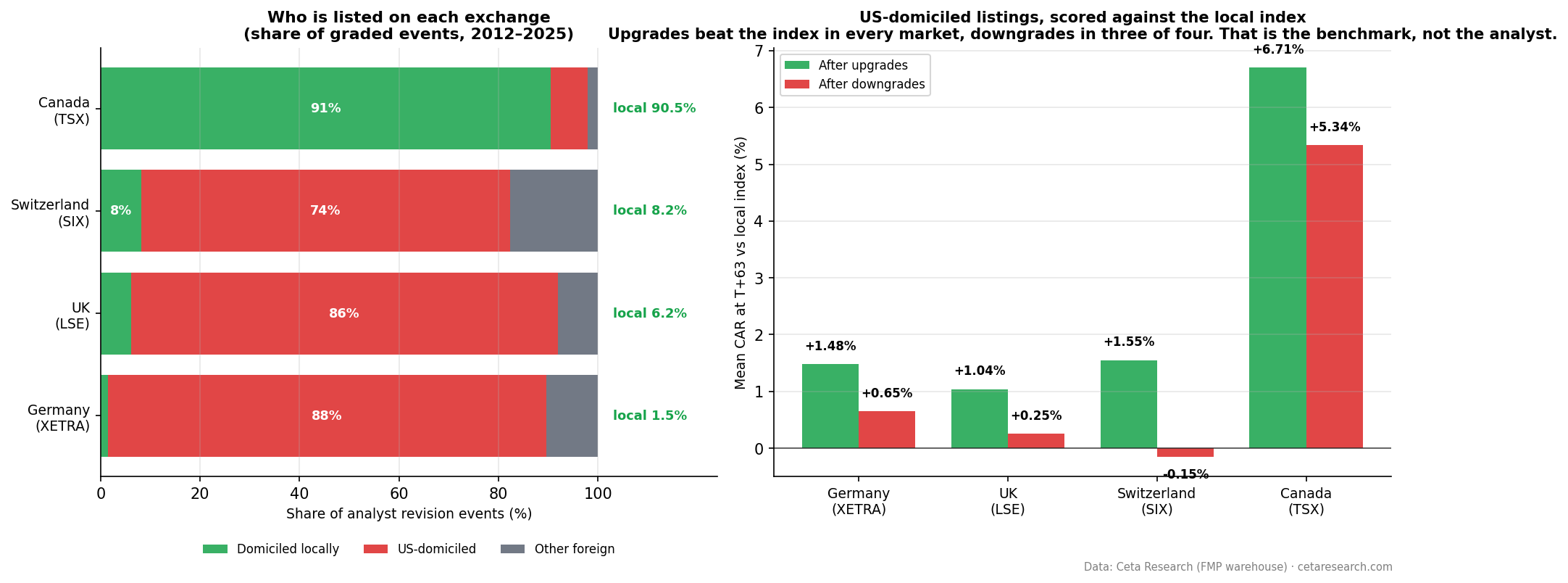
| Exchange | Domiciled locally | US-domiciled | Other foreign |
|---|---|---|---|
| Germany (XETRA) | 1.5% | 88.1% | 10.4% |
| UK (LSE) | 6.2% | 85.7% | 8.1% |
| Switzerland (SIX) | 8.2% | 74.2% | 17.6% |
| Canada (TSX) | 90.5% | 7.4% | 2.0% |
Germany's "German analyst upgrade study" was 1.5% German. The most-graded tickers on XETRA are NFC.DE (Netflix, 647 events), INL.DE (Intel, 609), TL0.DE (Tesla, 557) and APC.DE (Apple, 526).
From 2012 to 2025, US mega-caps beat the DAX and the FTSE 100 across almost any 63-day window. Subtract a local index from a US mega-cap's local listing and you get a positive number whether or not an analyst did anything. That's the drift we published.
What the US-domiciled block does in each market
| Exchange | Upgrade T+63 | Downgrade T+63 |
|---|---|---|
| Germany (XETRA) | +1.485%** | +0.649%** |
| UK (LSE) | +1.038%** | +0.250% (ns) |
| Switzerland (SIX) | +1.552%** | -0.153% (ns) |
| Canada (TSX) | +6.705%** | +5.342%** |
Canada is the clearest illustration precisely because it's the cleanest market overall. Only 7.4% of TSX events are US-domiciled, but that sliver returns +6.71% after upgrades and +5.34% after downgrades against the TSX Composite. Nobody would read +5.34% after a downgrade as an analyst effect. It's US equities beating Canadian equities, and the same mechanism is running at smaller magnitude on XETRA and the LSE.
Where that leaves each market
United States. The finding stands, on a tighter filter. We have since rerun the US leg with the size filter corrected, dropping events where the company's reporting currency isn't the listing currency, which leaves 125,598 events and a universe 90.4% US-domiciled. The rows above are the original cross-market computation and are left as they were, because their job is to show the comparison as we published it.
On the corrected run the surviving result is a difference rather than a level: one month after an upgrade, stocks upgraded by two or more independent firms are up 1.82% against 1.05% for single-analyst upgrades. That 0.77 point gap is on raw returns with no benchmark in the calculation, so no benchmark mismatch can have produced it. Three months out, upgraded stocks beat downgraded ones by 0.15 points. Read the full US study.
Germany. Withdrawn. 88.1% US-domiciled. German companies contribute 155 upgrade events across 31 names, a third of them Deutsche Bank, so there's no German result in either direction. Details.
United Kingdom. Withdrawn. 85.7% US-domiciled. UK-domiciled companies show +0.008% at T+21, t=0.03. Details.
Switzerland. Not usable, though it's the most interesting failure. 74.2% US-domiciled, but Swiss downgrades do point down (-0.45% at T+21, t=-2.6), so the direction test doesn't obviously fail here. Swiss-domiciled events number 147 upgrades, too few to separate signal from contamination. Ambiguous, so we're not reporting it.
Canada. Clean universe, no upgrade effect. 90.5% domestic. Canadian companies produce -0.350% at T+21 (t=-1.66) and +0.335% at T+63 (t=0.89), neither significant. Canadian downgrades show a positive drift of +0.575% at T+21 and +1.286% at T+63 on the domestic subset. We'd want a broader benchmark than the TSX Composite before calling that a reversal effect, but the universe at least is real.
The check, and why it's cheap
Two queries would have caught this before publication.
One: the direction test. Compute the same statistic for your signal and its inverse. Upgrades and downgrades. Cheap value and expensive value. Whatever the pair is. If both come out the same sign against your benchmark, you're measuring the benchmark.
Two: the domicile split. Join your universe to a country field and look at the shares.
WITH universe AS (
    SELECT DISTINCT symbol, COALESCE(country, '??') AS country
    FROM profile
    WHERE exchange = 'XETRA'
)
SELECT
    u.country,
    COUNT(*) AS grade_events,
    COUNT(DISTINCT g.symbol) AS symbols,
    ROUND(100.0 * COUNT(*) / SUM(COUNT(*)) OVER (), 2) AS pct_of_events
FROM stock_grade g
JOIN universe u ON g.symbol = u.symbol
WHERE CAST(g.date AS DATE) BETWEEN '2012-01-01' AND '2025-12-31'
  AND g.action IN ('upgrade', 'downgrade')
GROUP BY u.country
ORDER BY grade_events DESC
LIMIT 12
Run that against XETRA and the answer arrives in seconds: US 53,429, then GB 1,413, then NL 823, and DE in fourth place with 789.
Method
Data source: Ceta Research (FMP stock_grade table, individual analyst grade changes) Period: 2012–2025 (14 years) Study type: Event study. Each analyst revision is an independent event. Entry: Next-day close after announcement (MOC execution: you can't buy at the announcement-day close) Benchmarks: Local currency indices. S&P 500 via SPY (US), DAX (Germany), FTSE 100 (UK), SMI (Switzerland), TSX Composite (Canada) Windows: T+1, T+5, T+21, T+63 trading days Abnormal return: Stock return minus local benchmark return at each window Market cap filters: Exchange-specific thresholds in local currency: >$1B USD for the US, and >500M local for each of the others (€500M on XETRA, £500M on the LSE, CHF 500M on SIX, C$500M on the TSX) Deduplication: Duplicate entries from re-fetches removed, keeping the most recent record per analyst, stock and date Winsorization: 1st/99th percentile before computing statistics Data quality: Price rows whose adjusted close spikes and reverts within a day or two are removed before any return is computed. Events are dropped when the entry price is below $1 or a single window return exceeds +200%. Domicile: Company country from FMP's profile table, joined per event
Why these five markets: FMP's stock_grade coverage concentrates in Western markets. Asian markets carry too few individual analyst grade records to study, under 50 events per year for most, against more than 4,000 per year in the US.
Limitations
Domicile is a coarse proxy for risk exposure. A German company earning in dollars isn't well benchmarked by the DAX either. The split catches gross contamination, not residual factor exposure.
We haven't rerun the non-US markets properly. Doing it right needs a domestic universe and a benchmark that matches it on size and sector, which the DAX, FTSE 100 and SMI don't for these names. That's a different study.
Small domestic samples. Germany has 155 domestic upgrade events and Switzerland 147. Both are below the level where we'd report a number.
One regime. 2012–2025 covers a long bull market, a COVID crash and recovery, and a rate shock. It's also the period of maximum US mega-cap outperformance, which is exactly what makes the contamination so large here.
Takeaway
Analyst upgrade drift outside the US, as we measured it, was a listing artifact. The exchange filter picked up foreign companies' secondary lines, the local index was the wrong benchmark for them, and the resulting number tracked US-versus-Europe market performance.
The tell was free and we missed it on the first pass: downgraded stocks were also beating the local index. A signal that pays off in both directions isn't a signal.
What's left is the US result, on a domestic universe with a matched benchmark, and it's the least exciting version of the story. Analyst upgrades move prices on announcement day. After that, only clustered upgrades from multiple independent firms keep drifting, and single-analyst upgrades underperform.
Data: FMP warehouse via Ceta Research, 2012–2025. Individual analyst grade changes (stock_grade table). Five exchange groups: NYSE+NASDAQ+AMEX, XETRA, LSE, SIX, TSX. Local currency benchmarks. Domicile from FMP profile country. Not investment advice.
Backtest code and the domicile decomposition script are on GitHub.