FCF Yield Screen on Hong Kong Stocks: 25-Year Backtest
We screened for high FCF yield on Hong Kong Stock Exchange stocks from 2000 to 2025. 5.31% CAGR, +3.67% excess over Hang Seng. The screen beats a near-flat local index, but with a Sharpe of 0.119 and no crisis protection: in 2008 it fell 16.9% against a 16.2% index decline.

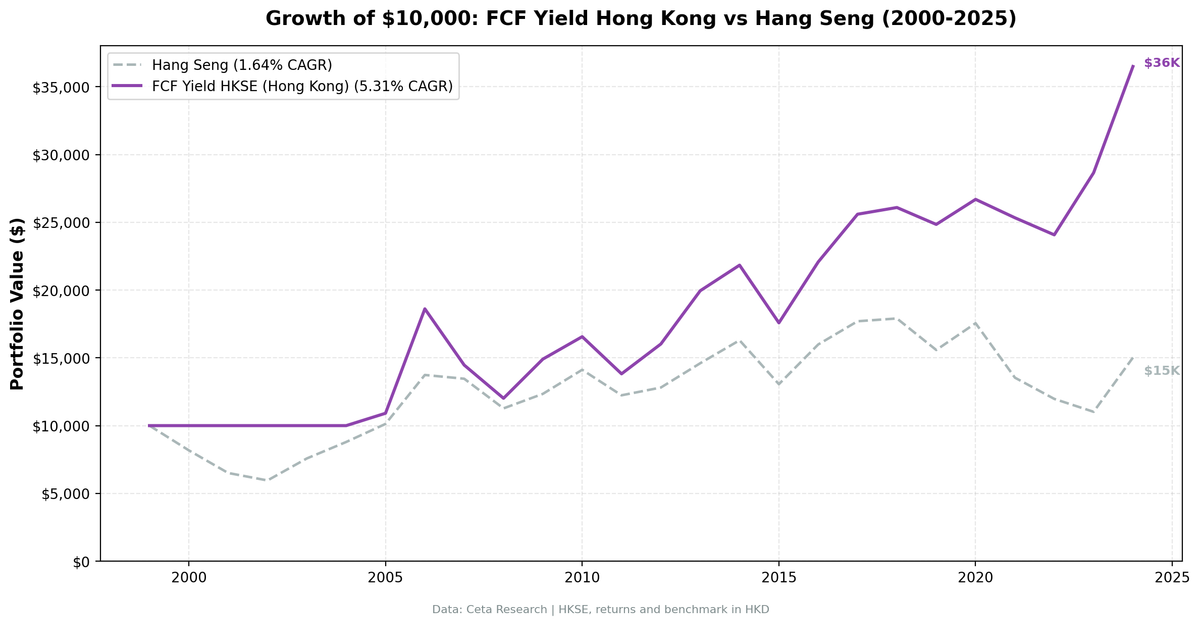
We screened for high free cash flow yield on the Hong Kong Stock Exchange (HKSE) from 2000 to 2025. The portfolio returned 5.31% annually against the Hang Seng Index, a +3.67% annual excess over 25 years. The Hang Seng returned 1.64% annually over the same period. Win rate: 60% of years.
Contents
- Method
- The Screen
- Live Screen (SQL)
- Results
- When It Works
- When It Fails
- Full Annual Returns
- Limitations
- Run It Yourself
- Takeaway
- References
Hong Kong is the weakest of the markets where this screen still works. It beats a near-flat local index, but it does so with a Sharpe ratio of 0.119 and a 35% drawdown. The edge comes from two clusters of years, not from steady quality compounding.
Returns are in HKD, which maintains a narrow peg to the USD (7.75-7.85 HKD/USD). Currency effects are minimal.
Data: FMP financial data warehouse, 2000-2025. Rerun August 2026 with next-day execution and price-artifact guards.
Method
Data source: Ceta Research (FMP financial data warehouse) Universe: Hong Kong Stock Exchange (HKSE), market cap > HK$2B Period: 2000-2025 (25 annual rebalance periods, 5 cash periods 2000-2004) Rebalancing: Annual (July), equal weight top 30 by highest FCF yield Benchmark: Hang Seng Index (^HSI, HKD), a price index that excludes dividends Cash rule: Hold cash if fewer than 10 stocks qualify Execution: Entry and exit at the next day's close after each rebalance date Transaction costs: Size-tiered model Data quality guards: FCF yield capped at 50%; entry price floor; single-period returns above 200% excluded as price artifacts
Historical financial data with 45-day lag to prevent look-ahead bias. Full methodology: backtests/METHODOLOGY.md
The Screen
| Criterion | Metric | Threshold | Why |
|---|---|---|---|
| Cash generation | FCF Yield | 8% - 50% | Genuinely cheap; cap removes data artifacts |
| Profitability | Return on Equity | > 10% | Business earns real returns on capital |
| Debt safety | Interest Coverage | > 3x | Can service debt comfortably |
| Pricing power | Operating Margin | > 10% | Not dependent on one-time cash events |
| Size | Market Cap | > HK$2B | Reliable data, investable |
Live Screen (SQL)
SELECT
    k.symbol,
    p.companyName,
    p.sector,
    k.freeCashFlowYieldTTM * 100 AS fcf_yield_pct,
    k.returnOnEquityTTM * 100 AS roe_pct,
    f.interestCoverageRatioTTM AS interest_coverage,
    f.operatingProfitMarginTTM * 100 AS op_margin_pct,
    p.marketCap / 1e9 AS mktcap_bn
FROM key_metrics_ttm k
JOIN financial_ratios_ttm f ON k.symbol = f.symbol
JOIN profile p ON k.symbol = p.symbol
WHERE k.freeCashFlowYieldTTM > 0.08
  AND k.freeCashFlowYieldTTM < 0.50
  AND k.returnOnEquityTTM > 0.10
  AND f.interestCoverageRatioTTM > 3
  AND f.operatingProfitMarginTTM > 0.10
  AND p.marketCap > 2000000000
  AND p.exchange IN ('HKSE')
  AND p.isFund = false
  AND p.isEtf = false
  AND p.isActivelyTrading = true
QUALIFY ROW_NUMBER() OVER (PARTITION BY p.companyName
                           ORDER BY p.averageVolume DESC) = 1
ORDER BY k.freeCashFlowYieldTTM DESC
LIMIT 30
Results
| Metric | Portfolio | Hang Seng |
|---|---|---|
| CAGR | 5.31% | 1.64% |
| Total Return | 265% | 50% |
| Max Drawdown | -35.5% | -40.5% |
| Volatility | 19.5% | 17.8% |
| Sharpe Ratio | 0.119 | -0.077 |
| Sortino Ratio | 0.249 | -0.114 |
| Down Capture | 46.2% | -- |
| Up Capture | 105.0% | -- |
| Win Rate (vs Hang Seng) | 60% | -- |
| Cash Periods | 5/25 | -- |
| Avg Stocks | 19.6 | -- |
HK$10,000 in 2000 grew to HK$36,496. Hang Seng: HK$15,022.
The Hang Seng Index returned just 1.64% annually over 25 years, a period of stagnant Hong Kong equity markets punctuated by sharp crises. The FCF yield screen more than doubled that, but the mechanism is worth stating plainly: down capture is 46.2% and up capture is 105.0%. The portfolio absorbs almost half of Hang Seng declines and captures barely more than the index on the way up. That's a much weaker asymmetry than the UK version of the same screen, and it shows up in the Sharpe ratio of 0.119.
The win rate is 60%, 15 of 25 years. Positive, but not the consistency you'd want from a quality screen.
When It Works
2006 (Hong Kong Bull Market): Best single year in the backtest.
+70.6% vs Hang Seng +35.7%, a +34.9% excess and the largest single-year gap in the 25-year period. The Hang Seng had a genuine bull market in 2006. The FCF yield portfolio, concentrated in about 20 quality cash generators, roughly doubled the index move. Small concentrated portfolios can meaningfully exceed the index during strong markets.
2021-2023 (Falling Index, Flat Portfolio): The strongest stretch, and the clearest evidence the screen does something.
| Year | Portfolio | Hang Seng | Excess |
|---|---|---|---|
| 2021 | -5.1% | -22.9% | +17.8% |
| 2022 | -5.0% | -11.6% | +6.6% |
| 2023 | +19.0% | -8.0% | +27.0% |
Three years in which the Hang Seng fell 37% cumulatively while the portfolio gained 7%. This is where most of the 25-year excess was earned. Chinese property developers and leveraged conglomerates drove the index down. The quality filters (interest coverage > 3x, operating margin > 10%) kept the portfolio out of them.
2009: +24.1% vs Hang Seng +9.5%, a +14.6% excess as markets recovered from the credit crisis.
When It Fails
2008 (-16.9% vs -16.2% for Hang Seng, -0.7% excess): No crisis protection at all. The quality filters did not help in the year they were supposed to matter most. The portfolio fell essentially in line with the index. This is the single biggest difference between Hong Kong and the UK version of the same screen, where the 2008 portfolio lost 4.4% against a 22% index decline.
2007 (-22.3% vs -2.0% for Hang Seng, -20.3% excess): The worst relative year in the backtest. The portfolio fell 22% in a year the index was roughly flat.
2011 (-16.6% vs -13.3%, -3.2% excess): The European debt crisis and concerns about China's growth hit Hong Kong. The portfolio fell slightly harder than the Hang Seng.
2015 (-19.5% vs -19.9%, +0.4% excess): The Chinese market crash of 2015 and resulting capital outflows hit HKSE stocks. The portfolio and the index fell together. When macro risk dominates, quality filters don't provide protection.
2024 (-8.9% excess): The portfolio gained +27.4% while the Hang Seng surged +36.3%. The FCF yield screen, concentrated in mature cash generators, captured about three-quarters of that move.
The worst periods align with Hong Kong-specific risks: China slowdown concerns, political events, and capital flow volatility. These are real risks for HKSE investors and no fundamental screen removes them.
Full Annual Returns
| Year | Portfolio | Hang Seng | Excess |
|---|---|---|---|
| 2000 | CASH | -18.2% | +18.2% |
| 2001 | CASH | -20.4% | +20.4% |
| 2002 | CASH | -8.5% | +8.5% |
| 2003 | CASH | +27.3% | -27.3% |
| 2004 | CASH | +16.0% | -16.0% |
| 2005 | +9.1% | +15.2% | -6.0% |
| 2006 | +70.6% | +35.7% | +34.9% |
| 2007 | -22.3% | -2.0% | -20.3% |
| 2008 | -16.9% | -16.2% | -0.7% |
| 2009 | +24.1% | +9.5% | +14.6% |
| 2010 | +11.1% | +14.4% | -3.3% |
| 2011 | -16.6% | -13.3% | -3.2% |
| 2012 | +15.9% | +4.7% | +11.3% |
| 2013 | +24.5% | +14.0% | +10.5% |
| 2014 | +9.5% | +11.6% | -2.1% |
| 2015 | -19.5% | -19.9% | +0.4% |
| 2016 | +25.6% | +22.4% | +3.1% |
| 2017 | +15.9% | +10.7% | +5.2% |
| 2018 | +1.9% | +1.2% | +0.8% |
| 2019 | -4.8% | -13.0% | +8.2% |
| 2020 | +7.4% | +12.7% | -5.2% |
| 2021 | -5.1% | -22.9% | +17.8% |
| 2022 | -5.0% | -11.6% | +6.6% |
| 2023 | +19.0% | -8.0% | +27.0% |
| 2024 | +27.4% | +36.3% | -8.9% |
Cash periods (2000-2004): insufficient qualifying HKSE stocks in the early period. During those cash years, the Hang Seng fell 18.2%, 20.4%, and 8.5% in 2000-2002 (cash outperformed), then rose 27.3% and 16.0% in 2003-2004 (cash underperformed). FMP data coverage for HKSE improved by 2005.
Limitations
Early cash periods. Five years of cash (2000-2004) reflect thin FMP coverage for HKSE stocks in the early period, not genuinely no qualifying stocks. Returns before 2005 should be treated as indicative.
Hong Kong-specific tail risks. The 2015 decline was driven by China macro risk. The 2007-2008 drawdown reflected the global credit crisis, which the quality filters did nothing to soften. These risks are structural for HKSE investments and no fundamental quality screen removes them.
The excess is concentrated. Two clusters, 2006 and 2021-2023, account for most of the 25-year outperformance. Strip out four years and the screen roughly matches the Hang Seng. Concentrated alpha is fragile alpha.
Volatility. At 19.5% annualized, the portfolio runs slightly above the Hang Seng's 17.8% while capturing 46% of its declines. The sources differ from the US version: US volatility comes from factor cycles (value vs growth), Hong Kong volatility comes from geopolitical and China-linked events.
Currency. Returns are in HKD, which is USD-pegged. The Hang Seng benchmark is also in HKD, so the comparison is fully currency-matched. Currency effects on the comparison are minimal.
Run It Yourself
Run this screen live on Ceta Research
git clone https://github.com/ceta-research/backtests.git
cd backtests
python3 fcf-yield/backtest.py --preset hongkong
Takeaway
The Hong Kong FCF yield screen produced 5.31% annually over 25 years, +3.67 percentage points ahead of the Hang Seng Index. Max drawdown of -35.5% vs -40.5% for the Hang Seng. The portfolio won 60% of years against the local index.
The signal works in Hong Kong, but weakly. It beats an index that returned 1.64% a year over a quarter century, which is a low bar. Sharpe of 0.119 and down capture of 46.2% say the rest: this is not the crisis-resistant quality portfolio the same screen produces in the UK. In 2008, the year the quality filters should have earned their keep, the portfolio fell 16.9% against a 16.2% index decline.
Where it did work was 2021-2023, when Chinese property and leveraged conglomerates dragged the Hang Seng down 37% cumulatively and the portfolio gained 7%. Avoiding blowups is the real contribution here, not compounding through crises.
The caveats are real: five early cash periods (2000-2004) limit the true track record to 20 years, most of the excess sits in four years, and HK-specific risks (China exposure, political events) create drawdowns unrelated to fundamentals. If you want this screen's strongest version, run it on the UK, not Hong Kong.
Data: Ceta Research (FMP financial data warehouse), 2000-2025. Universe: Hong Kong Stock Exchange (HKSE). Returns in HKD (USD-pegged). Full methodology: METHODOLOGY.md. Past performance does not guarantee future results. This is educational content, not investment advice.
References
- Gray, W. & Vogel, J. (2012). "Analyzing Valuation Measures: A Performance Horse-Race over the Past 40 Years." Journal of Portfolio Management, 39(1), 112-121.
- Lakonishok, J., Shleifer, A. & Vishny, R. (1994). "Contrarian Investment, Extrapolation, and Risk." Journal of Finance, 49(5), 1541-1578.