Canada: +4.9% Alpha Over the TSX Composite, 8.8% CAGR
OCF momentum returned 8.8% annually on TSX stocks, 2000-2025, vs 4.0% for the TSX Composite, a +4.9% alpha. $10,000 to $82,715. Zero cash periods, 52% win rate, -20.7% max drawdown.

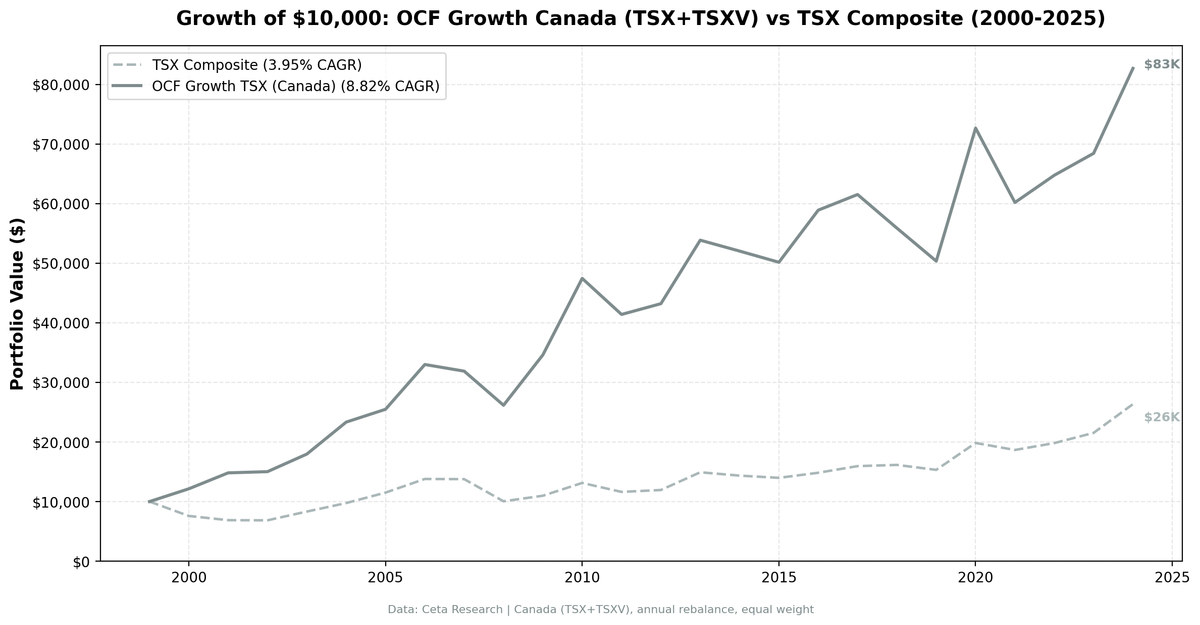
Operating cash flow momentum returned 8.8% annually on Canadian stocks from 2000 to 2025, beating the TSX Composite by 4.9% per year. The TSX Composite returned just 4.0% annually over the same period. $10,000 grew to $82,715. The strategy was fully invested every single year (zero cash periods), holding 21-22 stocks on average. Canada showed strong relative performance against a weak local index: information ratio 0.39 and 52% win rate.
Contents
- Method
- What We Found
- 25 years of data. 4.9% annual alpha over TSX Composite.
- Year-by-year returns
- Crisis resilience: Beats the TSX index when it matters
- The 2020 COVID year: +44.3% (best single year)
- Why OCF Momentum Works in Canada
- When It Works in Canada
- When It Struggles
- Part of a Series
- Run It Yourself
- OCF Momentum Screen for Canada (SQL)
- Limitations
- Takeaway
Data: FMP financial data warehouse, 2000–2025. Updated June 2026.
Method
Data source: Ceta Research (FMP financial data warehouse) Universe: TSX + TSXV, market cap > C$500M (~$362M USD) Period: 2000-2025 (25 years, annual rebalancing) Rebalancing: Annual (July), 45-day lag on FY financial data Benchmark: TSX Composite (^GSPTSE, local currency) Cash rule: Hold cash if fewer than 10 stocks qualify
Portfolio: Top 30 stocks by highest divergence (OCF growth minus NI growth), equal weight. Quality filters: ROE > 10%, operating margin > 5%.
What We Found
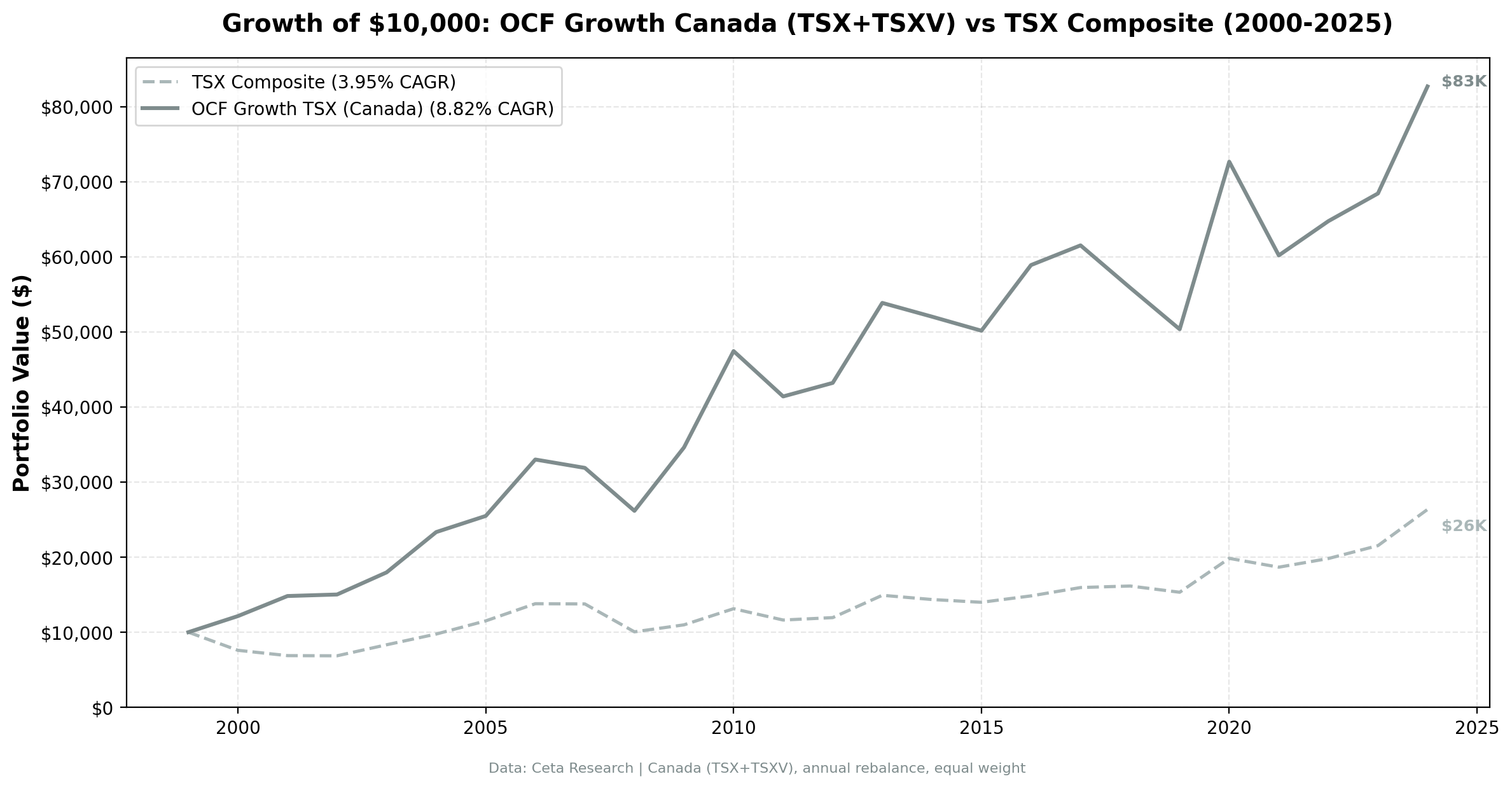
25 years of data. 4.9% annual alpha over TSX Composite.
| Metric | OCF Momentum (Canada) | TSX Composite |
|---|---|---|
| CAGR | 8.8% | 4.0% |
| Total Return | 727% | 164% |
| Volatility | 17.6% | - |
| Max Drawdown | -20.7% | -31.4% |
| Sharpe Ratio | 0.36 | - |
| Sortino Ratio | 0.83 | - |
| Info Ratio (vs TSX) | 0.39 | - |
| Win Rate (vs TSX) | 52% | - |
| Avg Stocks per Period | 21.5 | - |
| Cash Periods | 0 of 25 | - |
OCF Momentum turned $10,000 into $82,715. The TSX Composite turned it into $26,355. Over 25 years, the strategy delivered ~3.1× the TSX's total return (727% vs 164%).
The max drawdown was -20.7% vs the TSX's -31.4%. Lower volatility, much better returns, and better downside protection, all from a simple cash flow quality screen applied to an already quality-oriented index.
Year-by-year returns
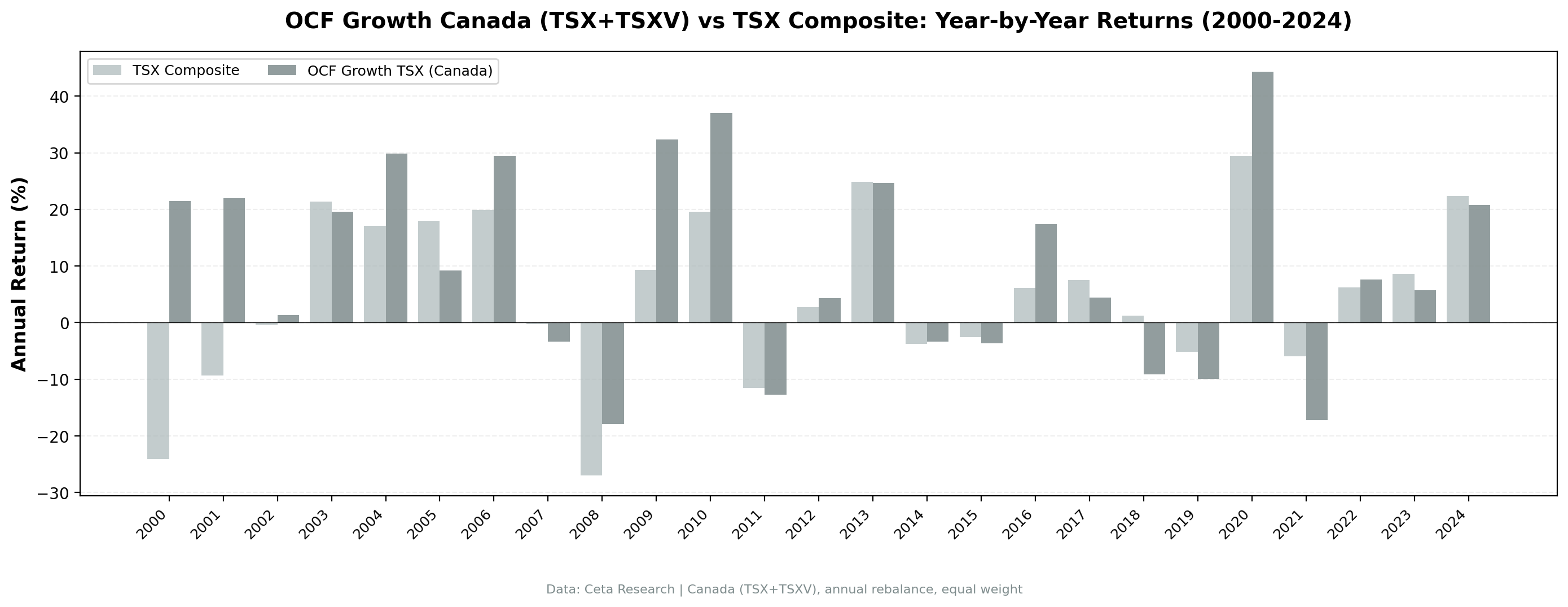
| Year | OCF Momentum | TSX Composite | Excess |
|---|---|---|---|
| 2000 | +21.4% | -24.1% | +45.6% |
| 2001 | +22.0% | -9.3% | +31.4% |
| 2002 | +1.4% | -0.3% | +1.7% |
| 2003 | +19.6% | +21.4% | -1.8% |
| 2004 | +29.9% | +17.1% | +12.7% |
| 2005 | +9.2% | +18.0% | -8.8% |
| 2006 | +29.5% | +19.9% | +9.6% |
| 2007 | -3.4% | -0.2% | -3.2% |
| 2008 | -17.9% | -27.0% | +9.1% |
| 2009 | +32.3% | +9.3% | +23.0% |
| 2010 | +37.1% | +19.6% | +17.5% |
| 2011 | -12.7% | -11.5% | -1.3% |
| 2012 | +4.4% | +2.8% | +1.6% |
| 2013 | +24.7% | +24.9% | -0.2% |
| 2014 | -3.4% | -3.8% | +0.4% |
| 2015 | -3.6% | -2.6% | -1.0% |
| 2016 | +17.4% | +6.1% | +11.3% |
| 2017 | +4.5% | +7.5% | -3.0% |
| 2018 | -9.2% | +1.3% | -10.4% |
| 2019 | -9.9% | -5.2% | -4.7% |
| 2020 | +44.3% | +29.5% | +14.8% |
| 2021 | -17.2% | -5.9% | -11.2% |
| 2022 | +7.6% | +6.2% | +1.4% |
| 2023 | +5.7% | +8.7% | -3.0% |
| 2024 | +20.8% | +22.4% | -1.6% |
Crisis resilience: Beats the TSX index when it matters
The Canadian strategy showed consistent outperformance during downturns: - 2000: +21.4% while TSX fell 24.1% (+45.6% excess) - 2001: +22.0% while TSX fell 9.3% (+31.4% excess) - 2008: -17.9% vs TSX's -27.0% (9.1 points better) - 2009: +32.3% vs TSX's +9.3% (+23.0% excess)
The pattern: when markets crash, the cash flow quality filter keeps highly leveraged resource companies and weak financials out of the portfolio. When markets recover, the strategy is fully invested in companies with genuine cash generation.
The 2020 COVID year: +44.3% (best single year)
2020 returned 44.3%, the strategy's best year. Why? Canadian markets were dominated by resource stocks (energy, materials) that showed explosive OCF recovery as commodity prices rebounded. The divergence signal caught this early: companies that had slashed capex and reduced working capital showed strong cash flow improvement even before earnings recovered.
Why OCF Momentum Works in Canada
Resource-heavy market. Canada is dominated by energy, materials, and financial stocks. These sectors have volatile earnings but more stable cash flows. The divergence signal works well when earnings are noisy but cash generation is genuine.
Conservative accounting culture. Canadian GAAP and IFRS enforcement is stricter than in many emerging markets but more conservative than US GAAP in some areas. Companies have less room to manipulate earnings through accruals.
Smaller market, less efficient. The TSX has far less analyst coverage per stock than US exchanges. Cash flow information takes longer to be incorporated into prices, giving the signal time to work.
Cyclical industries. Energy and materials stocks show extreme divergence between earnings (volatile, driven by commodity prices) and cash flow (more stable, driven by production). The signal helps identify which cyclical companies have genuine cash generation vs. those relying on accounting tricks.
When It Works in Canada
Crisis recoveries. 2000 (+21%), 2009 (+32%), 2010 (+37%), 2020 (+44%). When credit tightens and markets panic, companies with strong cash flow quality outperform.
Commodity cycles. 2004 (+30%), 2006 (+30%), 2016 (+17%), 2024 (+21%). When commodities recover from troughs, companies with genuine OCF growth (not just price-driven earnings spikes) capture the upside.
Value rotations. Canada is structurally a value market. When value outperforms growth globally, Canadian OCF momentum participates.
When It Struggles
Late-cycle growth rallies. 2012-2013 underperformed as Canadian tech and financial stocks rallied on earnings growth that wasn't backed by cash flow.
Oil price crashes without recovery. 2019 (-10%) and 2021 (-17%) saw energy stocks decline on weak cash flow without the immediate rebound that happened in 2020.
Currency headwinds. Returns are USD-adjusted. When the Canadian dollar weakens significantly (2014-2015), it can offset local market gains for US investors.
Part of a Series
This is the Canada-specific analysis. For methodology and cross-market comparison: - Operating Cash Flow Momentum: US Results (flagship post) - India: matches the Sensex with lower drawdown - Global comparison: 9 markets
Run It Yourself
OCF Momentum Screen for Canada (SQL)
WITH latest_cg AS (
    SELECT symbol, growthOperatingCashFlow, dateEpoch,
        ROW_NUMBER() OVER (PARTITION BY symbol ORDER BY dateEpoch DESC) AS rn
    FROM cash_flow_statement_growth
    WHERE period = 'FY' AND growthOperatingCashFlow IS NOT NULL
),
latest_ig AS (
    SELECT symbol, growthNetIncome, dateEpoch,
        ROW_NUMBER() OVER (PARTITION BY symbol ORDER BY dateEpoch DESC) AS rn
    FROM income_statement_growth
    WHERE period = 'FY' AND growthNetIncome IS NOT NULL
)
SELECT
    cg.symbol,
    p.companyName,
    ROUND(cg.growthOperatingCashFlow * 100, 1) AS ocf_growth_pct,
    ROUND(ig.growthNetIncome * 100, 1) AS ni_growth_pct,
    ROUND((cg.growthOperatingCashFlow - ig.growthNetIncome) * 100, 1) AS divergence_pct,
    ROUND(k.returnOnEquityTTM * 100, 1) AS roe_pct,
    ROUND(f.operatingProfitMarginTTM * 100, 1) AS op_margin_pct,
    ROUND(p.marketCap / 1e9, 1) AS market_cap_billions
FROM latest_cg cg
JOIN latest_ig ig ON cg.symbol = ig.symbol AND ig.rn = 1
JOIN key_metrics_ttm k ON cg.symbol = k.symbol
JOIN financial_ratios_ttm f ON cg.symbol = f.symbol
JOIN profile p ON cg.symbol = p.symbol
WHERE cg.rn = 1
  AND cg.growthOperatingCashFlow > 0.10
  AND cg.growthOperatingCashFlow < 5.0
  AND cg.growthOperatingCashFlow > ig.growthNetIncome
  AND k.returnOnEquityTTM > 0.10
  AND f.operatingProfitMarginTTM > 0.05
  AND p.marketCap > 500000000
  AND p.exchange IN ('TSX', 'TSXV')
  AND p.isFund = false
  AND p.isEtf = false
  AND p.isActivelyTrading = true
QUALIFY ROW_NUMBER() OVER (PARTITION BY p.companyName
                           ORDER BY p.averageVolume DESC) = 1
ORDER BY (cg.growthOperatingCashFlow - ig.growthNetIncome) DESC
LIMIT 30
Run this query on Ceta Research
Market cap threshold: C$500M (~$362M USD), targeting liquid mid-cap and large-cap stocks.
Limitations
Resource concentration. The strategy's success is heavily driven by Canadian resource stocks. A structural decline in commodities would hurt performance.
Currency risk. Returns are USD-adjusted. Canadian dollar volatility adds an extra layer of risk for US investors.
No transaction costs. The backtest doesn't model Canadian transaction costs or cross-border trading fees. Real-world returns would be lower.
Survivorship bias. FMP data may not capture all TSX/TSXV delistings. The 727% return could be overstated.
Takeaway
Canada delivered strong alpha vs its local benchmark: 8.8% CAGR vs 4.0% for the TSX Composite, Sharpe 0.36, max drawdown -20.7%. The cash flow divergence signal worked consistently across commodity cycles, crisis periods, and recoveries. The strategy was fully invested every year with a 52% win rate against the index.
If you believe resource-heavy markets with conservative accounting standards and less analyst coverage offer persistent inefficiencies, Canadian OCF momentum is a compelling signal. It won't outperform every year, but over 25 years it delivered ~3.1× the TSX's total return with better downside protection.
Data: Ceta Research (FMP financial data warehouse), TSX/TSXV 2000-2025. Full methodology: backtests/METHODOLOGY.md
Past performance does not guarantee future results. This is educational content, not investment advice.