China P/E Compression: +1.07% CAGR, -2.48% vs the SSE Composite
P/E compression on Chinese stocks returns 1.07% a year against 3.54% for the SSE Composite. Fully invested for all 25 years, so this failure isn't a data artifact. Negative Sharpe, -70% max drawdown, 94% down-capture.

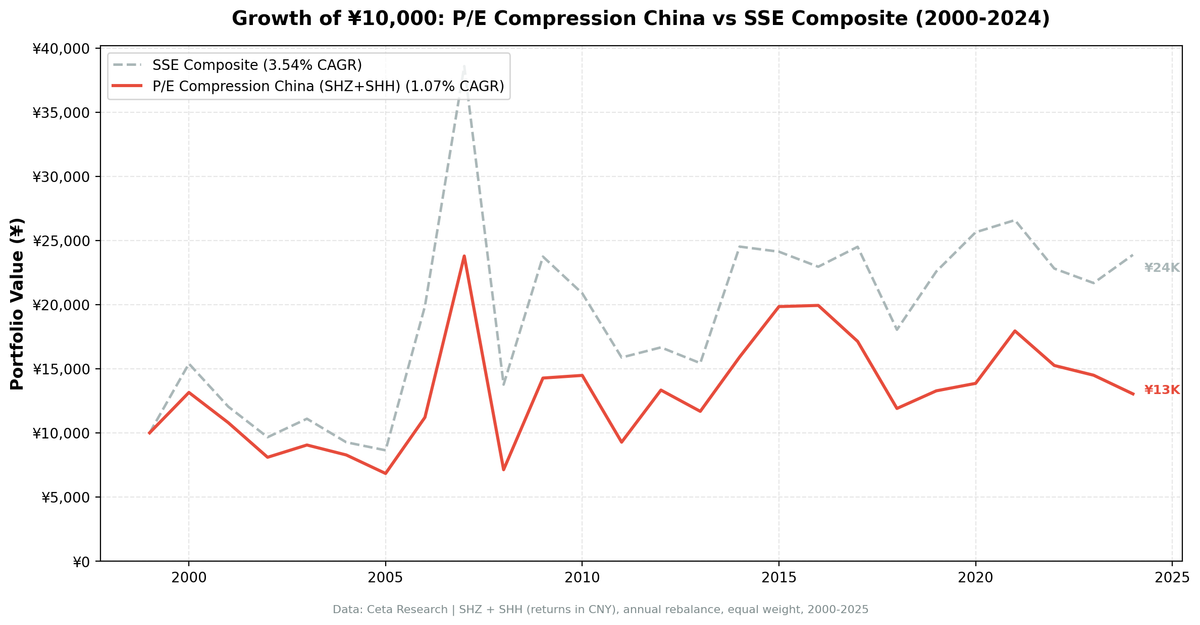
P/E compression on Chinese stocks delivers 1.07% CAGR against 3.54% for the SSE Composite, a shortfall of 2.48% a year. Unlike most markets in this study, China ran fully invested for all 25 years, so this result is a genuine test of the signal rather than an artifact of missing data. The signal fails on its own terms: negative Sharpe, a -70.04% max drawdown, and 94% down-capture.
Contents
Data: FMP financial data warehouse, 2000-2025. Updated August 2026.
What Changed From Our Earlier Version
An earlier version of this post compared Chinese stocks to the S&P 500 in USD and reported -0.68% CAGR against SPY's 7.64%, calling China the worst absolute return among all 21 markets tested. Both halves of that were wrong.
The benchmark was wrong: a CNY-denominated portfolio should be measured against a Chinese index, not a US one. China now runs against the SSE Composite. And the absolute number has moved with a data refresh: the strategy's CAGR is now positive at 1.07%, so China is no longer the worst absolute performer.
The conclusion doesn't change. Against the benchmark a Chinese investor could actually hold, the strategy still loses.
Method
Universe: SHZ + SHH (Shanghai + Shenzhen), market cap > ¥10B Period: 2000-2025 (25 years, 25 annual periods, all 25 invested) Benchmark: SSE Composite (000001.SS, CNY, price index) Execution: Next-day close (mark-on-close) Cash rule: Hold cash if fewer than 10 stocks qualify and can be priced
Returns in CNY. Benchmark in CNY.
What We Found
| Metric | China | SSE Composite |
|---|---|---|
| CAGR | 1.07% | 3.54% |
| Total Return | 30% | 139% |
| Excess | -2.48% | - |
| Sharpe | -0.035 | - |
| Sortino | -0.070 | - |
| MaxDD | -70.04% | -64.33% |
| Up Capture | 86.21% | 100% |
| Down Capture | 94.09% | 100% |
| Win Rate | 36% | - |
| Avg Stocks | 24.8 | - |
| Cash | 0 of 25 | - |
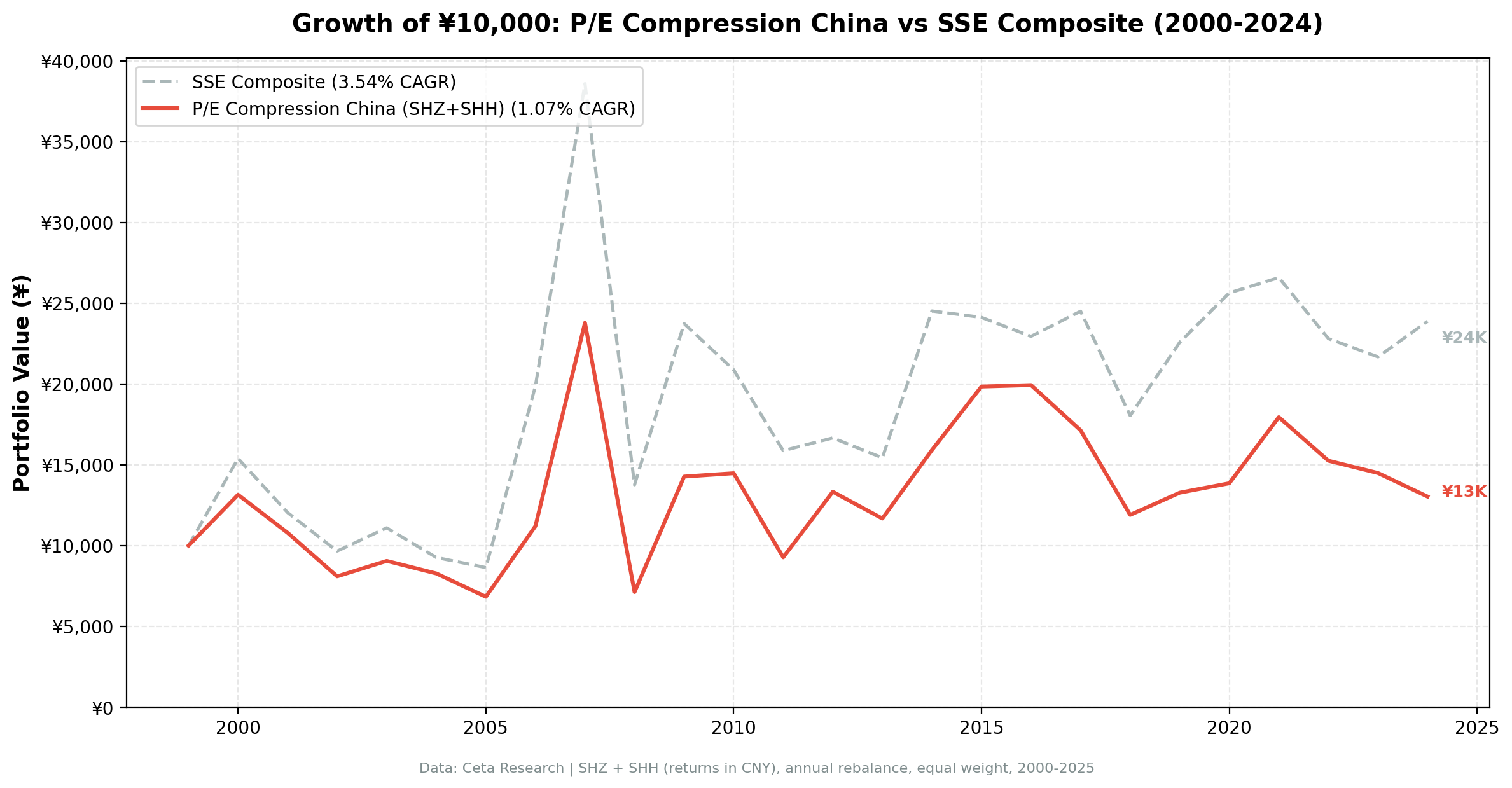
¥10,000 grew to ¥13,000 over 25 years while the SSE Composite reached ¥23,900. The Sharpe ratio is negative, so the strategy didn't clear the Chinese risk-free rate. The max drawdown of -70.04% is the worst in the 21-market study and worse than the index's own -64.33%.
The capture ratios explain why. 86% up-capture against 94% down-capture is the wrong way round. The portfolio takes most of the index's losses and less of its gains, which is the opposite of what a mean reversion screen is supposed to deliver. It won in only 9 of 25 years.
One thing works in China's favour as evidence. This is one of only three markets in the study invested in all 25 periods. Most of the other exchanges tested spend a third or more of the study in cash because FMP's price coverage doesn't reach back far enough, which makes their numbers hard to interpret. China's doesn't have that problem. The failure here is real, not a coverage artifact.
The benchmark excludes dividends. Portfolio returns use dividend-adjusted prices, but 000001.SS is the SSE Composite price index and does not reinvest dividends. The SSE has yielded roughly 2% a year over this period, so a like-for-like total-return comparison would widen the -2.48% deficit further.
Why China Fails
Policy-driven markets. Chinese stocks move on government policy, not fundamentals. P/E compression can persist for years if policy doesn't favour the sector.
State ownership. Many Chinese companies are state-owned enterprises with unclear governance. P/E compression often reflects genuine concern about capital allocation and shareholder treatment.
Speculative trading. Chinese retail investors drive massive volatility. P/E ratios swing based on momentum and speculation, not earnings expectations. The 2006-2008 sequence makes this concrete: the index rose 130% then 94%, then fell 64%. A valuation-anchored screen has nothing useful to say about moves that size.
Earnings quality. Financial reporting in China is less reliable. A compressed P/E may reflect skepticism about reported earnings, not temporary undervaluation.
Conclusion
China's P/E compression strategy delivers 1.07% CAGR against 3.54% for the SSE Composite, a deficit of 2.48% a year that widens once the index's dividend yield is accounted for. It wins in 9 of 25 years, absorbs 94% of the index's downside while capturing 86% of its upside, and drew down 70% at its worst.
This is the cleanest failure in the study. The strategy was fully invested in every one of the 25 periods, so there's no data gap to blame. Mean reversion requires stable, predictable P/E dynamics. China doesn't provide them.
Data: Ceta Research (FMP financial data warehouse). Returns in CNY. Benchmark: SSE Composite price index, which does not reinvest dividends. Past performance does not guarantee future results. Not investment advice. github.com/ceta-research/backtests