Germany P/E Compression: -1.13% vs the DAX, Against a Fair Benchmark
P/E compression on German stocks returns 3.32% annually vs 4.45% for the DAX. The DAX reinvests dividends, so unlike most markets in this study the comparison is like-for-like. Germany is the fair test, and the strategy loses it.

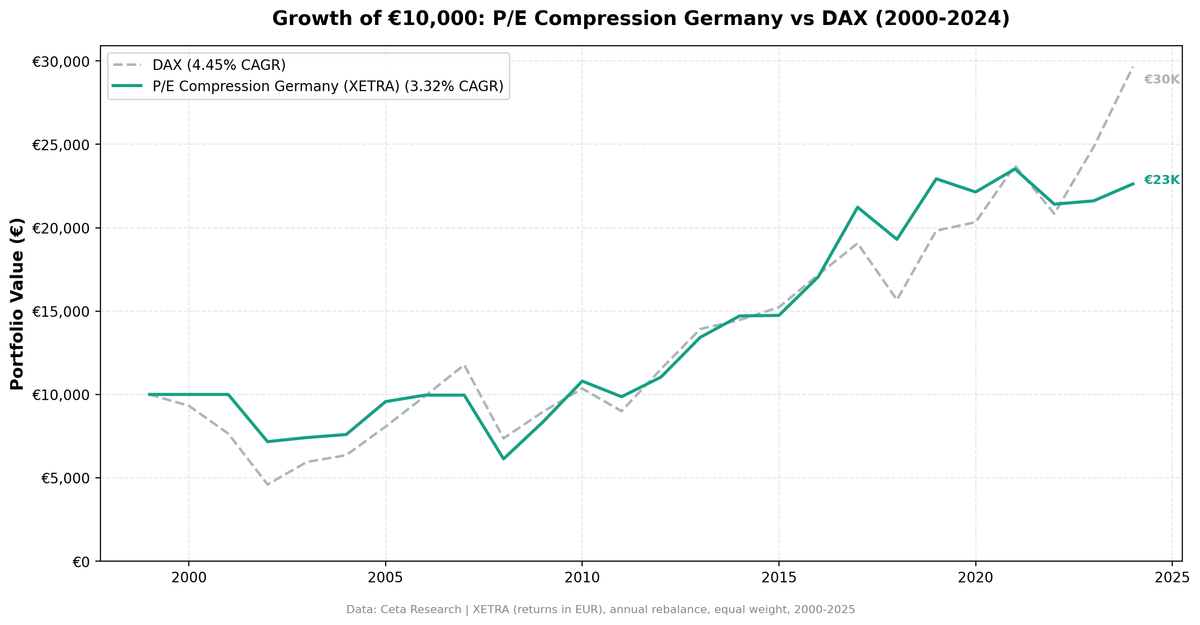
P/E compression on German stocks returns 3.32% annually vs 4.45% for the DAX. That's -1.13% excess. Germany is one of only two markets in this 21-market study where the comparison is genuinely like-for-like, because the DAX is a performance index that reinvests dividends. Most of the other benchmarks here are price indices that flatter the strategy. Germany's number needs no such adjustment, and it's negative.
Contents
- Method
- What We Found
- Year-by-year returns
- Does Domicile Change It?
- Why Germany Is a Mixed Result
- Backtest Methodology
- Conclusion
Data: FMP financial data warehouse, 2000-2025. Updated August 2026.
Method
Universe: XETRA, market cap > €500M Period: 2000-2025 (25 years, 25 annual periods, 22 invested) Benchmark: DAX (^GDAXI, EUR, total-return performance index) Execution: Next-day close (mark-on-close) Cash rule: Hold cash if fewer than 10 stocks qualify and can be priced
Returns in EUR. Benchmark in EUR.
What We Found
| Metric | Germany | DAX |
|---|---|---|
| CAGR | 3.32% | 4.45% |
| Total Return | 126% | 197% |
| Excess | -1.13% | - |
| Sharpe | 0.078 | - |
| Sortino | 0.121 | - |
| MaxDD | -38.67% | -54.00% |
| Up Capture | 68.82% | 100% |
| Down Capture | 64.40% | 100% |
| Win Rate | 48% | - |
| Avg Stocks | 17.9 | - |
| Cash | 3 of 25 | - |
The strategy trails the DAX by 1.13% a year and wins in only 12 of 25 years. The one thing in its favour is the drawdown: -38.67% against the DAX's -54.00%. If you weight risk heavily, a strategy that gives up 1.13% a year in return for cutting the worst drawdown by 15 percentage points is a defensible trade. If you don't, it's just underperformance.
The capture ratios say the same thing more precisely: 69% up, 64% down. The portfolio takes about two-thirds of the DAX in both directions. That's a lower-beta version of the index, not a source of alpha.
Why Germany's number is the most trustworthy in the study. The DAX is a performance index: it reinvests dividends by construction, exactly like the dividend-adjusted prices used for the portfolio. Every other benchmark in this series except SPY is a price index, which means their excess figures are overstated by roughly the local dividend yield. Germany and the US are the two markets where the reported excess is what it looks like. Germany's is negative.
Three cash years. 2000, 2001 and 2007 have no position. FMP's XETRA price coverage is thin in the earliest years, so the strategy couldn't fill a 10-name portfolio. Those years say nothing about the signal either way.
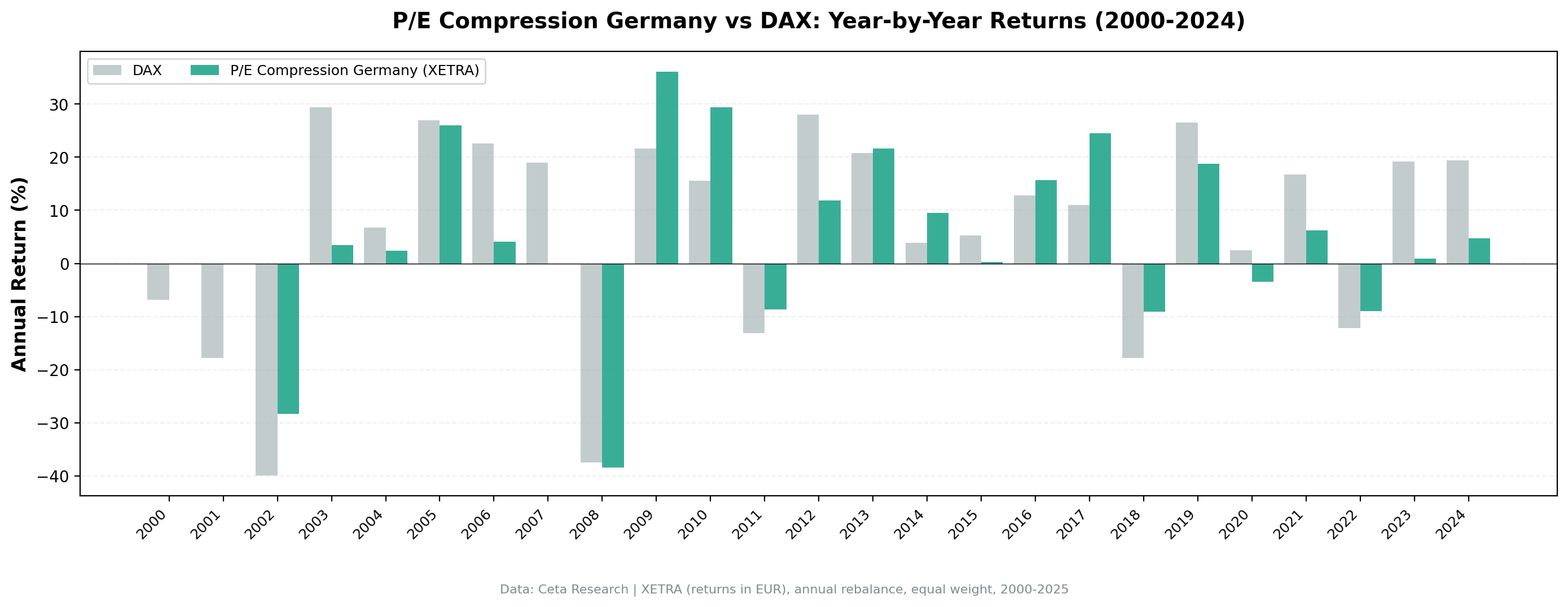
Year-by-year returns
| Year | Portfolio | DAX | Excess |
|---|---|---|---|
| 2000 | cash | -6.8% | +6.8% |
| 2001 | cash | -17.8% | +17.8% |
| 2002 | -28.3% | -39.9% | +11.6% |
| 2003 | +3.5% | +29.4% | -26.0% |
| 2004 | +2.4% | +6.8% | -4.4% |
| 2005 | +26.0% | +27.0% | -1.0% |
| 2006 | +4.1% | +22.6% | -18.5% |
| 2007 | cash | +19.0% | -19.0% |
| 2008 | -38.4% | -37.4% | -1.0% |
| 2009 | +36.1% | +21.6% | +14.5% |
| 2010 | +29.4% | +15.6% | +13.8% |
| 2011 | -8.7% | -13.1% | +4.4% |
| 2012 | +11.9% | +28.0% | -16.1% |
| 2013 | +21.6% | +20.8% | +0.8% |
| 2014 | +9.6% | +3.9% | +5.7% |
| 2015 | +0.2% | +5.3% | -5.1% |
| 2016 | +15.7% | +12.8% | +2.9% |
| 2017 | +24.5% | +11.0% | +13.5% |
| 2018 | -9.1% | -17.8% | +8.7% |
| 2019 | +18.8% | +26.5% | -7.7% |
| 2020 | -3.5% | +2.5% | -6.0% |
| 2021 | +6.2% | +16.7% | -10.5% |
| 2022 | -9.0% | -12.2% | +3.2% |
| 2023 | +0.9% | +19.2% | -18.3% |
| 2024 | +4.7% | +19.4% | -14.7% |
The pattern is mixed and getting worse. Strong alpha in 2002 (+11.6%), 2009 (+14.5%), 2010 (+13.8%) and 2017 (+13.5%). But 2003 (-26.0%), 2006 (-18.5%), 2012 (-16.1%), 2023 (-18.3%) and 2024 (-14.7%) are brutal. The last two years are the worst consecutive pair in the record: the DAX gained 19.2% then 19.4% while the portfolio managed 0.9% and 4.7%.
Does Domicile Change It?
Screens select every company listed on an exchange, and outside the US many of those are foreign companies' secondary listings. Re-running with the universe restricted to German-domiciled companies gives 4.17% CAGR and -0.28% excess, with 18 investable periods instead of 22.
So a German-only universe is slightly better than the all-listings version, and close to breakeven with the DAX. Neither version is positive. The domicile question doesn't rescue Germany, though it does mean the foreign listings on XETRA were a mild drag rather than a hidden source of return, which is the opposite of what we found in Switzerland.
Why Germany Is a Mixed Result
German companies are heavily export-driven and cyclical. P/E compression often reflects real economic headwinds (eurozone crises, trade wars, energy shocks), not temporary sentiment. When a German industrial stock's multiple compresses, it's usually because earnings forecasts have dropped, not because the market overreacted.
The honest read: this is a low-conviction strategy in Germany. It doesn't fail badly, and the drawdown profile is genuinely better than the index. But it doesn't add return, the year-to-year variation is large, and the 2023-2024 stretch is the worst in the record.
Backtest Methodology
| Parameter | Choice |
|---|---|
| Universe | XETRA, Market Cap > €500M |
| Signal | Current P/E < 85% of 5-year avg, P/E 5-40, ROE > 10%, D/E < 2.0 |
| Portfolio | Top 30 by lowest compression ratio, equal weight |
| Rebalancing | Annual (January) |
| Execution | Next-day close (mark-on-close) |
| Cash rule | Hold cash if fewer than 10 qualify and can be priced |
| Benchmark | DAX (^GDAXI, EUR, total-return performance index) |
| Period | 2000-2025 (25 years, 22 invested) |
| Returns | EUR-denominated (portfolio and benchmark) |
| Transaction costs | 0.3% one-way (€500M-€5B market cap tier) |
Conclusion
Germany's P/E compression strategy returns 3.32% a year against the DAX's 4.45%, a shortfall of 1.13%. Restricting the universe to German-domiciled companies narrows that to -0.28%, still short.
What makes Germany worth the space in this series is the benchmark. The DAX reinvests dividends, so unlike almost every other market here there's no adjustment to make and no margin to argue about. When you measure this strategy against a fair benchmark in a large, liquid, well-covered market, it loses. Modestly, with a better drawdown profile, but it loses.
Data: Ceta Research (FMP financial data warehouse). Returns in EUR. Benchmark: DAX performance index, which reinvests dividends, so this comparison is like-for-like. Past performance does not guarantee future results. Not investment advice. github.com/ceta-research/backtests