Sector Mean Reversion on Swiss Stocks (SIX): 4.69% CAGR, +2.38% vs SMI
Sector mean reversion on SIX large caps from 2000 to 2025: 4.69% CAGR in CHF vs 2.31% for the SMI, a +2.38% annual edge. Financial Services is the most-selected sector at 33% of quarters. Against SPY (8.02%) the strategy still trails by -3.33% a year.

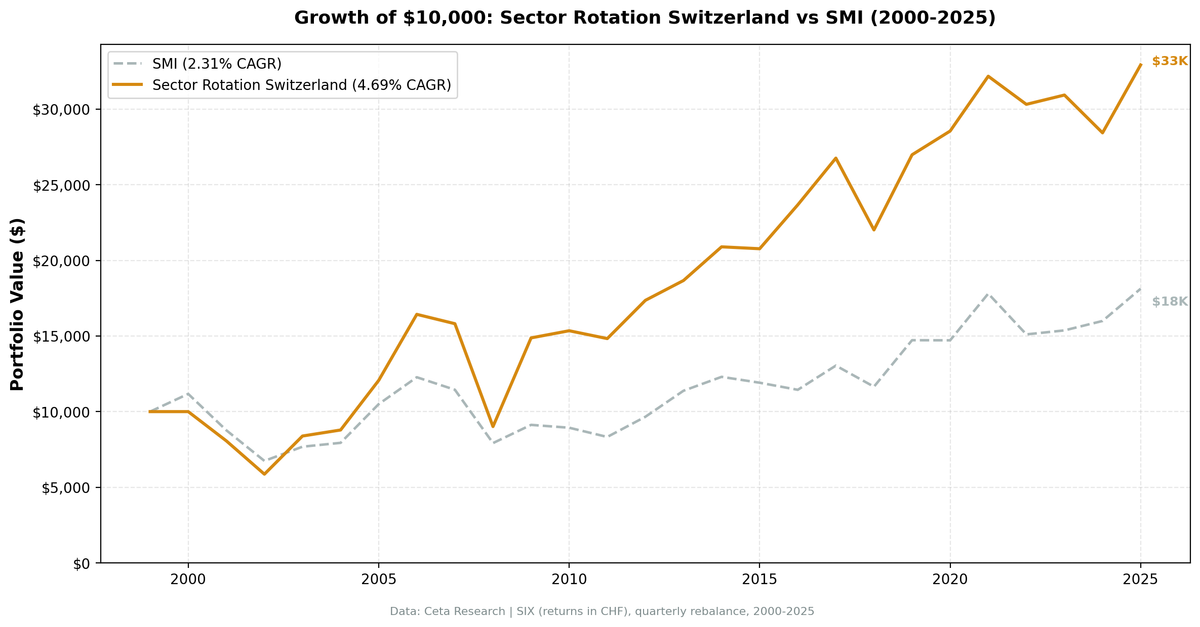
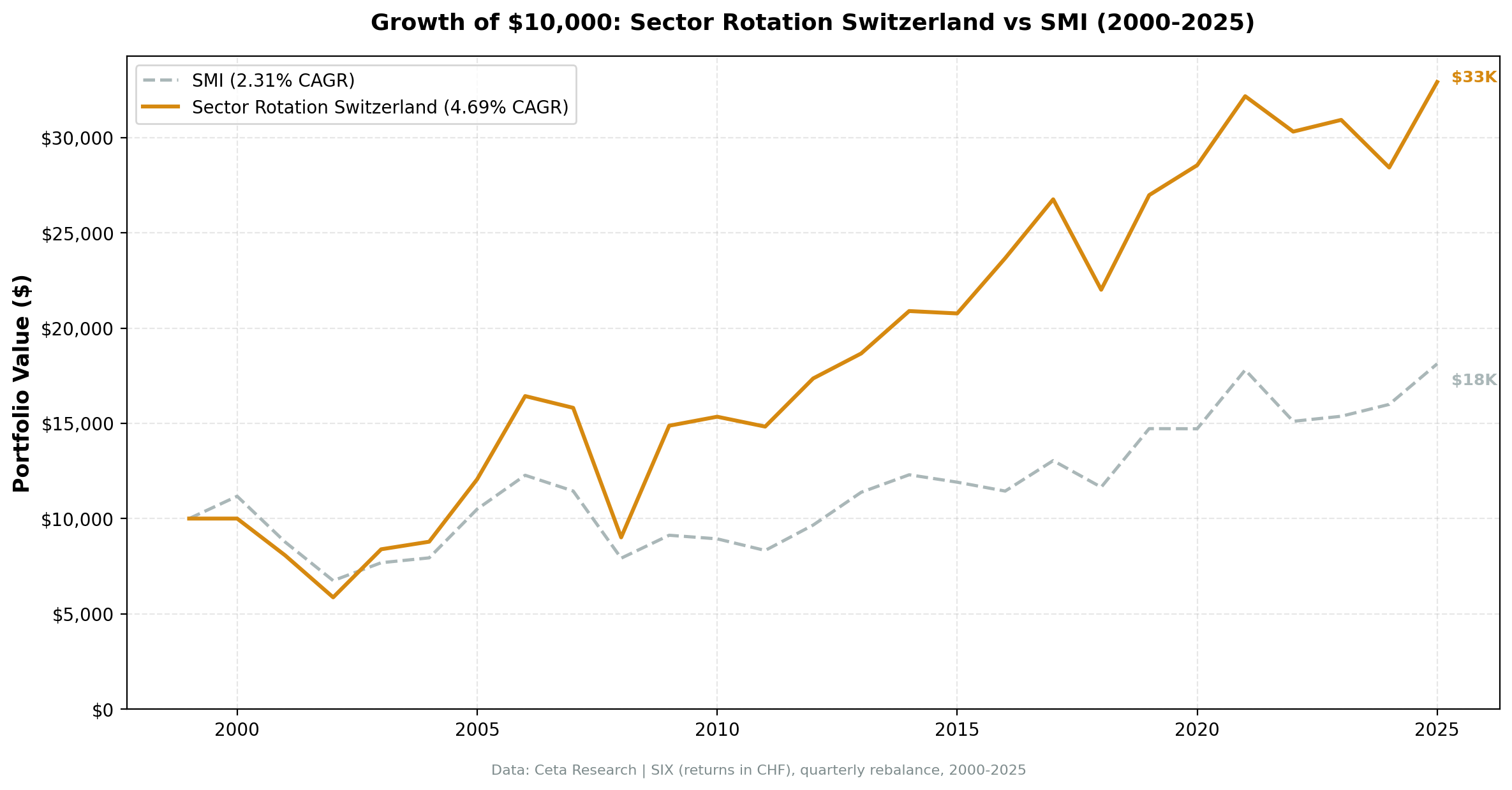
Switzerland's sector rotation strategy returned 4.69% annually from 2000 to 2025, in CHF, against the Swiss Market Index's 2.31%. That's +2.38% annual outperformance vs the local benchmark. It has a Sharpe ratio of 0.199, a max drawdown of -59.22%, and up capture of 123.53%.
Contents
- Method
- What Is Sector Mean Reversion?
- What We Found
- Most Frequently Selected Sectors
- Run This Screen Yourself
- Notable Years
- Full Annual Returns
- Backtest Methodology
- Limitations
- Takeaway
- Part of a Series
- References
The SMI comparison is the honest local benchmark. But a global investor should hold both numbers: vs SPY (8.02%), the Swiss strategy at 4.69% CAGR underperforms by -3.33% annually. A global investor would have done better holding SPY over this period.
We tested sector mean reversion on 13 exchanges. Switzerland beats its local index, but its 4.69% is the second-lowest absolute return in the study. This post covers what the data shows and why Switzerland's market structure limits the strategy's ceiling.
Data: FMP financial data warehouse, 2000-2025. Updated August 2026.
Method
Data source: Ceta Research (FMP financial data warehouse) Universe: SIX (Swiss Exchange), market cap > CHF 500M Period: 2000-2025 (26 years, 104 quarterly rebalance periods) Rebalancing: Quarterly (January, April, July, October) Signal: Buy all stocks in the bottom 2 sectors by 12-month trailing equal-weighted return Execution: Entry at the next available close after the signal date Benchmark: Swiss Market Index (^SSMI) Cash rule: Hold cash if fewer than 5 sectors qualify, or fewer than 10 stocks pass the filters Transaction costs: Size-tiered model, applied to every position
This is a pure price signal. No fundamental data is used. Full methodology: backtests/METHODOLOGY.md
What Is Sector Mean Reversion?
The idea is simple: sectors that underperform for 12 months are more likely to recover over the next quarter than sectors that just had a strong year. You buy the bottom 2 sectors by trailing return, hold for a quarter, rebalance, repeat.
It works when underperformance is temporary. A sector gets hit by sentiment, a macro headwind, or an earnings miss. The fundamentals are intact, prices overshoot, and capital rotates back in. That's the trade.
It doesn't work when underperformance is structural. A sector is down because the underlying businesses are deteriorating. There's no snap-back because there's no temporary mispricing to correct.
Switzerland's market is mostly the second case. The strategy still outperforms the SMI because the SMI itself has grown slowly. But the absolute return is low, and the gap to a global benchmark is wide.
What We Found
SIX has an up capture of 123.53% vs the SMI. In good markets, the portfolio captures more than a franc of every franc the SMI gains. The down capture of 96.80% is close to neutral: the strategy falls fractionally less than the SMI during bad markets. That asymmetry, capturing clearly more on the upside and marginally less on the downside, is what generates the +2.38% annual edge.
| Metric | Portfolio | SMI (^SSMI) |
|---|---|---|
| CAGR | 4.69% | 2.31% |
| Excess CAGR vs SMI | +2.38% | |
| Total Return | 229.15% | 81.23% |
| Annualized Volatility | 21.03% | 14.31% |
| Max Drawdown | -59.22% | -47.38% |
| Sharpe Ratio | 0.199 | 0.127 |
| Sortino Ratio | 0.320 | 0.173 |
| Calmar Ratio | 0.079 | 0.049 |
| Up Capture | 123.53% | |
| Down Capture | 96.80% | |
| Beta | 1.118 | |
| Alpha (Jensen) | 2.16% | |
| Win Rate vs SMI (quarters) | 53.85% | |
| Avg Stocks per Period | 33.3 | |
| Cash Periods | 4 of 104 |
Global context: The SMI has returned 2.31% annually over 26 years. Beating it by +2.38% to reach 4.69% CAGR is a real local edge. But vs SPY (8.02%), the strategy underperforms by -3.33% annually. A global investor would have done better holding SPY over this period.
A CHF 10,000 investment in January 2000 grew to CHF 32,915 by end of 2025. The SMI turned the same money into CHF 18,123. Better than the local index, well below what SPY would have delivered.
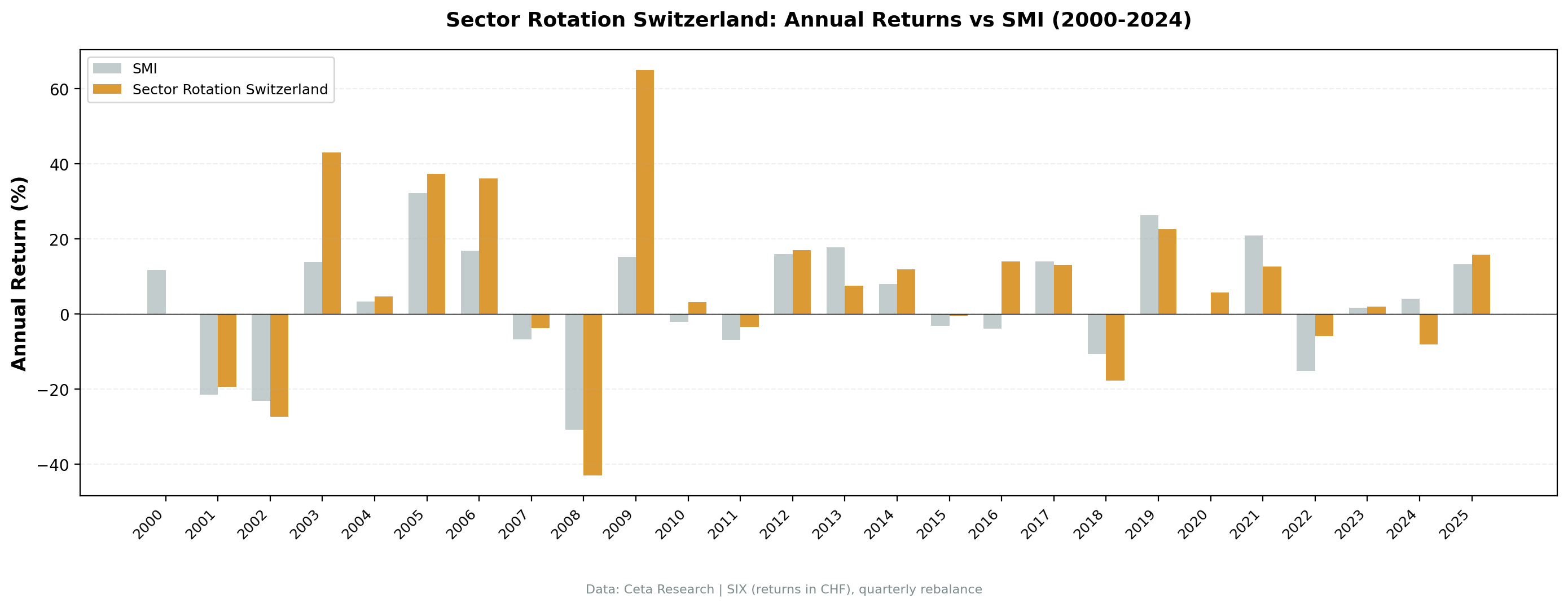
The four cash quarters are all of 2000. The SIX large-cap universe didn't clear the cash rule in a single quarter that year, which is why the strategy's 2000 return is exactly 0.00% while the SMI rose 11.71%.
Most Frequently Selected Sectors
Across the 100 invested quarters, these were the sectors that appeared most often as the bottom two by trailing return:
| Sector | Quarters Selected (of 104) |
|---|---|
| Financial Services | 35 (33%) |
| Consumer Cyclical | 30 (28%) |
| Healthcare | 29 (27%) |
| Consumer Defensive | 27 (25%) |
| Technology | 20 (19%) |
| Basic Materials | 18 (17%) |
| Communication Services | 18 (17%) |
| Real Estate | 14 (13%) |
| Industrials | 9 (8%) |
Financial Services leads at 33% of quarters. Swiss financials spent much of the study period in structural retreat: the 2008 banking crisis, the long unwind of Swiss banking secrecy, and Credit Suisse's decade-long decline into its 2023 rescue. The signal kept flagging the sector as cheap, and for most of that stretch it stayed cheap.
Consumer Cyclical and Healthcare are close behind, and they carry the same problem in a different form.
Consumer Cyclical on SIX is Swiss luxury goods and premium consumer brands. Think Richemont, Swatch, Straumann. These stocks underperform when global consumer demand slows. When global demand slows, it often stays slow for several quarters before recovering, and the recovery is uneven. Buying into beaten-down luxury goods and watches because they've had a bad 12 months doesn't consistently work.
Healthcare is Novartis, Roche, Alcon, Lonza. Swiss pharma in the bottom 2 sectors typically signals a pipeline setback, patent expiry cycle, or pricing pressure. These are multi-year structural headwinds, not temporary sentiment gaps. The mean reversion signal fires, but the mean it's reverting to is lower than it was before.
Run This Screen Yourself
The screen below runs live. It ranks sectors by their current 12-month equal-weighted return across SIX large caps. The bottom rows are what the backtest would buy today. Run it on Ceta Research Data Explorer:
WITH prices AS (
    SELECT e.symbol, e.adjClose, CAST(e.date AS DATE) AS trade_date
    FROM stock_eod e
    JOIN profile p ON e.symbol = p.symbol
    WHERE p.sector IS NOT NULL AND p.sector != ''
      AND p.marketCap > 500000000
      AND p.exchange IN ('SIX')
      AND CAST(e.date AS DATE) >= CURRENT_DATE - INTERVAL '400' DAY
      AND e.adjClose IS NOT NULL AND e.adjClose > 0
),
recent AS (
    SELECT symbol, adjClose AS recent_price
    FROM prices
    QUALIFY ROW_NUMBER() OVER (PARTITION BY symbol ORDER BY trade_date DESC) = 1
),
year_ago AS (
    SELECT symbol, adjClose AS old_price
    FROM prices
    WHERE trade_date <= CURRENT_DATE - INTERVAL '252' DAY
    QUALIFY ROW_NUMBER() OVER (PARTITION BY symbol ORDER BY trade_date DESC) = 1
),
stock_returns AS (
    SELECT r.symbol, pr.sector, (r.recent_price / ya.old_price - 1) * 100 AS return_12m
    FROM recent r
    JOIN year_ago ya ON r.symbol = ya.symbol
    JOIN profile pr ON r.symbol = pr.symbol
    WHERE ya.old_price > 0 AND r.recent_price > 0
      AND (r.recent_price / ya.old_price - 1) BETWEEN -0.99 AND 5.0
)
SELECT pr.sector,
    ROUND(AVG(sr.return_12m), 2) AS avg_return_12m_pct,
    COUNT(DISTINCT sr.symbol) AS n_stocks,
    ROW_NUMBER() OVER (ORDER BY AVG(sr.return_12m) ASC) AS rank_worst
FROM stock_returns sr
JOIN profile pr ON sr.symbol = pr.symbol
GROUP BY pr.sector
HAVING COUNT(DISTINCT sr.symbol) >= 5
ORDER BY avg_return_12m_pct ASC
Notable Years
2000: cash. The strategy held cash through all four quarters while the SMI gained 11.71%. That's a -11.71% excess, and it's the cost of a universe filter that the thin SIX large-cap universe of 2000 couldn't clear.
2009: +65.02%. The best absolute year and the best excess year in the dataset, +49.82% over an SMI that managed only +15.21%. Whatever the crisis destroyed in 2008 is what the signal was holding going into 2009, and it repriced off the lows. This is what the strategy looks like when it works.
2003 and 2006: the other two big wins. 2003 returned +43.01% against the SMI's +13.94%, a +29.07% excess. 2006 returned +36.18% against +16.93%, a +19.25% excess. Both follow the 2009 script: a global cycle turns and the sectors the strategy was already holding reprice.
2008: -43.00%. The worst year in the dataset in both absolute and relative terms. The SMI fell -30.81%, so the strategy lost 12 points more than the index it was trying to beat. This is the failure mode of a backward-looking signal at a cycle top: what looked cheap through 2007 was cheap for a reason that only became visible in 2008.
2024: -8.08%. The second-worst excess year at -12.14%. The SMI gained 4.06% while the strategy's holdings fell. The gap to the global benchmark was starker still: SPY returned 25.28% that year.
2023-2025 vs the global benchmark. The strategy returned +2.03%, -8.08% and +15.79% in those three years. Against the SMI that's +0.28%, -12.14% and +2.48%, so roughly nine points behind across three years. Against SPY (+26.00%, +25.28%, +17.88%) it's a rout. When the global benchmark is driven by US tech and AI-adjacent stocks that have no equivalent in Switzerland's market, any sector rotation signal on SIX will lag by design.
Full Annual Returns
| Year | Portfolio | SMI | Excess |
|---|---|---|---|
| 2000 | +0.00% | +11.71% | -11.71% |
| 2001 | -19.33% | -21.51% | +2.18% |
| 2002 | -27.30% | -23.11% | -4.19% |
| 2003 | +43.01% | +13.94% | +29.07% |
| 2004 | +4.75% | +3.33% | +1.42% |
| 2005 | +37.33% | +32.24% | +5.09% |
| 2006 | +36.18% | +16.93% | +19.25% |
| 2007 | -3.76% | -6.74% | +2.98% |
| 2008 | -43.00% | -30.81% | -12.20% |
| 2009 | +65.02% | +15.21% | +49.82% |
| 2010 | +3.18% | -2.07% | +5.26% |
| 2011 | -3.38% | -6.82% | +3.44% |
| 2012 | +17.05% | +16.02% | +1.02% |
| 2013 | +7.55% | +17.80% | -10.25% |
| 2014 | +11.93% | +8.08% | +3.85% |
| 2015 | -0.60% | -3.16% | +2.56% |
| 2016 | +13.97% | -3.93% | +17.90% |
| 2017 | +13.05% | +13.98% | -0.93% |
| 2018 | -17.74% | -10.69% | -7.06% |
| 2019 | +22.57% | +26.39% | -3.82% |
| 2020 | +5.82% | -0.05% | +5.87% |
| 2021 | +12.69% | +20.99% | -8.30% |
| 2022 | -5.78% | -15.15% | +9.37% |
| 2023 | +2.03% | +1.75% | +0.28% |
| 2024 | -8.08% | +4.06% | -12.14% |
| 2025 | +15.79% | +13.32% | +2.48% |
The strategy beat the SMI in 17 of 26 calendar years, 65.4%. On the finer quarterly grid the win rate is 53.85% of 104 quarters. Both are true for their own denominator, and neither is where the return came from. Four years carry the record: 2009, 2003, 2006 and 2016 sum to +116 points of annual excess. The other 22 years sum to -25.
Backtest Methodology
| Parameter | Value |
|---|---|
| Strategy | Sector Mean Reversion |
| Signal | Bottom 2 sectors by 12-month trailing EW return |
| Rebalancing | Quarterly (Jan, Apr, Jul, Oct) |
| Weighting | Equal weight within selected sectors |
| Universe | SIX (Swiss Exchange), market cap > CHF 500M |
| Execution | Next available close after the signal date |
| Period | 2000-2025 (26 years, 104 quarters) |
| Benchmark | Swiss Market Index (^SSMI) |
| Cash rule | Hold cash if < 5 sectors qualify or < 10 stocks pass filters |
| Transaction costs | Size-tiered model |
| Academic basis | Moskowitz & Grinblatt (1999) |
Limitations
Low SMI baseline. The SMI returned 2.31% annually over 26 years as a price index. Outperforming it by +2.38% is a meaningful local edge, but it's a lower bar than most global benchmarks. A total-return SMI (including dividends) would be higher, and would reduce the strategy's stated excess return.
Currency. All returns are in CHF. The Swiss franc is a safe-haven currency that tends to appreciate during global risk-off periods, which can mechanically reduce CHF returns when the benchmark recovers in USD. The 2009 +65.02% return is partly a function of CHF movements during the crisis recovery.
Mega-cap concentration. Switzerland's market is effectively 3-4 stocks: Nestlé, Novartis, Roche, UBS. Each dominates its sector. When Healthcare is the bottom 2 sector, that mostly means Novartis and Roche had a bad year. These are not temporary dislocations. They're large-cap stocks with analyst coverage measured in the dozens, and when they're down, there's usually a reason.
Structural vs cyclical underperformance. Mean reversion works on cyclical dislocations. Switzerland's dominant sectors (Healthcare, Consumer Defensive) are fundamentally acyclical. Their underperformance periods tend to reflect patent cycles, pipeline failures, and pricing headwinds, not temporary sentiment swings.
A thin universe. At 33.3 stocks per quarter on average, this is a concentrated portfolio, not a diversified factor bet. Two sectors out of nine, on an exchange where a handful of names carry each sector, means single-stock outcomes drive whole years.
Deep drawdown for a low return. A -59.22% max drawdown to earn 4.69% annualized gives a Calmar of 0.079. The local edge is real, but the risk budget it consumes is hard to justify in absolute terms.
Listed, not domiciled. The universe is every company listed on SIX, which includes foreign secondary listings. Restricting to Swiss-domiciled companies raises the result to 6.34% CAGR and +4.02% excess, but it also thins the universe enough to force 10 cash periods instead of 4. The published listed-universe figure is the conservative one.
Costs are modelled, not measured. A size-tiered cost model is applied to every position, but bid-ask spread and market impact aren't. On a small universe with quarterly turnover, real execution would cut into an already thin return.
Survivorship bias. Exchange membership uses current profiles, not historical. Delisted companies aren't tracked over time.
Takeaway
Sector mean reversion on SIX returns 4.69% annually over 26 years, beating the SMI (2.31%) by +2.38% per year. The 123.53% up capture against 96.80% down capture is a genuine local edge: the strategy amplifies SMI upside and gives back marginally less on the way down.
The broader context is less flattering. At 4.69% CAGR, Switzerland underperforms SPY (8.02%) by 3.33% annually, and only Germany posts a lower absolute return in this 13-exchange study. A global investor had better alternatives. Switzerland's market is too concentrated in mega-caps with structural, multi-year headwinds for the rotation signal to work at the level seen in Asian or US markets.
The years where Switzerland excels (2009, 2003, 2006) share a pattern: global industrial or financial cycles turned, and the beaten-down CHF sectors caught the wave. Those are real periods where mean reversion works. Strip those three years out and the remaining 23 sum to a negative annual excess against the local index.
Part of a Series
We tested this strategy across 13 exchanges. Other analyses in the series:
- US (NYSE + NASDAQ + AMEX) →
- India (NSE) →
- Korea (KSC) →
- Taiwan (TAI + TWO) →
- Sweden (STO) →
- Global comparison →: All 13 exchanges ranked by Sharpe, CAGR, and down capture
References
Moskowitz, T. J., & Grinblatt, M. (1999). Do industries explain momentum? Journal of Finance, 54(4), 1249-1290.
Data: Ceta Research (FMP financial data warehouse), 2000-2025. Universe: SIX (Swiss Exchange). Market cap > CHF 500M. Returns in CHF. Benchmark: Swiss Market Index (^SSMI). Full methodology: METHODOLOGY.md. Past performance does not guarantee future results.
Past performance does not guarantee future results. This is educational content, not investment advice.