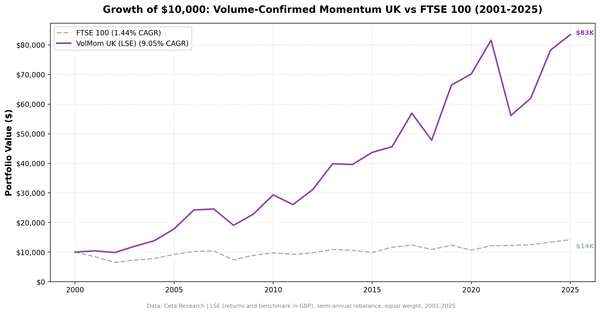
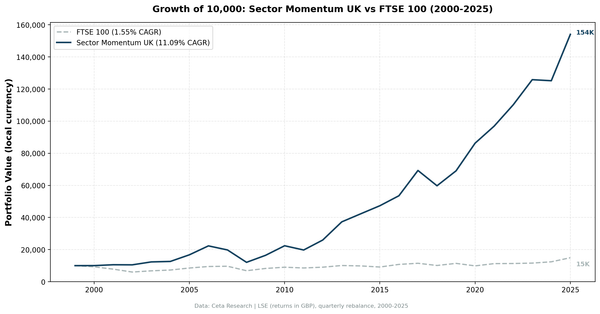
Sector Momentum Rotation: Tested on 13 Global Markets (2000-2025)
We ran sector momentum rotation on 13 stock exchanges. All 13 beat their local benchmark, and all 13 survive a risk adjustment. Korea leads on alpha at +14.29%, Canada on Sharpe at 0.591, India on raw return at 21.45% CAGR. Switzerland was never a failure.

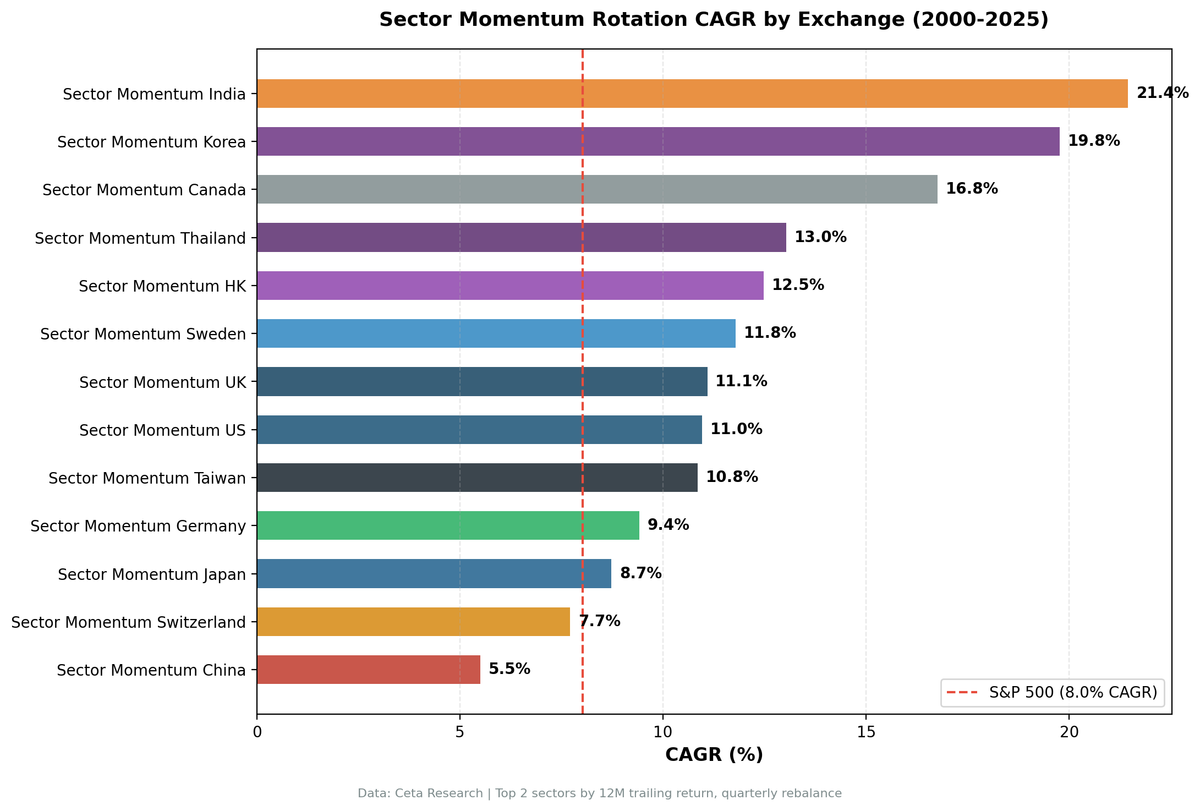
We ran the same strategy on 13 stock exchanges. All 13 beat their local benchmark, and all 13 still beat it after adjusting for market risk. Every single one.
Contents
- The Setup
- Full Results: 13 Exchanges
- Excess Is Not Alpha, and Here They Agree
- What the Pattern Shows
- Korea leads on risk-adjusted return
- India leads on raw return, and on risk
- Canada surprises
- Switzerland: the benchmark-choice lesson
- China: last on every return measure
- Japan and Thailand: the defensive end
- The Regional Pattern
- Limitations
- Run It Yourself
The strategy: rank all sectors by 12-month equal-weighted trailing return, buy stocks in the top 2, rebalance every quarter. No fundamental screening. No valuation filters. Pure price momentum applied at the sector level.
Data: FMP financial data warehouse, 2000-2025. Updated August 2026.
The Setup
Data source: Ceta Research (FMP financial data warehouse) Universe: 13 global exchanges, market cap thresholds in local currency Period: 2000-2025 (26 years, 104 quarterly periods) Signal: Top 2 sectors by 12-month equal-weighted trailing return Portfolio: All qualifying stocks in the top 2 sectors, equal weight Execution: Entry at the close of the trading day after each rebalance date Cash rule: Hold cash if fewer than 5 sectors have 5+ qualifying stocks, or fewer than 10 stocks pass the filters Benchmark: Local index per exchange (Sensex, KOSPI, TSX Composite, S&P 500, and so on) Transaction costs: Size-tiered per trade: 0.1% (market cap >$10B), 0.3% ($2-10B), 0.5% (<$2B), one-way, with thresholds converted to local currency
The tier is a one-way rate and the model charges a full round trip every quarter, on every holding, even when a sector stays in the top 2 and the position carries over untouched. That's deliberately conservative: real turnover is lower than the cost model assumes.
For full methodology detail, see the US flagship analysis or backtests/METHODOLOGY.md.
Full Results: 13 Exchanges
| Exchange | Market | CAGR | Excess vs Local | Alpha | Beta | Sharpe | Max DD | Benchmark |
|---|---|---|---|---|---|---|---|---|
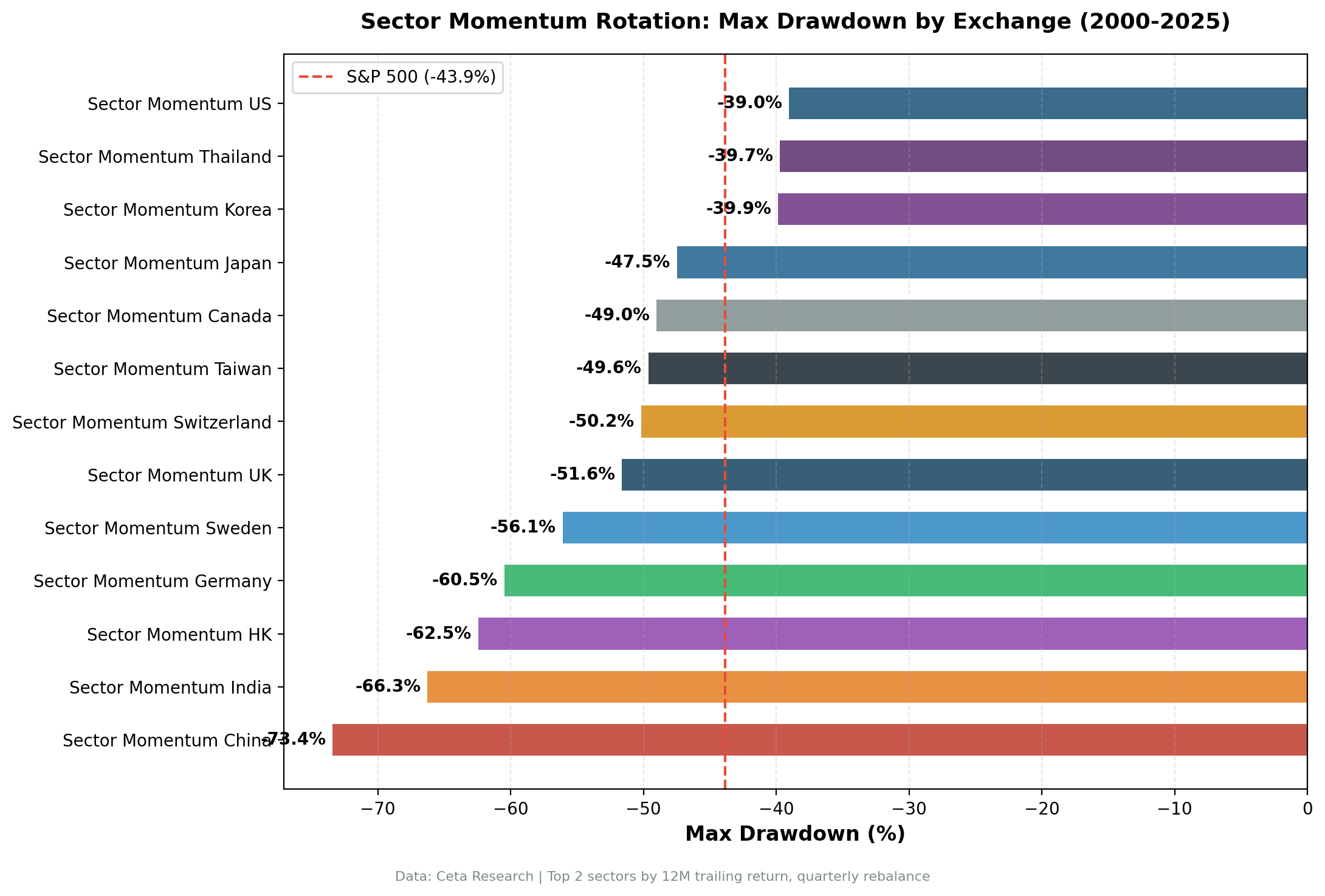
| NSE | India | 21.45% | +10.21% | +8.88% | 1.28 | 0.411 | -66.28% | Sensex |
| KSC | Korea | 19.76% | +14.21% | +14.29% | 0.97 | 0.585 | -39.86% | KOSPI |
| TSX | Canada | 16.76% | +11.51% | +11.06% | 1.16 | 0.591 | -49.01% | TSX Composite |
| SET | Thailand | 13.03% | +9.34% | +9.62% | 0.76 | 0.466 | -39.73% | SET Index |
| HKSE | Hong Kong | 12.48% | +10.87% | +10.94% | 1.05 | 0.333 | -62.45% | Hang Seng |
| STO | Sweden | 11.79% | +8.41% | +8.54% | 0.90 | 0.456 | -56.09% | OMX Stockholm 30 |
| LSE | UK | 11.09% | +9.54% | +9.39% | 0.93 | 0.433 | -51.63% | FTSE 100 |
| NYSE_NASDAQ_AMEX | US | 10.96% | +2.94% | +3.08% | 0.98 | 0.438 | -39.05% | S&P 500 |
| TAI_TWO | Taiwan | 10.85% | +6.08% | +7.29% | 0.68 | 0.432 | -49.63% | TAIEX |
| XETRA | Germany | 9.41% | +4.22% | +5.20% | 0.69 | 0.390 | -60.47% | DAX |
| JPX | Japan | 8.73% | +4.80% | +6.05% | 0.67 | 0.461 | -47.48% | Nikkei 225 |
| SIX | Switzerland | 7.71% | +5.40% | +5.37% | 1.01 | 0.402 | -50.17% | SMI |
| SHH_SHZ | China | 5.50% | +1.26% | +1.36% | 0.94 | 0.093 | -73.42% | SSE Composite |
South Africa (JNB) was dropped from this study. With current FMP data the strategy holds cash for 82 of 104 quarters, because the JNB large-cap universe never reaches 5 sectors of 5+ stocks before 2017. Only 2018-2025 is investable, so a 26-year CAGR for that market would not be a real result.
Excess Is Not Alpha, and Here They Agree
Excess return is just portfolio CAGR minus benchmark CAGR. It says nothing about how much market risk you took to get it. A portfolio running a beta of 1.3 should beat its index in a rising market; that's leverage, not skill.
We ran Jensen alpha alongside excess for every market, and in this study the two agree. All 13 markets are positive on both. The gaps are small and they point in both directions:
- India shows the largest gap in the unflattering direction: +10.21% excess but +8.88% alpha, because a beta of 1.28 means part of the headline came from carrying more market risk than the Sensex. Canada is milder in the same direction (+11.51% vs +11.06%).
- Japan, Germany and Taiwan run the other way. Japan's beta of 0.674 means its +4.80% excess understates the risk-adjusted edge, which is +6.05%. Germany goes from +4.22% to +5.20%, Taiwan from +6.08% to +7.29%.
Read the alpha column when comparing markets to each other. Read the excess column when asking what a local investor would actually have collected.
What the Pattern Shows
Korea leads on risk-adjusted return
Korea's excess return is +14.21% annualized over the KOSPI across 26 years, and its alpha of +14.29% is the largest in the study. It got there at a beta of 0.970, meaning less market risk than the index it beat, with a 59.46% down capture and a maximum drawdown of -39.86% against the KOSPI's -52.73%. That combination is what makes Korea the strongest result here, more than the raw CAGR does.
The explanation is sector persistence. Korea's Consumer Defensive sector appeared in the top 2 for 34 of 104 quarters, Healthcare for 33. These aren't short-term blips. Korea's aging demographics created a structural demand trend for medical services and consumer staples that persisted across multiple market cycles.
India leads on raw return, and on risk
India produced the highest CAGR in the study at 21.45%, and the single largest calendar-year margin anywhere: +97.52% over the Sensex in 2003. India's Technology sector appeared in the top 2 for 30 quarters, Healthcare for 28.
It's also one of only two markets, with China, where the strategy amplifies losses rather than cushioning them, and by far the more extreme of the pair. Down capture is 120.56% against China's 102.91%, max drawdown -66.28% against the Sensex's -51.34%, and 2008 alone cost 62%. India rewards conviction and punishes anyone who needs the drawdown to be tolerable.
Canada surprises
Canada's +11.51% excess return over the TSX Composite is the largest in the developed-market set and second in the study overall. Basic Materials appeared in the top 2 for 38 quarters, Energy for 37. Canada also posts the study's highest Sharpe ratio at 0.591.
Canada's sector composition is concentrated in resources. When commodity cycles run, they run for years, not quarters. Sector momentum caught the 2002-2007 commodity boom and the 2020-2022 energy cycle and held positions throughout. The cost: a -42.17% year in 2008, 8.5 points worse than the TSX Composite.
Switzerland: the benchmark-choice lesson
In an earlier version of this analysis, Switzerland looked like the one failure, with -4.54% excess return measured against SPY. That was a benchmark artifact.
Against its local index, the SMI, Switzerland returned 7.71% CAGR with +5.40% annual excess and +5.37% alpha. It beat the Swiss market. The confusion came from comparing Swiss franc returns against a USD-denominated S&P 500 that happened to grow faster than the SMI over 26 years.
The lesson: compare to the local benchmark, not a foreign index. A Swiss investor buying Swiss stocks should measure against the SMI, not against an American index in a different currency.
China: last on every return measure
China ranks thirteenth of thirteen on CAGR, on excess, on Jensen alpha, on Sharpe and on Sortino, and its max drawdown of -73.42% is the deepest in the study. Excess is +1.26% over the SSE Composite and alpha +1.36%. Down capture of 102.91% means it amplifies declines, the only market other than India to do so.
China's Energy, Technology and Consumer Defensive sectors rotate through the top 2 fairly evenly, so the strategy isn't structurally broken. But the A-share market is highly volatile and momentum signals are noisy. Sector trends in China are partly driven by government policy shifts, speculative retail participation, and index rebalancing rather than sustained earnings cycles. The signal fires, but the follow-through is inconsistent.
China is the clearest case of "technically beats the benchmark, but the edge isn't worth the risk to collect it."
Japan and Thailand: the defensive end
Japan has the lowest down capture in the study at 45.37% and the lowest up capture at 82.41%. It gives up index upside to buy downside protection, and over 26 years that trade came out ahead: -47.48% max drawdown against the Nikkei's -61.06%.
Thailand is close behind on down capture at 49.16%, with a -39.73% max drawdown, the second shallowest in the study. Both markets run a portfolio less volatile than the index they beat, as do Germany and Taiwan.
The Regional Pattern
All 13 exchanges beat their local benchmark. The margin varies, and that variation tells you something about where momentum works best.
Asian markets (Korea, India, Hong Kong, Thailand, Taiwan): excess returns from +6% to +14% over local benchmarks. Sector trends are long-lived and markets are less efficient than Western developed markets. Momentum anomalies persist longer because institutional arbitrage capital is smaller relative to market size.
Western developed markets (US, Germany, UK, Japan, Sweden, Switzerland): excess returns from +2.94% to +9.54%. Sector rotations are shorter-lived and significant institutional participation means momentum gets arbitraged away faster. The edge is thinner but positive everywhere. The US, the most studied and most efficient market in the set, has the smallest edge outside China.
Commodity-heavy Canada: +11.51% over the TSX Composite, an outlier in the developed world due to structural concentration in resources. Sector momentum works because commodity cycles are long and persistent.
The Moskowitz and Grinblatt (1999) paper that established sector momentum as an academic anomaly was based on US data, and it documented continuation: industries that outperformed over 6 to 12 months kept outperforming. That is exactly the horizon this strategy trades. The US results (+2.94% excess over the S&P 500) are consistent with that literature, and the international results suggest the size of the anomaly scales inversely with market efficiency.
Limitations
Benchmarks. Each exchange uses its own local index. This makes excess returns more meaningful per market but less directly comparable across markets. A +5% excess over the SMI and a +5% excess over the Sensex aren't equivalent in difficulty.
Currency. All returns are in local currency. A US investor accessing Korean or Indian stocks would face currency risk and additional transaction costs not modelled here.
Data quality. FMP data includes most delisted stocks for larger exchanges, which reduces survivorship bias, but coverage varies. South Africa was dropped entirely because coverage gaps produced 82 of 104 cash quarters. Australia, Brazil and Singapore are excluded from the study for the reasons documented in the repository.
Cash quarters cluster early. Seven of the 13 markets hold cash in at least one quarter, and those quarters concentrate in 2000-2004 where FMP coverage is thinnest. In Japan and Korea, the 2000 cash quarter happens to fall in a year the local index dropped sharply, which flatters both markets' relative record. Read those two years as a coverage artifact as much as a signal decision.
Fund contamination. FMP classifies closed-end funds and ETFs under Financial Services. In the US that sector is mostly funds by count. It never reached the top 2 in the US over 26 years, so no fund entered that portfolio, but the Financial Services row in any sector screen should be read as a fund average rather than a bank average.
Listed is not domiciled. Outside the US, an exchange filter picks up foreign secondary listings alongside domestic companies. We checked this on the two European markets where it bites hardest. Germany improves under a domicile-only filter (+4.22% excess to +6.66%) and Switzerland weakens (+5.40% to +3.53%), with neither changing sign. Published figures use the listed universe throughout.
Small universes. Thailand and Korea average under 60 holdings. Individual sector trends can be amplified by a few names, and liquidity constraints would reduce live execution returns.
These benchmarks leave dividends out. Portfolio returns here use dividend-adjusted prices, so they include dividends. Most of the indices we measure against do not. The FTSE 100, Hang Seng, KOSPI, Nikkei 225, OMX Stockholm 30, SET Index, SMI, SSE Composite, Sensex, TAIEX and TSX Composite are price indices, so excess return against them is overstated by roughly the local dividend yield, which has run between about 1.3% and 3.5% in these markets. Those comparisons are like for like: the S&P 500 figure runs through SPY, which is dividend-adjusted; the DAX is a performance index. Treat any edge thinner than the local yield as a tie rather than a win.
Run It Yourself
The full backtest code is available at github.com/ceta-research/backtests.
Run the live sector ranking screen on Ceta Research: cetaresearch.com/data-explorer?q=XWQD6e9yhy
Detailed per-market analysis:
Data: Ceta Research (FMP financial data warehouse). Backtest period: 2000-2025. All returns in local currency unless otherwise noted. Past performance does not guarantee future results. This is educational content, not investment advice.