Small-Cap Growth in India: 12.46% CAGR, but the Sensex Did 12.06%
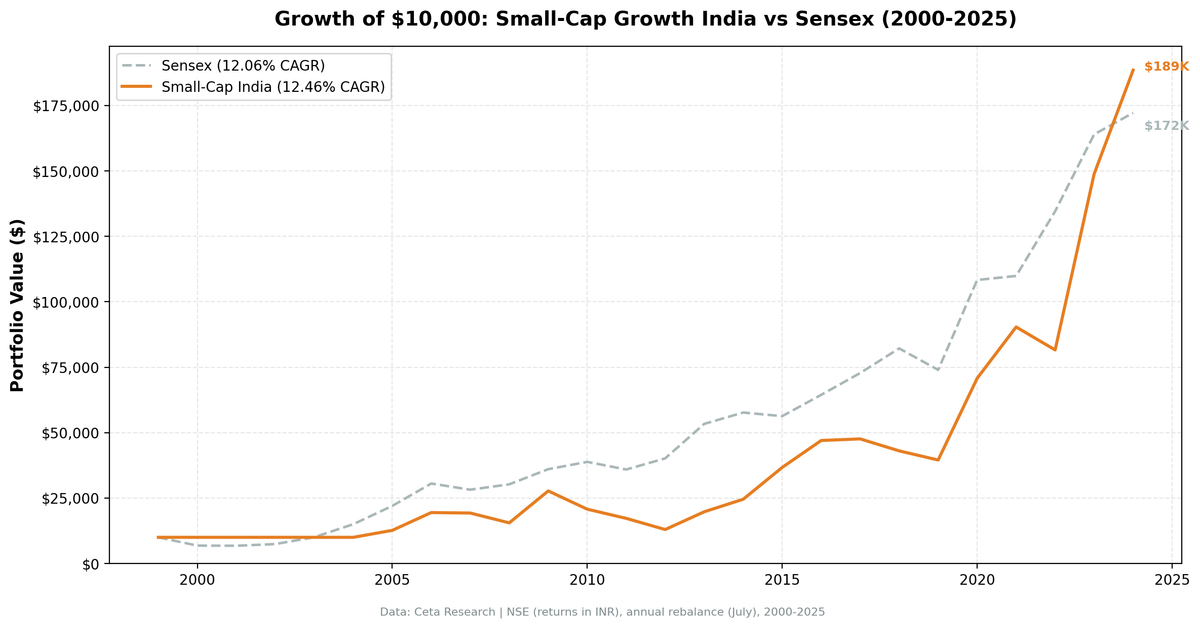
NSE small-cap growth stocks returned 12.46% CAGR over 25 years. The Sensex returned 12.06%. The premium is +0.41%/yr, thin but real, and it comes with a -39% down capture.

The small-cap growth premium is gone in the US. We showed that in a separate post: 25 years of screening to finish 0.03 percentage points a year behind the S&P 500. India looks different, but not as different as the headline suggests.
Contents
- What We Tested
- What We Found
- Annual Returns: 25 Years
- Why the Premium Is So Thin
- When It Fails
- The Local Benchmark Perspective
- Limitations
- Run It Yourself
- Takeaway
- References
NSE small-cap growth stocks returned 12.46% CAGR from 2000 to 2024, against a Sensex benchmark of 12.06%. $10,000 became $188,510. The premium over the local benchmark is +0.41%/yr, thin enough that a single basis point of extra brokerage would eat it. What makes the strategy interesting isn't the excess return. It's the shape: a down capture of -39.2%, meaning the portfolio averaged a positive return in the years the Sensex fell.
Data: FMP financial data warehouse, 2000-2025. Updated August 2026.
What We Tested
The strategy selects small-cap Indian stocks with demonstrated revenue momentum:
- Market cap: ₹1 billion to ₹40 billion (small-cap range, 5%-200% of exchange threshold)
- Revenue growth: >15% year-over-year (fiscal year)
- Profitability: Net income > 0
- Leverage: Debt-to-equity < 2.0
- Selection: Top 30 by revenue growth, equal-weighted
- Rebalancing: Annual in July, 45-day filing lag
- Execution: Next-day close after each rebalance date
- Benchmark: Sensex (BSE 30 index, local currency)
Universe covers NSE only. We excluded BSE from this run to avoid double-counting: approximately 38% of NSE stocks are dual-listed on BSE, and including both exchanges inflates the stock count without adding unique companies. Data from the FMP financial data warehouse, 2000-2025. Full methodology: METHODOLOGY.md.
Run the stock selection query yourself: cetaresearch.com/data-explorer?q=GEAzmRxz3r
What We Found
The strategy beat the Sensex in 14 of 25 years, a 56% win rate, and generated +0.41% annual excess return. The margin is small because the Sensex is a hard benchmark: 12.06% a year over 25 years is one of the strongest equity index records anywhere in the world over that window.
The down capture of -39.2% is the number worth understanding. In the 6 years when the Sensex had negative returns (2000, 2001, 2007, 2011, 2015, 2019), the portfolio averaged +3.9% while the Sensex averaged -10.0%. A negative down capture means the portfolio earned positive returns on average when the benchmark fell. Two mechanisms drive it:
First, the cash periods. In 2000 and 2001, the Indian small-cap universe didn't have enough qualifying stocks to build a portfolio, so the strategy held 0% and beat the Sensex's -31.6% and -0.8%. Second, 2015. The Sensex fell 2.4% while the portfolio gained 49.5%. The RBI rate cut cycle from 2015-2016 supercharged domestic small-cap companies: banks, NBFCs, consumer goods companies, and industrial names all re-rated sharply.
That mechanism cuts both ways. The 5 cash periods (2000-2004) also meant sitting out the Sensex's +9.6%, +35.2% and +49.4% years. Those three years alone cost 94 percentage points of relative return, which is why the 25-year excess is so thin despite the strategy's strong second half.
Average portfolio size across active years: 15.3 stocks, half the 30-stock target. The Indian universe is genuinely selective at this quality tier.
Annual Returns: 25 Years
| Year | Strategy | Sensex | Excess |
|---|---|---|---|
| 2000 | 0.0% (cash) | -31.6% | +31.6% |
| 2001 | 0.0% (cash) | -0.8% | +0.8% |
| 2002 | 0.0% (cash) | +9.6% | -9.6% |
| 2003 | 0.0% (cash) | +35.2% | -35.2% |
| 2004 | 0.0% (cash) | +49.4% | -49.4% |
| 2005 | +26.6% | +46.5% | -19.9% |
| 2006 | +53.7% | +38.9% | +14.8% |
| 2007 | -0.9% | -7.7% | +6.8% |
| 2008 | -19.5% | +7.3% | -26.8% |
| 2009 | +78.6% | +19.1% | +59.5% |
| 2010 | -25.2% | +7.8% | -32.9% |
| 2011 | -16.9% | -7.5% | -9.4% |
| 2012 | -24.8% | +11.9% | -36.6% |
| 2013 | +52.2% | +32.8% | +19.5% |
| 2014 | +24.3% | +8.1% | +16.1% |
| 2015 | +49.5% | -2.4% | +51.9% |
| 2016 | +28.1% | +14.5% | +13.6% |
| 2017 | +1.3% | +13.0% | -11.6% |
| 2018 | -9.6% | +12.9% | -22.5% |
| 2019 | -8.1% | -10.0% | +1.9% |
| 2020 | +79.0% | +46.4% | +32.5% |
| 2021 | +27.7% | +1.4% | +26.3% |
| 2022 | -9.7% | +22.5% | -32.2% |
| 2023 | +82.4% | +21.8% | +60.6% |
| 2024 | +26.6% | +5.0% | +21.6% |
Return years run July to July, matching the rebalance date.
The pattern that stands out: exceptional single-year outperformance in 2009 (+59.5%), 2015 (+51.9%), 2023 (+60.6%), and 2020 (+32.5%). These correspond to Indian recovery cycles: the post-global-financial-crisis recovery, the rate cut cycle, the 2023 domestic growth acceleration, and the post-COVID bounce. In each case, the quality filter positioned the portfolio in companies that compounded capital fastest.
The failure years cluster around domestic macro stress: 2010-2012 (RBI tightening, INR weakness), 2018 (NBFC crisis), 2022 (rate hike cycle).
Why the Premium Is So Thin
The Sensex compounded at 12.06% a year for 25 years. That's the answer. India's problem for a stock picker isn't that the market is efficient, it's that the index is very hard to beat.
The academic conditions for a size premium are present. SEBI data shows average analyst coverage for NSE small-caps below 2 analysts per stock, and many qualifying companies have no coverage at all. India also has structural growth tailwinds that the screen captures: formalisation of the economy, financial inclusion driving regional financial services, and domestic consumption expansion. Global emerging market funds can't allocate to small NSE companies without moving the price, so mispricing persists longer than in developed markets.
All of that shows up in the results, just not as excess return. It shows up as a portfolio with a beta of 0.66 that still kept pace with a 12% index, producing a Jensen's alpha of +2.3%/yr. You got index-like returns from a portfolio holding two-thirds of the market's systematic risk. Whether that's worth the concentration and the drawdown is a separate question.
When It Fails
The strategy's worst years cluster around domestic Indian macro stress. 2010-2012 was a three-year run of underperformance: -32.9%, -9.4%, -36.6% excess against the Sensex. That period saw RBI rate tightening, INR depreciation, and slowing credit growth for small businesses. Quality companies with revenue growth couldn't escape the macro headwind.
2018 (-22.5% excess) reflected the NBFC liquidity crisis: small financial companies that met the revenue growth filter ran into credit market seizures that an annual filing screen can't detect.
The Sharpe of 0.181 and MaxDD of -53.19% are real constraints, and both are worse than the Sensex's 0.281 and -32.20%. On risk-adjusted terms the index wins. The strategy doesn't protect against domestic Indian downturns. What it avoids is global correlation: when US equities sell off for global reasons, Indian small-caps don't necessarily follow.
The Local Benchmark Perspective
Measured against the Sensex rather than a global index, the picture is demanding. Beating 12.06% a year by 0.41 percentage points is close to a coin flip, and the 56% win rate reflects that.
The strategy's value comes from concentration of upside: four years of 30-60 percentage point outperformance carry the entire record. Strip out 2009, 2015, 2020 and 2023 and the strategy trails the Sensex badly. A passive Sensex investor would have done well without the drawdowns. The small-cap growth screen adds a premium that is real in sign but marginal in size.
Limitations
- Currency risk: Returns are in INR. USD investors face additional FX volatility, and the rupee depreciated substantially against the dollar over this period.
- Liquidity: NSE small-caps can be illiquid. Real execution at the prices implied by daily close data requires planning.
- Cash years: The 5 cash years (2000-2004) mean the full return history isn't comparable to a fully invested strategy. The portfolio effectively started in 2005.
- Filing timing: Indian annual reports can be filed later than the 45-day assumption. Some selection delay may exist.
- Exchange coverage: This run uses NSE only to avoid dual-listing duplicates. All results reflect the NSE universe.
- Fund contamination: Closed-end funds report investment income as
revenue, so a revenue-growth screen can pick them up. India is one of the cleaner markets on this measure, but see the US post for the full analysis. The live screen linked above excludes funds and ETFs. - Data revisions: FMP restates and backfills financial history. The same code run in March 2026 produced 13.44% CAGR against today's 12.46%, purely from data revisions.
Run It Yourself
The live stock selection query is public: cetaresearch.com/data-explorer?q=GEAzmRxz3r
Modify the revenue growth threshold or leverage filter directly in SQL. The query runs against the live FMP warehouse and returns current qualifying NSE stocks.
Takeaway
India's small-cap growth screen returned 12.46% a year over 25 years. That's a strong absolute number, one of the best in our 14-market study, and it comes almost entirely from being invested in India rather than from the screen. The Sensex did 12.06% on its own.
The +0.41% premium is real but marginal, and it's paid for with a deeper drawdown (-53.19% against the index's -32.20%) and a lower Sharpe. What the strategy genuinely offers is the -39.2% down capture: cash periods in the early years and a standout 2015 mean it tends to hold its ground when the Sensex falls.
The structural conditions that should produce a premium here, thin analyst coverage, domestic demand insulation, genuine corporate growth, are all intact. They just haven't produced much excess return against an index that compounded at 12%.
References
- Banz, R. (1981). "The Relationship Between Return and Market Value of Common Stocks." Journal of Financial Economics, 9(1), 3-18.
- Fama, E. & French, K. (1992). "The Cross-Section of Expected Stock Returns." Journal of Finance, 47(2), 427-465.
- Fama, E. & French, K. (1993). "Common Risk Factors in the Returns on Stocks and Bonds." Journal of Financial Economics, 33(1), 3-56.
- Van Dijk, M. (2011). "Is size dead? A review of the size effect in equity returns." Journal of Banking & Finance, 35(12), 3263-3274.
Data: Ceta Research (FMP financial data warehouse), 2000-2025. Full methodology: METHODOLOGY.md. Past performance does not guarantee future results. This is educational content, not investment advice.