Small-Cap Growth in South Africa: 9.57% a Year, With the Alpha All in the 2000s
South African small-cap growth returned 9.57% CAGR over 25 years, the second-highest absolute return in our study. The excess was earned before 2010 and gave way to five straight losing years.

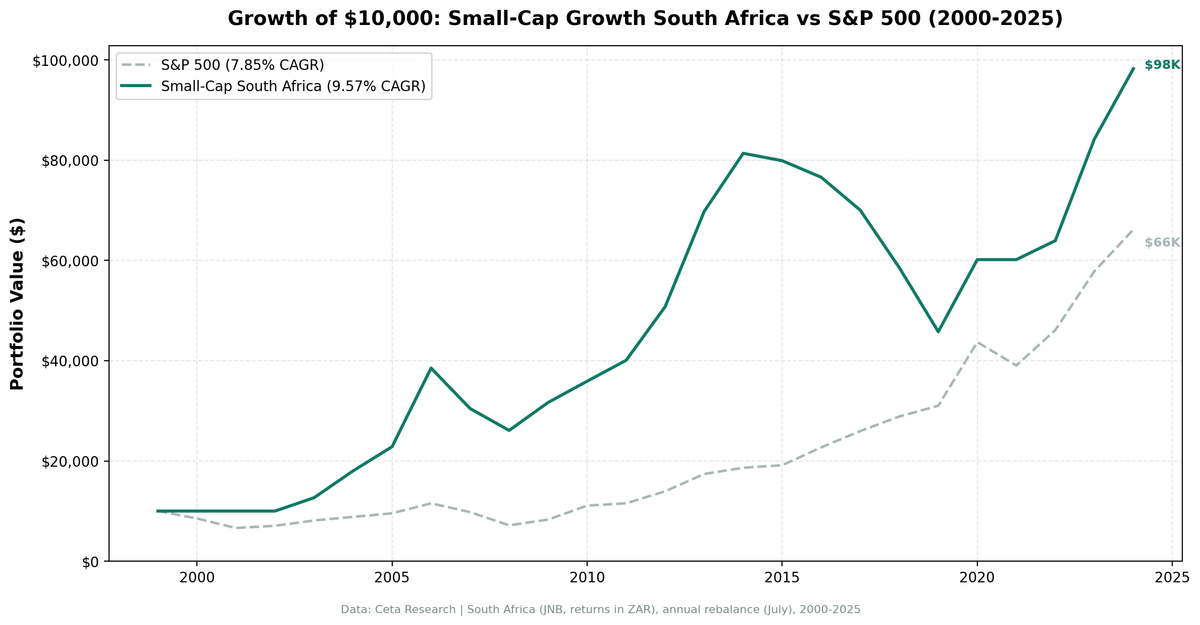
South Africa returned 9.57% CAGR from 2000 to 2024, $10,000 growing to $98,246, the second-highest absolute return of the 14 markets we tested.
Contents
- What We Tested
- What We Found
- 2019: The Worst Year
- Annual Returns: 25 Years
- Why the Premium Existed
- Currency Risk
- Limitations
- Takeaway
- References
Two things complicate that. FMP's warehouse has no usable JSE index, so the comparison here is against the S&P 500, which mixes a rand-denominated portfolio with a dollar benchmark. And the excess return is entirely a 2000s story: the strategy beat its benchmark in 8 of 10 years from 2000 to 2009 by an average of 15.4 points, then averaged -4.4 points through 2017 and -8.4 points since 2018.
Data: FMP financial data warehouse, 2000-2025. Updated August 2026.
What We Tested
The strategy selects small-cap stocks listed on the Johannesburg Stock Exchange (JNB) showing revenue momentum:
- Market cap: 5%-200% of the exchange threshold (small-cap range)
- Revenue growth: >15% year-over-year (fiscal year)
- Profitability: Net income > 0
- Leverage: Debt-to-equity < 2.0
- Selection: Top 30 by revenue growth, equal-weighted
- Rebalancing: Annual in July, 45-day filing lag, entry at the next-day close
- Benchmark: S&P 500, because the dataset has no JSE composite index
Data from the FMP financial data warehouse, 2000-2025. Average portfolio size 16.0 stocks, with 4 cash years. Full methodology: METHODOLOGY.md.
On the benchmark. Every other market in this study is measured against a local index in the same currency as the portfolio. South Africa can't be, so the +1.72%/yr excess figure compares rand returns to dollar returns and should be read as an approximation rather than a clean alpha estimate. The risk-adjusted figures are affected too: we apply a 9% South African risk-free rate, which drags both Sharpe ratios down and makes the S&P 500's read negative here. Use the absolute return and the year-by-year table, not the ratios.
What We Found
60% win rate, 15 of 25 years. Up capture of 102% against down capture of 39% is a good asymmetry. In the 5 years the benchmark fell, the portfolio averaged -7.1% against the benchmark's -18.0%.
The strong period is 2003-2014. Twelve years of mostly double-digit gains: +26.5%, +42.3%, +26.8%, +68.7%, +21.4%, +13.4%, +11.6%, +26.7%, +37.4%, +16.6%. South Africa's commodity super-cycle, infrastructure spending, and domestic consumption growth all fed small-cap revenues. Companies growing fast were genuinely worth more.
Then it stopped. From 2015 through 2019 the strategy posted five consecutive negative years: -1.8%, -4.1%, -8.6%, -16.4%, -21.8%. The rand weakened, load-shedding raised operating costs across the economy, and state capture created investment paralysis. 2023 (+31.7%) and 2024 (+16.7%) suggest a recovery, but two years isn't a trend.
2019: The Worst Year
2019: -21.84% for the strategy against the benchmark's +7.43%. A -29.28 point excess, the worst in the sample.
This was the Eskom crisis at its worst: stage 4-6 load-shedding and rolling blackouts across every sector. Small businesses, which make up the bulk of the JSE small-cap universe, faced higher generator fuel costs, production disruptions, and collapsing consumer confidence.
A company growing revenue at 20% a year doesn't deliver that growth when the power is off for eight hours a day. No revenue-growth filter protects against a national power grid failing, and that's the useful lesson: country-specific infrastructure risk can overwhelm fundamental screening entirely.
Annual Returns: 25 Years
| Year | Strategy | S&P 500 | Excess |
|---|---|---|---|
| 2000 | 0.0% (cash) | -14.8% | +14.8% |
| 2001 | 0.0% (cash) | -22.5% | +22.5% |
| 2002 | 0.0% (cash) | +6.9% | -6.9% |
| 2003 | +26.5% | +14.9% | +11.6% |
| 2004 | +42.3% | +8.9% | +33.5% |
| 2005 | +26.8% | +8.0% | +18.8% |
| 2006 | +68.7% | +21.0% | +47.7% |
| 2007 | -21.0% | -15.2% | -5.8% |
| 2008 | -14.3% | -26.9% | +12.6% |
| 2009 | +21.4% | +16.0% | +5.4% |
| 2010 | +13.4% | +33.6% | -20.2% |
| 2011 | +11.6% | +4.2% | +7.5% |
| 2012 | +26.7% | +20.7% | +6.0% |
| 2013 | +37.4% | +24.7% | +12.7% |
| 2014 | +16.6% | +7.2% | +9.5% |
| 2015 | -1.8% | +2.7% | -4.5% |
| 2016 | -4.1% | +18.6% | -22.7% |
| 2017 | -8.6% | +14.3% | -22.9% |
| 2018 | -16.4% | +11.2% | -27.6% |
| 2019 | -21.8% | +7.4% | -29.3% |
| 2020 | +31.4% | +41.0% | -9.6% |
| 2021 | 0.0% (cash) | -10.7% | +10.7% |
| 2022 | +6.3% | +18.1% | -11.8% |
| 2023 | +31.7% | +25.4% | +6.2% |
| 2024 | +16.7% | +14.4% | +2.3% |
Return years run July to July, matching the rebalance date. Returns are in rand, the benchmark in dollars. Best year: 2006 (+68.68%). Worst year: 2019 (-21.84%).
The early cash years (2000-2002) reflect insufficient qualifying stocks before the strategy could run. Sitting in cash through the dot-com crash preserved capital that compounded strongly in the 2003-2006 bull run, and it flatters the record: two of those three years count as wins without the strategy picking a single stock.
2021 is also a cash year. Revenue figures from 2020 filings were too distorted by COVID for the screen to find 10 qualifying companies.
Why the Premium Existed
Coverage gap. JSE-listed small-caps average fewer than 3 analyst estimates per stock, and many have none. Without coverage, price discovery is slow and mispriced companies stay mispriced longer.
Institutional capacity. South Africa's pension funds and insurers concentrate in large caps and government bonds. Even the GEPF, Africa's largest pension fund, doesn't move prices in small-cap industrials. The space is less contested.
Foreign investor access. International allocators who invest in South Africa typically buy the JSE Top 40 for exposure. Small-cap allocation from foreign capital is minimal.
Genuine economic development. The 2003-2014 period saw real GDP growth, an expanding middle class, and infrastructure spend that directly benefited small companies in construction, retail, financial services and consumer goods. The growth screen was capturing real economic trends.
That last point explains the post-2015 collapse as clearly as it explains the earlier run. A screen for revenue growth can't create growth that isn't there. When the economy stalled, so did the strategy.
Currency Risk
All returns here are in South African rand. USD investors face additional volatility from the ZAR/USD exchange rate, and the rand has been on a long-term depreciation path with sharp devaluations during stress events in 2008, 2015-2016 and 2018-2019.
Dollar-converted returns would be materially lower than the rand returns shown above. A South African small-cap strategy for an international investor is also a long-rand bet, and over this period that bet lost money. The headline 9.57% doesn't capture it.
Limitations
- Benchmark mismatch: No JSE index in the dataset means the excess figure compares rand returns to a dollar index. Treat +1.72%/yr as indicative, not precise.
- Currency: Returns in rand. Dollar returns would be materially lower.
- Liquidity: JSE small-caps can have wide spreads and thin order books. Real execution costs would exceed the size-tiered costs modelled here.
- Cash years: Four cash years (2000, 2001, 2002, 2021) reduce the comparable history, and two of them score as wins purely from sitting out a falling benchmark.
- Country concentration risk: 2015-2019 shows what concentrated South African exposure looks like under structural stress. This isn't a diversified emerging market fund.
- Filing quality: South African small-cap reporting can be delayed and sometimes restated. The 45-day lag may not fully account for this.
- Fund contamination: Excluding closed-end funds and ETFs moves the result by +0.02pp of CAGR. South Africa is clean on this measure.
- Data revisions: The identical code run in March 2026 produced 10.81% CAGR. This run produces 9.57%, purely from data revisions.
Takeaway
South African small-cap growth returned 9.57% a year in rand over 25 years, the second-best absolute return in our study, with a 60% win rate and a 39% down capture. The mechanism is credible: thin analyst coverage and limited institutional interest in JSE small-caps create mispricing that a systematic revenue growth screen can find.
The timing matters more than the average. Eight of the ten years from 2000 to 2009 beat the benchmark by an average of 15 points. The fifteen years since have averaged negative excess, including five consecutive losing years from 2015 to 2019 as the economy hit infrastructure and governance crises the screen had no way to see.
For an investor who wants South African small-cap exposure and is comfortable holding rand, the historical case rests on a decade that ended in 2014. The 2023 and 2024 results are encouraging but not yet a trend.
References
- Banz, R. (1981). "The Relationship Between Return and Market Value of Common Stocks." Journal of Financial Economics, 9(1), 3-18.
- Fama, E. & French, K. (1992). "The Cross-Section of Expected Stock Returns." Journal of Finance, 47(2), 427-465.
- Fama, E. & French, K. (1993). "Common Risk Factors in the Returns on Stocks and Bonds." Journal of Financial Economics, 33(1), 3-56.
- Van Dijk, M. (2011). "Is size dead? A review of the size effect in equity returns." Journal of Banking & Finance, 35(12), 3263-3274.
Data: Ceta Research (FMP financial data warehouse), 2000-2025. Full methodology: METHODOLOGY.md. Past performance does not guarantee future results. This is educational content, not investment advice.