We Tested GARP in 17 Markets. UK Beats Its Benchmark by 3.52%.
We ran the GARP strategy on 17 stock exchanges from 2000 to 2025. Against local benchmarks, UK (+3.52% vs FTSE), Germany (+2.69% vs DAX), and Sweden (+1.92% vs OMX) outperform. India barely ties the Sensex (+0.10%). Here's the full comparison.

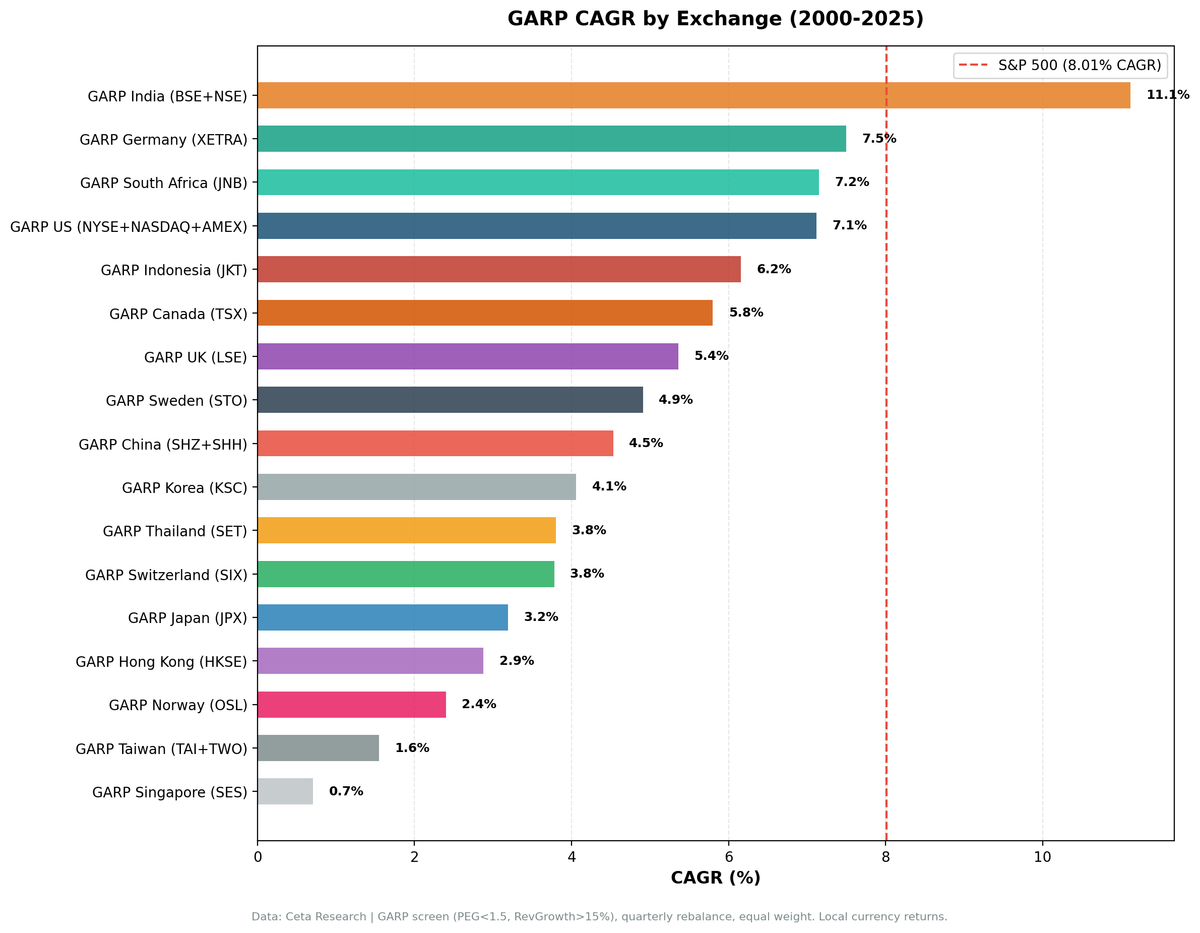
We ran the Growth at a Reasonable Price (GARP) strategy — PEG < 1.5, revenue growth > 15%, ROE > 10% — on 17 stock exchanges worldwide from 2000 to 2025. The S&P 500 benchmark returned 8.02% annually. When compared to local currency benchmarks, the picture changes completely: the UK beats the FTSE by 3.52% per year, Germany beats the DAX by 2.69%, and several other markets show modest outperformance. India's apparent 3.20% excess vs SPY is mostly India's growth premium, not GARP alpha. Against the Sensex, India barely outperforms by 0.10%.
Contents
- Method
- What We Found
- Cross-market comparison (all vs SPY in USD)
- Local Benchmark Comparison: The Real Alpha
- Why Local Benchmarks Matter
- Max Drawdowns
- Cash Periods: Where the Signal Doesn't Fire
- The Real Winners
- Why Developed Markets Outperform With Local Benchmarks
- The India Reversal
- What the Pattern Suggests
- Limitations
- Takeaway
- Individual Exchange Posts
- References
Data: FMP financial data warehouse, 2000–2025. Updated March 2026.
Method
Data source: Ceta Research (FMP financial data warehouse) Period: 2000–2025 (25 years, 103 quarterly periods) Rebalancing: Quarterly (January, April, July, October), equal weight Benchmarks: Cross-market comparison uses SPY; local alpha measured vs local indices Transaction costs: Size-tiered model (0.1–0.5% one-way based on market cap) Cash rule: Hold cash if fewer than 10 stocks qualify at a rebalance date
Each exchange uses exchange-specific market cap thresholds in local currency. Financial data has a 45-day lag on annual filings to prevent look-ahead bias.
GARP signal filters (all must pass at each rebalance):
| Filter | Threshold |
|---|---|
| PEG ratio | 0 < PEG < 1.5 |
| P/E ratio | 5 < P/E < 50 |
| Revenue growth (YoY) | > 15% |
| ROE | > 10% |
| Debt/Equity | < 2.0 |
| Market cap | Exchange-specific threshold |
What We Found
Cross-market comparison (all vs SPY in USD)
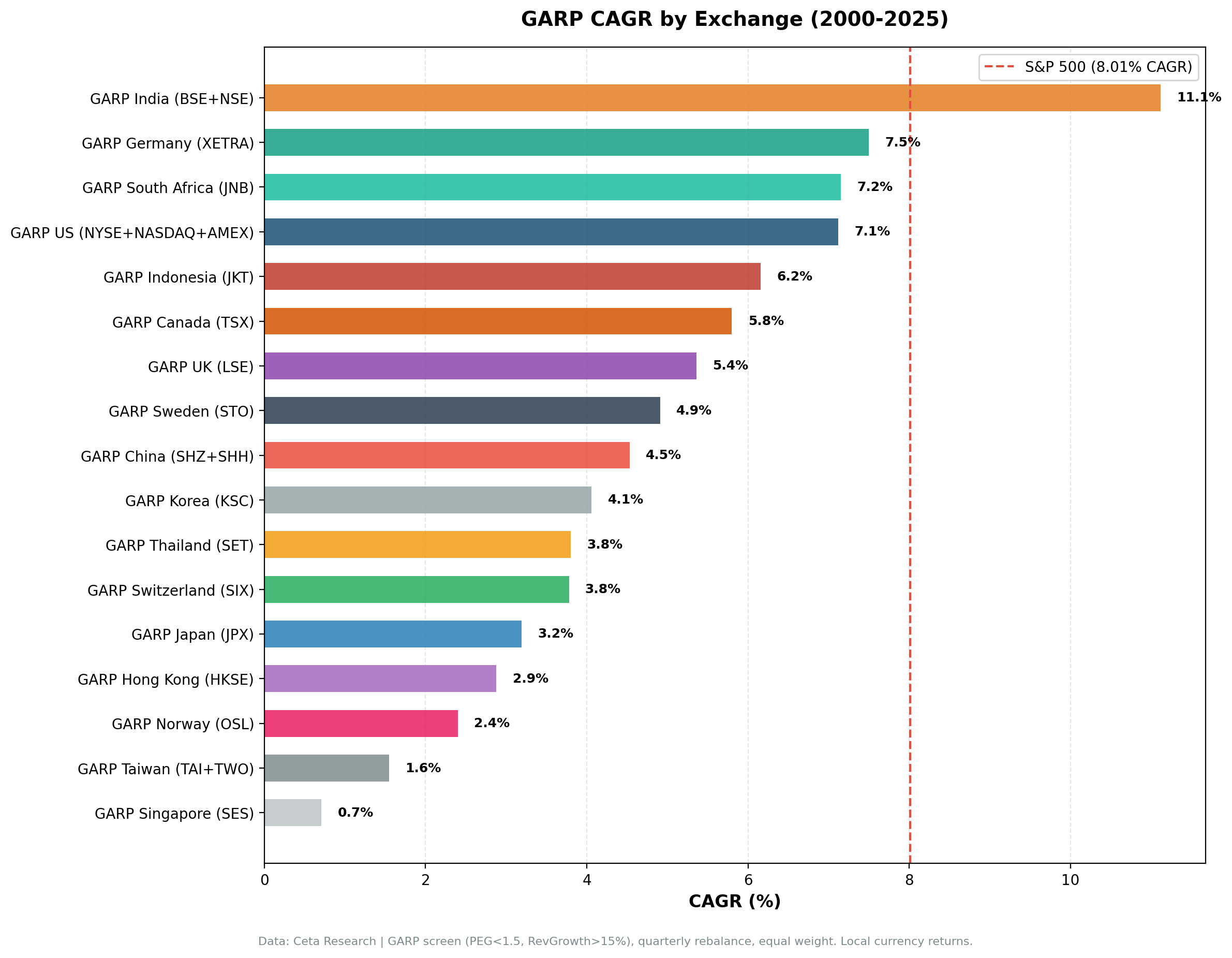
| Exchange | CAGR | vs SPY | Sharpe |
|---|---|---|---|
| India (NSE) | 11.22% | +3.20% | 0.145 |
| Norway (OSL) | 9.55% | +1.53% | 0.359 |
| Germany (XETRA) | 7.81% | -0.21% | 0.278 |
| US (NYSE+NASDAQ+AMEX) | 7.15% | -0.87% | 0.228 |
| South Africa (JNB) | 6.74% | -1.28% | -0.125 |
| Indonesia (JKT) | 6.14% | -1.88% | 0.192 |
| Canada (TSX) | 5.18% | -2.84% | 0.118 |
| Sweden (STO) | 5.09% | -2.93% | 0.138 |
| China (SHZ+SHH) | 4.93% | -3.09% | 0.066 |
| UK (LSE) | 4.88% | -3.14% | 0.067 |
| Korea (KSC) | 4.35% | -3.67% | 0.082 |
| Thailand (SET) | 4.07% | -3.95% | 0.066 |
| Switzerland (SIX) | 3.84% | -4.18% | 0.176 |
| Hong Kong (HKSE) | 3.40% | -4.62% | 0.014 |
| Japan (JPX) | 2.98% | -5.04% | 0.134 |
| Taiwan (TAI+TWO) | 1.52% | -6.50% | 0.027 |
| Singapore (SES) | 0.96% | -7.06% | -0.081 |
SPY benchmark: 8.02% CAGR, Sharpe 0.361
India tops the vs-SPY ranking at +3.20%, but most of that gap reflects India's faster economic growth relative to the US, not the GARP signal finding alpha. When we compare each market to its own local benchmark, the story changes.
Local Benchmark Comparison: The Real Alpha
Comparing strategies to SPY is useful for cross-market portfolio allocation, but it mixes currency effects, economic growth differentials, and stock selection skill. To isolate the GARP signal's actual performance, we need local currency benchmarks.
GARP excess return vs local market index:
| Exchange | GARP CAGR | Local Bench | Bench CAGR | Excess | Sharpe GARP vs Bench |
|---|---|---|---|---|---|
| UK (LSE) | 4.88% | FTSE 100 | 1.36% | +3.52% | 0.067 vs 0.000 |
| Germany (XETRA) | 7.81% | DAX | 5.12% | +2.69% | 0.278 vs 0.139 |
| Sweden (STO) | 5.09% | OMX Stockholm | 3.17% | +1.92% | 0.138 vs 0.066 |
| Switzerland (SIX) | 3.84% | SMI | 2.10% | +1.73% | 0.176 vs 0.074 |
| Hong Kong (HKSE) | 3.40% | Hang Seng | 1.77% | +1.63% | 0.014 vs -0.031 |
| China (SHZ+SHH) | 4.93% | SSE Composite | 4.19% | +0.74% | 0.066 vs 0.025 |
| Thailand (SET) | 4.07% | SET Index | 3.76% | +0.31% | 0.066 vs 0.043 |
| India (NSE) | 11.22% | Sensex | 11.12% | +0.10% | 0.145 vs 0.194 |
| Canada (TSX) | 5.18% | TSX Composite | 5.08% | +0.10% | 0.118 vs 0.114 |
| Japan (JPX) | 2.98% | Nikkei 225 | 3.40% | -0.42% | 0.134 vs 0.121 |
| Korea (KSC) | 4.35% | KOSPI | 4.81% | -0.45% | 0.082 vs 0.099 |
| US (NYSE+NASDAQ+AMEX) | 7.15% | S&P 500 | 8.02% | -0.86% | 0.228 vs 0.361 |
| Singapore (SES) | 0.96% | STI | 2.17% | -1.21% | -0.081 vs -0.031 |
| South Africa (JNB) | 6.74% | SPY | 8.02% | -1.28% | -0.125 vs 0.361 |
| Norway (OSL) | 9.55% | Oslo All Share | 10.91% | -1.36% | 0.359 vs 0.422 |
| Indonesia (JKT) | 6.14% | SPY | 8.02% | -1.88% | 0.192 vs 0.361 |
| Taiwan (TAI+TWO) | 1.52% | TAIEX | 4.38% | -2.86% | 0.027 vs 0.069 |
Note: Norway data only covers 2013–2025 (Oslo All Share index availability). South Africa and Indonesia use SPY due to limited local index data.
The UK shows +3.52% excess vs the FTSE, the strongest result in the dataset. Germany's +2.69% vs the DAX is second. Sweden, Switzerland, and Hong Kong all show +1.6% to +1.9% excess.
India's +0.10% vs Sensex is essentially flat. The apparent 3.20% excess vs SPY reflects India's growth premium over US equities, not GARP's stock selection adding value above the Indian market.
Why Local Benchmarks Matter
The SPY comparison showed "India +3.11%, everyone else underperforms." That's accurate for USD-based portfolio allocation, but it doesn't tell you whether the GARP signal is working.
India's economy grew faster than the US from 2000–2025. The Sensex returned 11.12% while SPY returned 8.02%. Any long-only India strategy would have shown ~3% excess vs SPY. GARP India's +0.10% excess vs Sensex shows the screen barely adds value beyond a simple Indian index fund.
Germany's story flips. Against SPY (-0.21%), it looks like a near-miss. Against the DAX (+2.69%), it's a meaningful outperformer. The DAX had a brutal 2000–2009 period. GARP's quality filters (ROE > 10%, D/E < 2.0) kept financially stressed companies out during that decade.
The UK result (+3.52% vs FTSE) is the most surprising. The FTSE 100 returned only 1.36% CAGR from 2000–2025, dragged down by the financial crisis and Brexit. A quality-growth screen on mid-cap UK stocks found better companies than the FTSE 100's blue chips.
Max Drawdowns
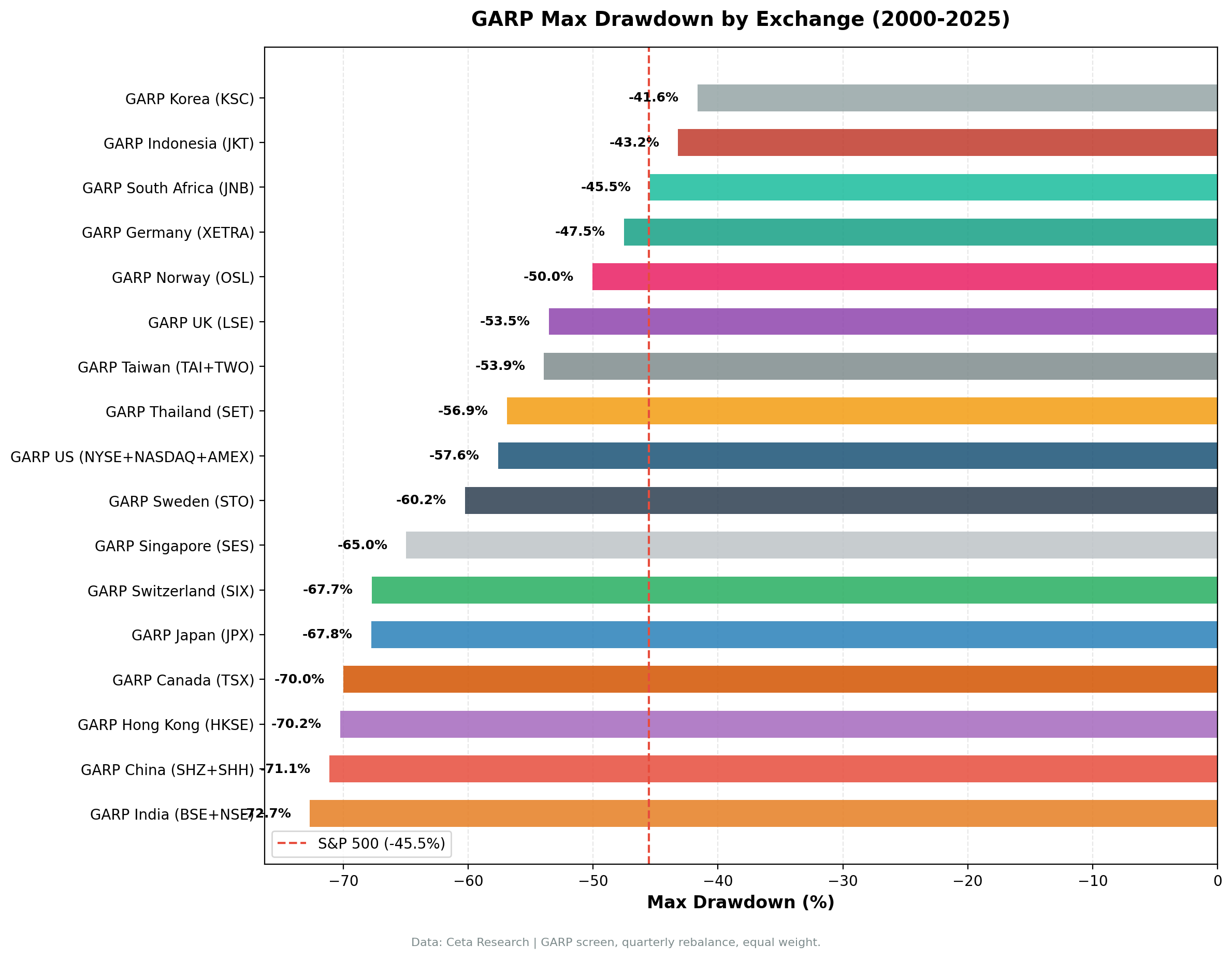
| Exchange | Max Drawdown | Local Bench MDD | Protection |
|---|---|---|---|
| India (NSE) | -72.98% | -51.34% | worse |
| Canada (TSX) | -70.09% | N/A | N/A |
| Hong Kong (HKSE) | -69.66% | N/A | N/A |
| Japan (JPX) | -68.19% | N/A | N/A |
| Switzerland (SIX) | -66.55% | N/A | N/A |
| Singapore (SES) | -62.78% | N/A | N/A |
| Sweden (STO) | -58.09% | N/A | N/A |
| US (NYSE+NASDAQ+AMEX) | -54.60% | -43.86% | worse |
| Taiwan (TAI+TWO) | -54.06% | N/A | N/A |
| Thailand (SET) | -52.67% | N/A | N/A |
| UK (LSE) | -52.76% | N/A | N/A |
| Germany (XETRA) | -46.88% | -65.15% | better |
| South Africa (JNB) | -45.31% | N/A | N/A |
| Indonesia (JKT) | -42.54% | N/A | N/A |
| Korea (KSC) | -40.77% | N/A | N/A |
| Norway (OSL) | -30.93% | N/A | N/A |
Germany is the standout: -46.88% max drawdown vs the DAX's -65.15%. The DAX lost nearly two-thirds of its value peak-to-trough (2000–2009). Germany GARP's quality filters provided genuine crash protection.
India's -72.98% drawdown vs Sensex -51.34% shows the opposite: concentrated growth stocks in an emerging market amplify downside during global crises.
Cash Periods: Where the Signal Doesn't Fire
Some markets showed high cash usage — quarterly periods when fewer than 10 stocks qualified. High cash means the GARP signal is structurally weak for that market.
| Exchange | Cash Periods | Cash % | Interpretation |
|---|---|---|---|
| Norway (OSL) | 73 of 103 | 71% | Signal rarely fires (oil-heavy, limited growth companies) |
| Korea (KSC) | 34 of 103 | 33% | Chaebol structure limits PEG candidates |
| Sweden (STO) | 33 of 103 | 32% | Small mid-cap universe for GARP |
| Indonesia (JKT) | 33 of 103 | 32% | Cyclical, limited depth |
| South Africa (JNB) | 32 of 103 | 31% | Thin qualifying universe |
| Taiwan (TAI+TWO) | 29 of 103 | 28% | Concentrated economy, tech-heavy |
| Japan (JPX) | 23 of 103 | 23% | Low ROE culture limits qualifying stocks |
| India (NSE) | 22 of 103 | 21% | Cash in 2000–2004 only; consistent since 2005 |
| Singapore (SES) | 21 of 103 | 20% | Small market, limited qualifying depth |
| Thailand (SET) | 20 of 103 | 19% | Limited mid-cap GARP universe |
| Switzerland (SIX) | 5 of 103 | 5% | Concentrated but consistent |
| Hong Kong (HKSE) | 3 of 103 | 3% | Large qualifying universe |
| US, Germany, UK, Canada, China | 0 of 103 | 0% | Consistently deep qualifying universe |
Norway's 71% cash rate means the GARP signal fired in only 30 of 103 quarters. Combined with Norway's limited 2013–2025 data window (Oslo All Share index availability), the result is more of a data artifact than a strategy performance measurement.
The Real Winners
Using local benchmarks to measure true alpha:
- UK: +3.52% vs FTSE. The FTSE 100 returned only 1.36% CAGR (2000–2025), dragged by financials and Brexit. GARP's mid-cap quality-growth filter found better UK companies.
- Germany: +2.69% vs DAX. The DAX lost heavily in the early 2000s. GARP's filters avoided that crash, built long-run excess, and delivered nearly double the Sharpe ratio (0.278 vs 0.139).
- Sweden: +1.92% vs OMX Stockholm. Modest but positive edge with consistent 32% cash rate.
- Switzerland, Hong Kong: +1.7% to +1.6%. Positive but thin edges.
India's +0.10% vs Sensex is noise territory. The screen doesn't add value beyond an Indian index fund on risk-adjusted terms (Sharpe 0.145 vs Sensex 0.194).
Why Developed Markets Outperform With Local Benchmarks
The pattern reverses when we use local benchmarks. UK, Germany, Sweden, and Switzerland all show positive alpha vs their home indices. These are efficient markets — why does GARP work?
The explanation: these local indices had poor performance from 2000–2025 relative to SPY. The FTSE returned 1.36%, the DAX 5.12%, OMX Stockholm 3.17%. All were dragged by the dot-com crash, financial crisis, and European sovereign debt issues.
GARP's quality filters (ROE > 10%, D/E < 2.0, PEG < 1.5) systematically screened out the damaged companies during those crises. The screen found mid-cap companies that weren't part of the headline indices and weren't as exposed to the crisis sectors (financials, telecoms, extreme-leverage industrials).
This isn't inefficiency producing alpha. It's quality filtering during a bad period for headline indices. The GARP screen naturally tilts toward industrial, chemical, and specialty companies with genuine earnings growth. Those companies were the survivors, not the casualties, of the 2000–2009 period.
The India Reversal
India's headline vs SPY (+3.20%) is strong. But the Sensex itself returned 11.12% vs SPY's 8.02%. A passive Sensex fund would have shown +3.10% excess. GARP India adds 0.10% above that — statistically indistinguishable from zero.
The capture ratios vs Sensex (113% up, 109% down) show the screen amplifies both bull and bear markets. The cash periods in 2000–2004 cost performance — the Sensex surged +79% in 2003 while GARP held cash. The exceptional years (2007: +36% excess, 2009: +61%, 2023: +53%) are offset by bad years (2008: -19%, 2018: -40%, 2019: -27%).
India is the strongest absolute GARP market globally (11.22% CAGR), but the edge vs its local market is marginal.
What the Pattern Suggests
Run GARP in a market where:
- The local index had a rough 25 years. UK (FTSE 1.36%), Germany (DAX 5.12%), Sweden (OMX 3.17%) all underperformed global equities. GARP's quality bias helped avoid the worst.
- The mid-cap universe differs from the headline index. UK, German, and Swedish mid-caps showed different sector exposure and better fundamentals than their large-cap indices.
- Quality filters matter during crises. ROE > 10% and D/E < 2.0 kept overleveraged and loss-making companies out. This paid off in Europe's difficult 2000s.
Don't run GARP expecting alpha in:
- High-performing indices. SPY's 8.02% from 2000–2025 was strong. GARP couldn't beat it.
- Markets where local benchmarks are already quality-tilted. The Sensex (India) and KOSPI (Korea) already represent quality companies. GARP doesn't add much.
Limitations
Currency. Each market's returns are in local currency. Cross-currency comparison to SPY (USD) doesn't adjust for exchange rate movements. A market can outperform SPY in local currency while an international investor loses to USD strength.
Exchange-specific market cap thresholds. We use exchange-appropriate minimums (not a flat $1B USD), which affects the qualifying universe size per market.
Survivorship bias. Company profiles use current exchange listings. Delistings, bankruptcies, and mergers aren't tracked through terminal events.
25-year period. The 2000–2025 window includes multiple regime changes. Results could differ significantly over shorter or different time windows. Germany, UK, and Sweden all benefited from their indices having rough 2000–2010 periods — GARP's quality bias helped there. If we ran 2010–2025, results might differ.
Norway data limitation. Oslo All Share index only available from 2013. Norway's 9.55% CAGR reflects 2013–2025 performance, not the full 25 years.
Takeaway
We tested GARP across 17 stock exchanges. When measured vs local benchmarks, five markets show meaningful outperformance: UK (+3.52%), Germany (+2.69%), Sweden (+1.92%), Switzerland (+1.73%), and Hong Kong (+1.63%). India barely matches the Sensex (+0.10%). Canada ties the TSX (+0.10%).
The finding is that GARP works where local indices had difficult periods and the quality screen filtered out the worst performers. UK, Germany, and Sweden fit this pattern. The screen doesn't find hidden gems in efficient markets — it finds quality-growth companies when the headline indices are dragged by damaged sectors.
For global investors: Germany and UK stand out as markets where GARP adds value vs the local benchmark. For Indian investors: GARP matches the Sensex with higher volatility. For US investors: SPY beats GARP.
Run the global GARP screen on Ceta Research
Individual Exchange Posts
- GARP on US Stocks — Fully invested 25 years, underperforms SPY
- GARP on Indian Stocks — Barely beats Sensex, strong vs SPY due to India's growth premium
- GARP on German Stocks — Beats DAX by 2.69% annually, 63% down capture
References
- Lynch, P. (1989). One Up on Wall Street. Simon & Schuster.
- Fama, E. & French, K. (1998). "Value Versus Growth: The International Evidence." Journal of Finance, 53(6), 1975–1999.
- Rouwenhorst, K. (1999). "Local Return Factors and Turnover in Emerging Stock Markets." Journal of Finance, 54(4), 1439–1464.
- Griffin, J., Ji, X. & Martin, S. (2003). "Momentum Investing and Business Cycle Risk: Evidence from Pole to Pole." Journal of Finance, 58(6), 2515–2547.
Data: Ceta Research, FMP financial data warehouse. All exchanges, quarterly rebalance, equal weight, transaction costs included, 2000–2025. Returns in local currency.