Sector Momentum in Germany: 9.41% CAGR, +4.22% Excess Over DAX, 26 Years (XETRA)
Germany produced the smallest excess return of the four European markets in our 13-exchange study: 9.41% CAGR, +4.22% vs DAX. What it does deliver is a beta of 0.693, a 59.70% down capture and a shallower drawdown than the index. Technology held a top-2 slot in 35 of 104 quarters.

Germany produced the smallest excess return of the four European markets in our 13-exchange sector momentum study. The strategy still beat the DAX, by 4.22% annually over 26 years, but the UK (+9.54%), Sweden (+8.41%) and Switzerland (+5.40%) all did better against their own indices.
Contents
- The Strategy
- Results
- Technology Leads, and Nothing Else Comes Close
- When It Worked, When It Didn't
- Full Annual Returns
- Listed in Germany Is Not the Same as German
- Limitations
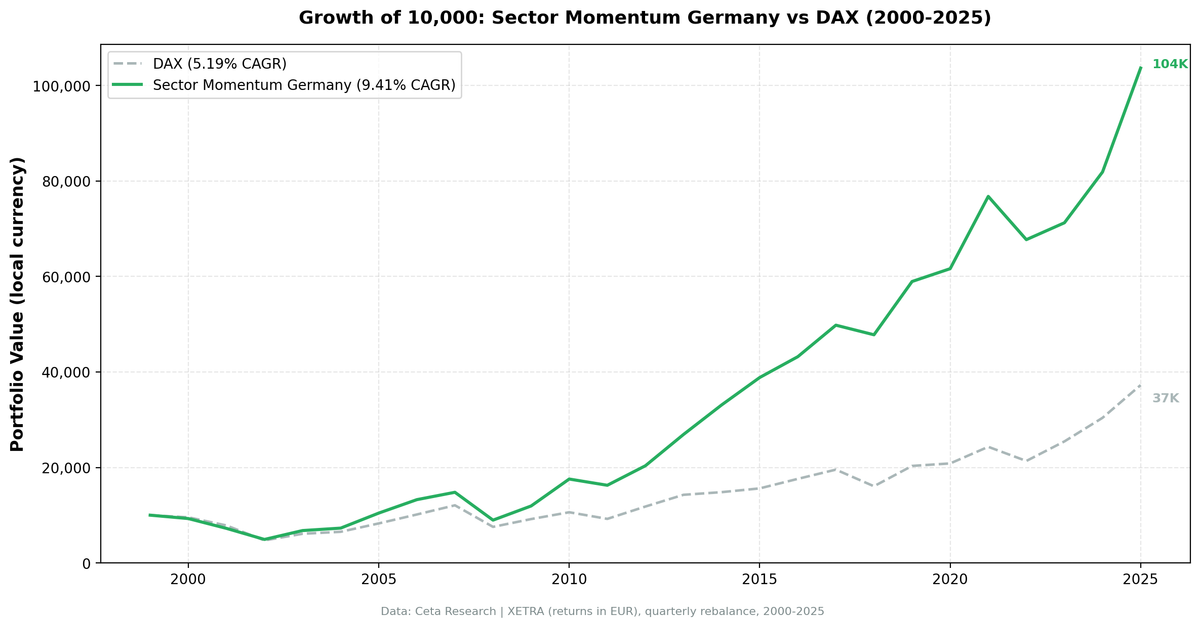
What Germany does deliver is a different risk profile. €10,000 grew to €103,666 against €37,252 for the DAX, and it got there with a beta of 0.693, a down capture of 59.70%, and a maximum drawdown of -60.47% against the DAX's -65.15%. This is the low-beta version of sector momentum. The returns are modest by the study's standards. The ride is calmer than the index.
Data: FMP financial data warehouse, 2000-2025. Updated August 2026.
The Strategy
Each quarter, we rank all 11 GICS sectors by their equal-weighted 12-month trailing return across XETRA-listed stocks. We hold stocks from the top 2 sectors, equal-weighted, and rebalance quarterly. Stocks must clear an exchange-specific market cap threshold. Entry is at the close of the day after each rebalance date. Transaction costs are size-tiered by market cap, from 0.1% to 0.5% one-way.
Full methodology: backtests/METHODOLOGY.md
| Parameter | Value |
|---|---|
| Universe | XETRA (Germany) |
| Signal | Top 2 sectors by trailing 12-month equal-weighted return |
| Selection | All qualifying stocks in those sectors |
| Rebalancing | Quarterly |
| Period | 2000-2025 (26 years, 104 quarters) |
| Execution | Next-day close after each rebalance date |
| Cash rule | Cash if fewer than 5 sectors qualify or fewer than 10 stocks pass |
| Cash periods | 0 of 104 |
| Avg stocks held | 59.4 |
| Benchmark | DAX (EUR) |
| Transaction costs | Size-tiered by market cap, 0.1% to 0.5% one-way |
| Data source | Ceta Research (FMP financial data warehouse) |
The tier is a one-way rate and the model charges a full round trip every quarter, on every holding, even when a sector stays in the top 2 and the position carries over untouched. That's deliberately conservative: real turnover is lower than the cost model assumes.
Returns are in EUR. The DAX is also EUR-denominated, so this is an apples-to-apples comparison.
Results
The aggregate numbers:
| Metric | Portfolio | DAX (EUR) |
|---|---|---|
| CAGR (2000-2025) | 9.41% | 5.19% |
| Excess CAGR | +4.22% | |
| Alpha (Jensen) | +5.20% | |
| Total return | 937% | 273% |
| €10K grows to | €103,666 | €37,252 |
| Max drawdown | -60.47% | -65.15% |
| Annualized volatility | 19.01% | 22.13% |
| Sharpe ratio | 0.390 | |
| Sortino ratio | 0.577 | |
| Calmar ratio | 0.156 | |
| Up capture | 90.15% | |
| Down capture | 59.70% | |
| Beta | 0.693 | |
| Win rate vs DAX (quarterly) | 58.65% |
The down capture of 59.70% vs DAX means the portfolio fell about 60% as much as the German index in down periods on average. A beta of 0.693 reflects lower sensitivity to German market cycles, and the annualized volatility of 19.01% is below the DAX's own 22.13%. Germany is one of four markets in this study, along with Japan, Taiwan and Thailand, where the strategy runs less volatile than the index it beats.
That low beta is why Germany's alpha exceeds its excess. Raw excess is +4.22%; adjust for the fact that the portfolio took only 0.693 of the market's risk and Jensen alpha comes out at +5.20%. Unlike India or Canada, where beta above 1.0 inflates the headline excess, Germany's number understates the risk-adjusted edge.
The Sharpe of 0.390 is the third lowest of the 13 markets in the study, ahead of only China (0.093) and Hong Kong (0.333). Germany works, but it works modestly.
Technology Leads, and Nothing Else Comes Close
| Sector | Quarters in Top 2 |
|---|---|
| Technology | 35 |
| Basic Materials | 23 |
| Real Estate | 22 |
| Healthcare | 21 |
| Consumer Defensive | 19 |
| Consumer Cyclical | 19 |
| Utilities | 18 |
| Communication Services | 18 |
| Energy | 18 |
| Industrials | 14 |
| Financial Services | 1 |
Technology held a top-2 slot in 35 of 104 quarters, a third of the study, and no other sector reaches 24. Germany's technology sector is anchored by companies like SAP and Infineon, enterprise software and semiconductor leaders rather than speculative growth stocks. (Siemens, often assumed to be in this group, is filed under Industrials in this data.) When global tech cycles run, Germany's version runs with lower volatility.
Below Technology the distribution is unusually flat. Basic Materials, Real Estate, Healthcare, Consumer Defensive, Consumer Cyclical, Utilities, Communication Services, and Energy all cluster between 18 and 23 quarters. Germany rotates more evenly than most markets in the study: there's one persistent leader and then a broad rotation underneath it. That flat distribution is part of why the portfolio's volatility stays below the index.
Financial Services appeared once. Germany's financial sector, anchored by Deutsche Bank, struggled with persistently low margins in the European rate environment. The signal correctly avoided it.
When It Worked, When It Didn't
2010: the best year in the series. The portfolio returned +47.33% while the DAX gained +15.57%, a +31.76% margin. Post-GFC recovery drove Real Estate and Basic Materials for consecutive quarters and the strategy stayed positioned throughout. No other year comes close to this margin.
2005 and 2014: sustained sector trends.
| Year | Portfolio | DAX | Excess |
|---|---|---|---|
| 2005 | +43.24% | +26.99% | +16.25% |
| 2014 | +22.98% | +3.88% | +19.10% |
2005 was a Real Estate and Technology momentum year in Germany, with both sectors running sustained multi-quarter trends. 2014 saw the strategy compound while the DAX went nearly flat.
2018: the defensive year. The portfolio fell 4.04% while the DAX fell 17.80%, a +13.76% margin. European defensive and real estate sectors held far better than the broader market. This is the low-beta profile doing exactly what it's supposed to do.
2008: no crisis protection here. This is where an earlier version of this analysis got the story wrong, and it's worth correcting plainly.
| Year | Portfolio | DAX | Excess |
|---|---|---|---|
| 2008 | -39.44% | -37.44% | -2.01% |
In 2008 the strategy fell further than the DAX, by two points. Germany's low beta shows up across the average down quarter and in the 26-year drawdown figure, but it did not show up in the single worst year of the century. Momentum carried the portfolio into the crash still holding the sectors that had led into it. A strategy with a 0.693 beta is not a hedge, and 2008 is the proof.
2001-2002: the tech unwind. The portfolio fell 22.09% in 2001 (DAX -17.84%) and 32.09% in 2002 (DAX -39.92%). The first year lagged, the second beat. Germany's tech and telecom complex suffered its own version of the dot-com crash, and the momentum signal held those sectors into the first leg down.
2023: the worst relative year. The strategy returned +5.22% while the DAX gained +19.19%, a 13.97-point shortfall. When the DAX rallies broadly across sectors, a two-sector portfolio has nowhere to hide.
Full Annual Returns
| Year | Portfolio (EUR) | DAX (EUR) | Excess |
|---|---|---|---|
| 2000 | -7.11% | -4.51% | -2.60% |
| 2001 | -22.09% | -17.84% | -4.25% |
| 2002 | -32.09% | -39.92% | +7.83% |
| 2003 | +37.83% | +29.42% | +8.41% |
| 2004 | +7.55% | +6.79% | +0.75% |
| 2005 | +43.24% | +26.99% | +16.25% |
| 2006 | +26.97% | +22.59% | +4.38% |
| 2007 | +11.65% | +18.98% | -7.33% |
| 2008 | -39.44% | -37.44% | -2.01% |
| 2009 | +33.10% | +21.62% | +11.48% |
| 2010 | +47.33% | +15.57% | +31.76% |
| 2011 | -7.43% | -13.08% | +5.65% |
| 2012 | +25.15% | +28.03% | -2.88% |
| 2013 | +32.20% | +20.84% | +11.36% |
| 2014 | +22.98% | +3.88% | +19.10% |
| 2015 | +17.37% | +5.31% | +12.06% |
| 2016 | +11.23% | +12.79% | -1.56% |
| 2017 | +15.29% | +10.98% | +4.31% |
| 2018 | -4.04% | -17.80% | +13.76% |
| 2019 | +23.36% | +26.52% | -3.16% |
| 2020 | +4.55% | +2.55% | +2.01% |
| 2021 | +24.57% | +16.71% | +7.86% |
| 2022 | -11.80% | -12.18% | +0.38% |
| 2023 | +5.22% | +19.19% | -13.97% |
| 2024 | +14.94% | +19.41% | -4.47% |
| 2025 | +26.57% | +22.55% | +4.02% |
The strategy beat the DAX in 17 of 26 calendar years. The early period through 2015 shows consistent outperformance. Since 2016 the record is mixed, with 2023 and 2024 both trailing.
Listed in Germany Is Not the Same as German
XETRA lists a large number of companies headquartered elsewhere, so a screen filtered on exchange picks up foreign secondary listings alongside domestic names. We reran the backtest restricted to companies domiciled in Germany to check whether the result depends on those foreign lines.
| Universe | CAGR | Excess vs DAX | Avg stocks | Invested quarters |
|---|---|---|---|---|
| Listed on XETRA | 9.41% | +4.22% | 59.4 | 104 of 104 |
| Domiciled in Germany | 11.85% | +6.66% | 30.5 | 104 of 104 |
The domestic-only universe is roughly half the size and performs better, and the strategy stays fully invested in both. The published figures above use the listed universe, which is the conservative choice here. German sector momentum isn't an artifact of foreign listings.
Limitations
Modest edge by the study's standards. +4.22% excess is the smallest of the four European markets tested and eleventh of thirteen overall. Germany's case rests on risk-adjusted return and drawdown, not on raw outperformance.
Currency exposure. Returns are in EUR. Non-European investors face EUR/USD exchange rate exposure on top of equity volatility. The DAX comparison is apples-to-apples for EUR investors, but USD investors carry an additional currency layer.
Low beta is not downside protection. The 0.693 beta and 59.70% down capture describe average behaviour. In 2008, the single worst year, the strategy lost 2 points more than the index. Averages don't help in the year that matters most.
Max drawdown. -60.47% is not a comfortable number, even though it beats the DAX's -65.15%. The GFC and the European debt crisis together put pressure on the strategy across multiple consecutive years.
Sector concentration. With an average of 59.4 stocks across just 2 sectors, the portfolio is more concentrated than the US or India versions of this strategy. Technology alone holds a top-2 slot a third of the time, so this is closer to a persistent tech tilt with a rotating second leg than to a broad rotation.
Recent DAX underperformance. The 2023 (-13.97%) and 2024 (-4.47%) gaps show that Germany's rotation doesn't always keep up with the local index. When the DAX rallies broadly, the strategy's sector concentration lags.
Data: Ceta Research (FMP financial data warehouse). Universe: XETRA (Germany). Period: 2000-2025 (26 years), quarterly rebalance, next-day-close execution, returns in EUR. Past performance does not guarantee future results. This is educational content, not investment advice.
Part of the Sector Momentum Rotation series. US flagship blog