Small-Cap Growth in Japan: The Strategy That Lost 58% Over 25 Years
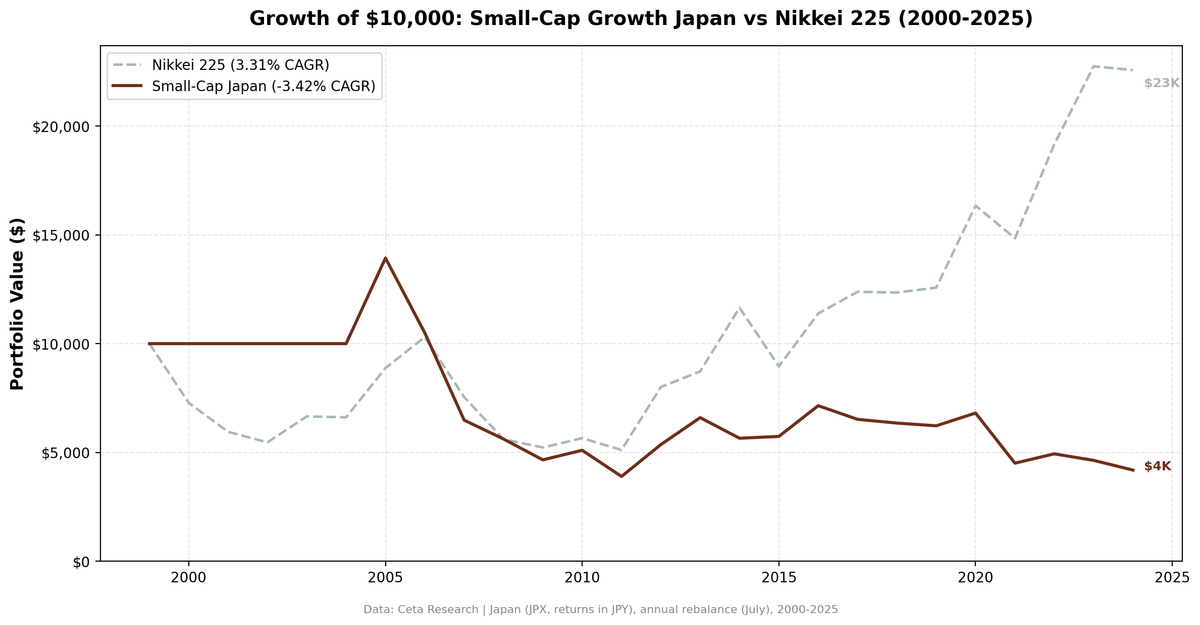
Japanese small-cap growth returned -3.42% CAGR over 25 years, turning $10,000 into $4,186. It trailed the Nikkei 225 by 6.73 points a year and has not beaten it since 2017.

CAGR: -3.42% | Excess: -6.73%/yr vs Nikkei 225 | Sharpe: -0.182 | Max Drawdown: -72.06% | Win Rate: 36%
Contents
- The Method
- What We Found
- Annual Returns
- Why the Strategy Fails in Japan
- The Windows Where It Worked
- Limitations
- Run It Yourself
- Takeaway
- References
This is the credibility post. We're reporting on a strategy that lost money against its own market, badly, for a quarter century.
A small-cap growth screen applied to the Japanese market returned -3.42% CAGR from 2000 to 2024. The Nikkei 225 returned 3.31%. A $10,000 investment ended at $4,186. The Nikkei turned the same money into $22,574. This isn't a bad decade followed by recovery. It's a net loss of 58% across a full quarter-century that spanned multiple global bull markets.
The numbers are stark. The strategy beat the Nikkei in 9 of 25 years, a 36% win rate, and in none of the last seven. Up capture of 33.0% means that when the local benchmark rose, this portfolio captured a third of the gains. Down capture of 87.5% means it absorbed almost all of the losses. Maximum drawdown of -72.06%, against the Nikkei's -50.38%.
This is what complete factor failure looks like in a real market. We're writing about it because backtests that only show what works teach you nothing.
Data: FMP financial data warehouse, 2000-2025. Updated August 2026.
The Method
We screened JPX-listed stocks each July for:
- Market cap between ¥5B and ¥200B (small-cap range for Japan)
- Revenue growth >15% year-over-year (most recent fiscal year)
- Positive net income
- Debt/equity ratio below 2.0
Top 30 by revenue growth, equal-weight, rebalanced annually in July with a 45-day filing lag and entry at the next-day close. Same framework as every other region in this study.
The key structural difference: Japan had five consecutive cash years from 2000 through 2004. The universe of qualifying stocks was too thin to meet the 10-stock minimum. The strategy only became active in 2005. That's 20 active years out of 25, and the results over those 20 years were still deeply negative. When invested, it averaged 22.6 holdings.
What We Found
The up-down capture asymmetry is the wrong way round in both directions. 33.0% up capture means that when the Nikkei 225 rallies 10%, this portfolio tends to gain about 3.3%. 87.5% down capture means that when the Nikkei falls 10%, this portfolio falls about 8.8%. A strategy wants the opposite. This one participates less in the good times and almost fully in the bad ones, on a beta of 0.52, producing a Jensen's alpha of -5.19%.
It has gotten worse, not better. From 2000 to 2009 the average excess was -1.3 points, helped by the cash years. From 2010 to 2017 it was -7.6 points. From 2018 to 2024 it was -14.9 points, with zero winning years. Twelve of the 25 years produced negative absolute returns, five of them in the last seven.
The good years don't make up for the bad ones. 2005 returned +39.36%, 2012 +37.62%, and 2016 +24.65%. But 2006 lost 24.70%, 2007 lost 38.22%, 2011 lost 23.59%, and 2021 lost 33.85%. The wins are episodic. The losses are structural.
2014 was the worst relative year: -47.88%. The strategy lost 14.35% while the Nikkei 225 gained 33.52%. That's not a drawdown, it's a decoupling, and it happened in a year when Japanese large caps were rallying on Abenomics and yen weakness.
2021 was the worst on a whole-of-market basis: -33.85% against a Nikkei that fell 9.14%. The global small-cap growth rally of 2020-2021 didn't reach Japan. While US small-caps surged on fiscal stimulus and rate cuts, Japanese small-cap growth companies saw no comparable earnings inflection.
Annual Returns
| Year | Strategy | Nikkei 225 | Excess vs Nikkei 225 |
|---|---|---|---|
| 2000 | 0.00% | -27.23% | +27.23% |
| 2001 | 0.00% | -18.29% | +18.29% |
| 2002 | 0.00% | -8.10% | +8.10% |
| 2003 | 0.00% | +21.78% | -21.78% |
| 2004 | 0.00% | -0.60% | +0.60% |
| 2005 | +39.36% | +34.22% | +5.15% |
| 2006 | -24.70% | +16.04% | -40.74% |
| 2007 | -38.22% | -26.78% | -11.44% |
| 2008 | -13.37% | -25.67% | +12.29% |
| 2009 | -17.07% | -6.81% | -10.26% |
| 2010 | +9.43% | +8.27% | +1.15% |
| 2011 | -23.59% | -9.65% | -13.94% |
| 2012 | +37.62% | +56.59% | -18.97% |
| 2013 | +23.11% | +9.02% | +14.09% |
| 2014 | -14.35% | +33.52% | -47.88% |
| 2015 | +1.48% | -23.13% | +24.60% |
| 2016 | +24.65% | +27.13% | -2.48% |
| 2017 | -8.80% | +8.76% | -17.55% |
| 2018 | -2.62% | -0.26% | -2.36% |
| 2019 | -1.98% | +1.80% | -3.78% |
| 2020 | +9.43% | +29.97% | -20.54% |
| 2021 | -33.85% | -9.14% | -24.72% |
| 2022 | +9.52% | +29.06% | -19.53% |
| 2023 | -6.07% | +18.73% | -24.80% |
| 2024 | -9.64% | -0.78% | -8.87% |
Return years run July to July, matching the rebalance date. The 0.00% rows are cash years. Best year: 2005 (+39.36%). Worst year: 2007 (-38.22%). Best excess: 2000 (+27.23%, a cash year). Worst excess: 2014 (-47.88%). Active years: 20 (2005-2024). Cash years: 5 (2000-2004).
Why the Strategy Fails in Japan
The small-cap growth premium documented by Banz (1981) and Fama & French (1993) has preconditions that Japan's economic environment systematically violates.
Japan's lost decades and deflationary environment. From the early 1990s through roughly 2012, Japan had deflation or near-zero inflation, stagnant GDP growth, and persistent corporate excess capacity. In that environment, genuine revenue growth above 15% at a small company is exceptional precisely because the aggregate economy isn't growing. The companies that pass the screen are usually cyclical outliers, not structural growers, and a screen can't tell the difference.
Corporate governance and cross-holdings. Japan's corporate structure has featured dense webs of cross-shareholdings, management entrenchment, and low shareholder return orientation. Small-cap companies growing rapidly often lacked the governance to translate revenue growth into earnings consistency. A net income filter helps, but it can't capture quality.
Weak total factor productivity growth. Japan's TFP growth was among the weakest of any major developed economy over this period. Small companies need a growing economy to sustain 15%+ revenue growth. When the underlying economy has structural growth problems, the few companies clearing that threshold are often one-cycle wonders.
The screen missed the reflation trades. 2012 (Abenomics) and 2022 (yen collapse and corporate governance reform) were the two big Japanese rallies of the period. The Nikkei returned 56.59% and 29.06%. The strategy returned 37.62% and 9.52%, lagging both. When Japan finally worked, it worked for large exporters, not for small domestic growth companies.
The Windows Where It Worked
2013 and 2015. 2013 returned +23.11% against the Nikkei's +9.02%. 2015 returned +1.48% while the Nikkei fell 23.13%, a +24.60 point excess and the best active-year result in the sample. Both came from the yen weakness and global reflation cycle lifting Japanese small industrials.
2008. Losing 13.37% while the Nikkei lost 25.67% is the only genuinely defensive year in the record.
Three winning years out of twenty active ones, all macro-driven. The strategy worked when external conditions shifted sharply in Japan's favour, not because the screen filtered for durable quality.
Limitations
The five cash years are a survival artifact. The early universe was too thin to run the strategy, which means we're implicitly crediting it for sitting in cash at 0% during a period when Japanese markets were also struggling. Deploying with a lower stock count threshold would likely have made the results worse.
The market cap bounds (¥5B-¥200B) reflect current-era thresholds. In 2000 those bounds captured a different set of companies than in 2024. The universe shift over 25 years is real and unmodelled.
Transaction costs in Japan's smaller-cap universe are non-trivial. Bid-ask spreads on ¥5B-¥50B names can be meaningful, and the backtest applies size-tiered costs without modelling market impact.
Excluding closed-end funds and ETFs from the universe changes the Japanese result by 0.00pp. Japan is the cleanest market in the study on that measure, so the failure here is entirely about the underlying companies.
FMP restates and backfills financial history. The identical code run in March 2026 produced -1.17% CAGR and a -55.68% drawdown. This run produces -3.42% and -72.06%. The conclusion is the same either way, but the magnitude moved a long way on data revisions alone.
Run It Yourself
The screen definition and SQL are in our US flagship post. The Japan version uses a JPX exchange filter with ¥5B-¥200B bounds.
Query the data directly at Ceta Research.
Takeaway
Japan is where the small-cap growth premium doesn't exist against either the local or a global benchmark. Over 25 years the strategy destroyed 58% of the capital committed to it, underperformed the Nikkei 225 by 6.73 percentage points a year, captured a third of its upside and 88% of its downside, and has not beaten it in a single year since 2017.
This isn't a strategy that needs refinement or better parameters. Japan's small-cap growth environment has structural features that make revenue-growth screening a poor signal: the governance environment, the deflationary history, weak productivity growth, and a universe too thin to fill a 30-stock portfolio for the first five years.
Factor premia aren't laws of physics. They're empirical regularities that depend on structural conditions. When those conditions aren't met, the premium doesn't show up. Japan proves that as clearly as any market in this study.
References
- Banz, R. (1981). "The Relationship Between Return and Market Value of Common Stocks." Journal of Financial Economics, 9(1), 3-18.
- Fama, E. & French, K. (1992). "The Cross-Section of Expected Stock Returns." Journal of Finance, 47(2), 427-465.
- Fama, E. & French, K. (1993). "Common Risk Factors in the Returns on Stocks and Bonds." Journal of Financial Economics, 33(1), 3-56.
- Van Dijk, M. (2011). "Is size dead? A review of the size effect in equity returns." Journal of Banking & Finance, 35(12), 3263-3274.
Data: Ceta Research (FMP financial data warehouse), 2000-2025. Full methodology: METHODOLOGY.md. Past performance does not guarantee future results. This is educational content, not investment advice.