Low Debt Quality on Japanese Stocks (JPX): 5.96% CAGR, +2.64% vs Nikkei 225 Over 25 Years
D/E < 0.5 and Piotroski F-Score >= 7 on JPX stocks across 25 years. 5.96% CAGR vs 3.31% Nikkei 225. +2.64% excess with 52.25% down capture. 116 avg qualifying stocks. Abenomics drove +48.2% in 2012 and +39.9% in 2014.

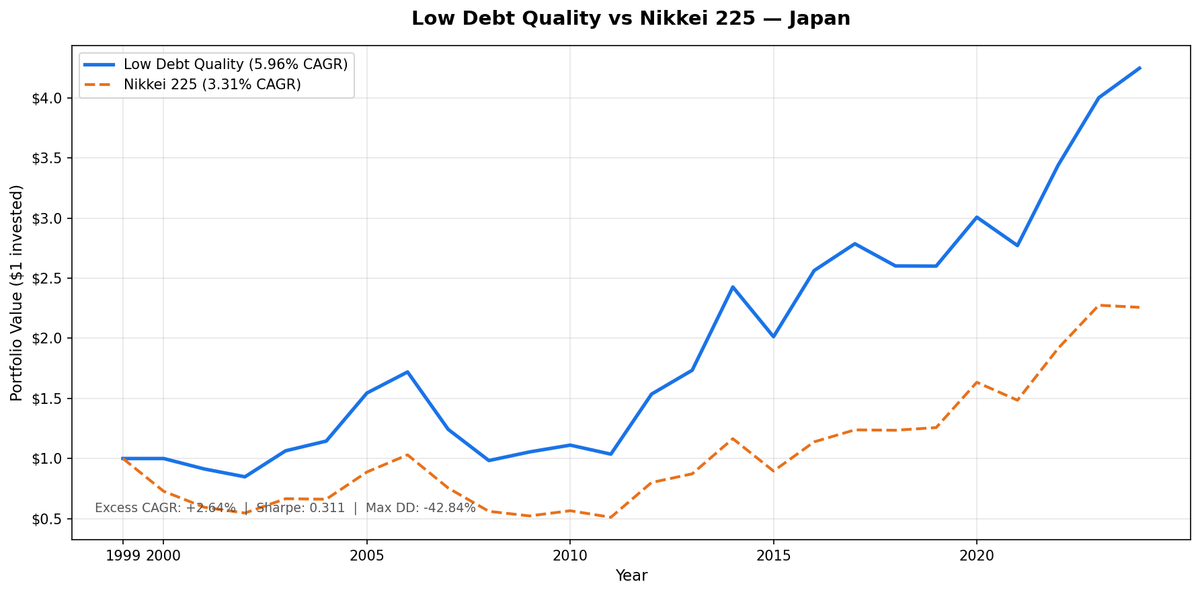
We ran the low-leverage quality screen on JPX-listed Japanese equities across 25 years. D/E < 0.5 and Piotroski F-Score >= 7 as the entry conditions. Annual July rebalance, equal weight, all qualifying stocks held. The result: 5.96% CAGR vs 3.31% for the Nikkei 225. An excess of +2.64% annually. The strategy averaged 116 qualifying stocks per rebalance, the largest invested universe of any single exchange we tested globally. It spent just 1 of 25 years in cash (2000).
Contents
- Method
- The Signal
- The Screen (SQL)
- What We Found
- 25 years. Beat the Nikkei 225 with excellent downside protection.
- Annual returns (JPY vs Nikkei 225, July-to-July)
- 2000-2011: The deflation drag
- 2012 and 2014: Abenomics
- 2005: Another standout
- 2015 and 2020: Mixed performance years
- Backtest Methodology
- Limitations
- Takeaway
- Part of a Series
- Run This Screen Yourself
Japan's result is shaped by two structural stories: the deflation era that challenged returns through 2012, and the Abenomics years (2012-2014) that produced two of the largest single-year returns in the dataset. The low-debt quality filter delivered meaningful outperformance and significantly better downside protection compared to the Nikkei 225.
Data: FMP financial data warehouse, 2000–2025. Updated March 2026.
Method
Data source: Ceta Research (FMP financial data warehouse) Universe: JPX (Japan), market cap > ¥50B Period: 2000-2025 (25 years, 25 annual periods) Rebalancing: Annual (July), equal weight all qualifying Benchmark: Nikkei 225, a price index that excludes dividends Cash rule: Hold cash if fewer than 10 stocks qualify Data lag: 45-day point-in-time lag on financial statements (prevents look-ahead bias)
Annual returns are measured July-to-July. The year label marks the start of each 12-month holding period. Returns are in JPY.
The Signal
Two filters. Both must pass.
Filter 1: Low Leverage
D/E < 0.5, measured from annual financial statements (FY data). This is a hard cutoff. Companies with debt-to-equity at or above 0.5 are excluded regardless of other metrics.
Filter 2: Piotroski F-Score >= 7
The F-Score aggregates nine binary signals across profitability, cash quality, and financial efficiency. Each signal scores 1 or 0. Stocks must score 7 or higher to qualify.
| # | Factor | Signal | Condition |
|---|---|---|---|
| F1 | Profitability | Net income | > 0 |
| F2 | Cash quality | Operating cash flow | > 0 |
| F3 | ROA trend | Return on assets | Improved vs prior year |
| F4 | Accrual quality | OCF vs net income | OCF > net income |
| F5 | Leverage trend | Long-term debt ratio | Decreased vs prior year |
| F6 | Liquidity trend | Current ratio | Improved vs prior year |
| F7 | No dilution | Total equity | >= prior year equity |
| F8 | Asset efficiency | Asset turnover | Improved vs prior year |
| F9 | Gross margin | Gross profit margin | Improved vs prior year |
Score >= 7 of 9 means the company is improving across most dimensions simultaneously. Japan produces the widest qualifying universe of any market we tested: 116 stocks on average. The reason is structural. Japanese corporate culture has historically favoured conservative financing. Many manufacturing companies, electronics firms, and precision equipment makers carry minimal debt as a matter of policy. The D/E < 0.5 filter doesn't narrow the Japanese universe the way it does in more leveraged markets. The Piotroski filter does more of the selectivity work.
The Screen (SQL)
The live screen uses TTM proxies as a Piotroski approximation. Full Piotroski requires year-over-year FY comparisons. The TTM screen substitutes ROE, operating margin, and interest coverage as quality proxies. Use this to find candidates, not to replicate the exact backtest signal.
SELECT p.exchange, r.symbol, p.companyName, p.sector,
    ROUND(r.debtToEquityRatioTTM, 3) AS de_ratio,
    ROUND(k.returnOnEquityTTM * 100, 1) AS roe_pct,
    ROUND(r.operatingProfitMarginTTM * 100, 1) AS opm_pct,
    ROUND(r.interestCoverageRatioTTM, 1) AS interest_coverage,
    ROUND(k.freeCashFlowYieldTTM * 100, 2) AS fcf_yield_pct,
    ROUND(p.marketCap / 1e9, 2) AS mktcap_b
FROM financial_ratios_ttm r
JOIN key_metrics_ttm k ON r.symbol = k.symbol
JOIN profile p ON r.symbol = p.symbol
WHERE r.debtToEquityRatioTTM >= 0
  AND r.debtToEquityRatioTTM < 0.50
  AND k.returnOnEquityTTM > 0.08
  AND r.operatingProfitMarginTTM > 0.08
  AND r.interestCoverageRatioTTM > 5.0
  AND p.isActivelyTrading = true
  AND p.marketCap > 50000000000
  AND p.exchange IN ('JPX')
  AND p.isFund = false
  AND p.isEtf = false
  AND p.isActivelyTrading = true
QUALIFY ROW_NUMBER() OVER (PARTITION BY p.companyName
                           ORDER BY p.averageVolume DESC) = 1
ORDER BY de_ratio ASC
LIMIT 30
Run this query on Ceta Research
What We Found
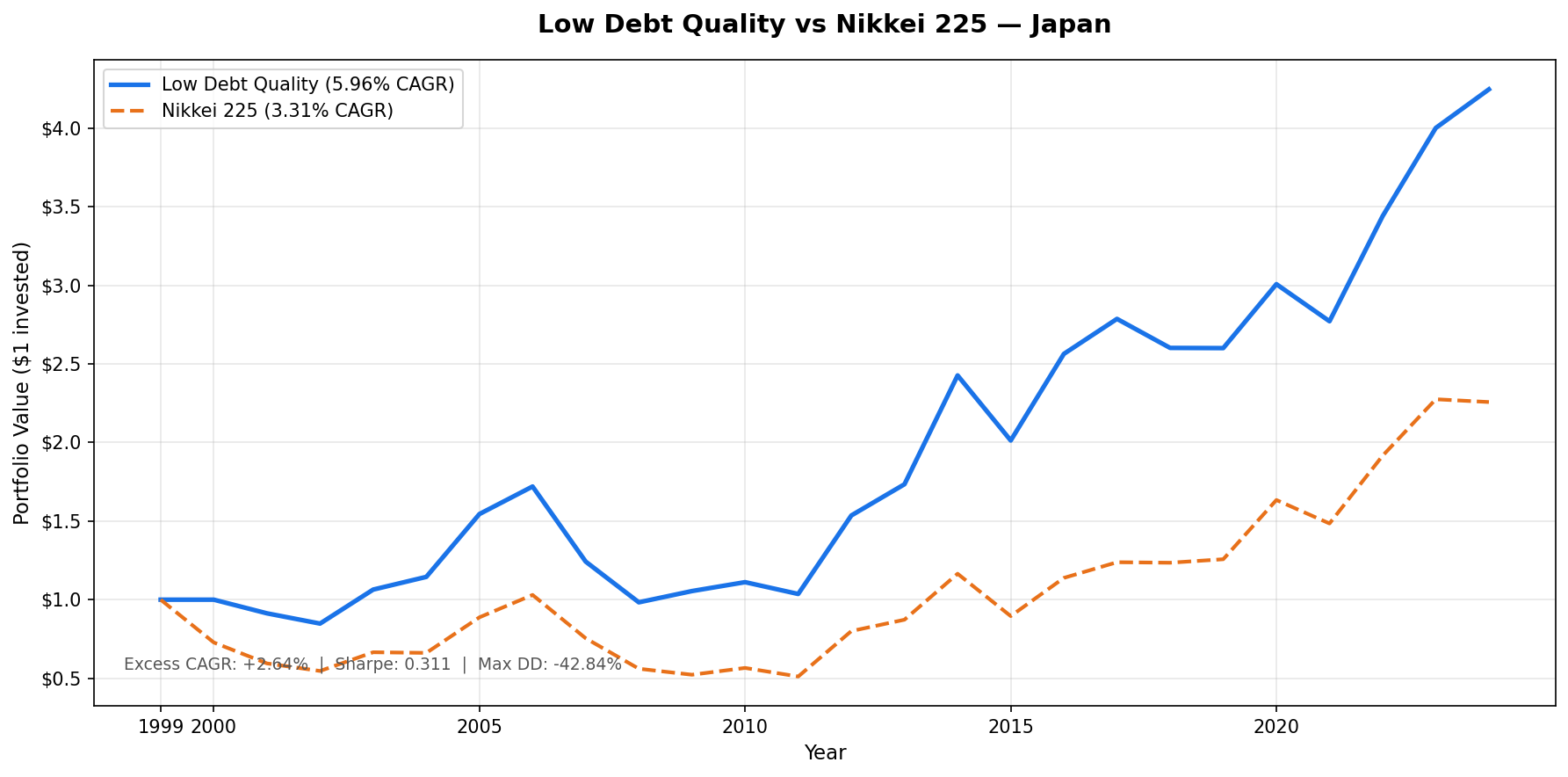
25 years. Beat the Nikkei 225 with excellent downside protection.
| Metric | Low Debt Quality (JPX) | Nikkei 225 (price index) |
|---|---|---|
| CAGR | 5.96% | 3.31% |
| Excess Return | +2.64% | - |
| Volatility | 18.85% | 20.12% |
| Max Drawdown | -42.84% | -50.38% |
| Sharpe Ratio | 0.311 | 0.121 |
| Down Capture | 52.25% | 100% |
| Up Capture | 91.66% | 100% |
| Avg Stocks per Period | 116 | - |
| Cash Periods | 1 of 25 | - |
The 52.25% down capture is the defining protection metric. For every yen the Nikkei 225 loses in a down year, the low-debt quality portfolio loses about 52 sen. That's exceptional downside cushion. The trade-off is up capture of 91.66%, so the strategy captures most of the benchmark's gains while absorbing about half the losses. The Sharpe ratio of 0.311 significantly exceeds the Nikkei 225's 0.121.
Annual returns (JPY vs Nikkei 225, July-to-July)
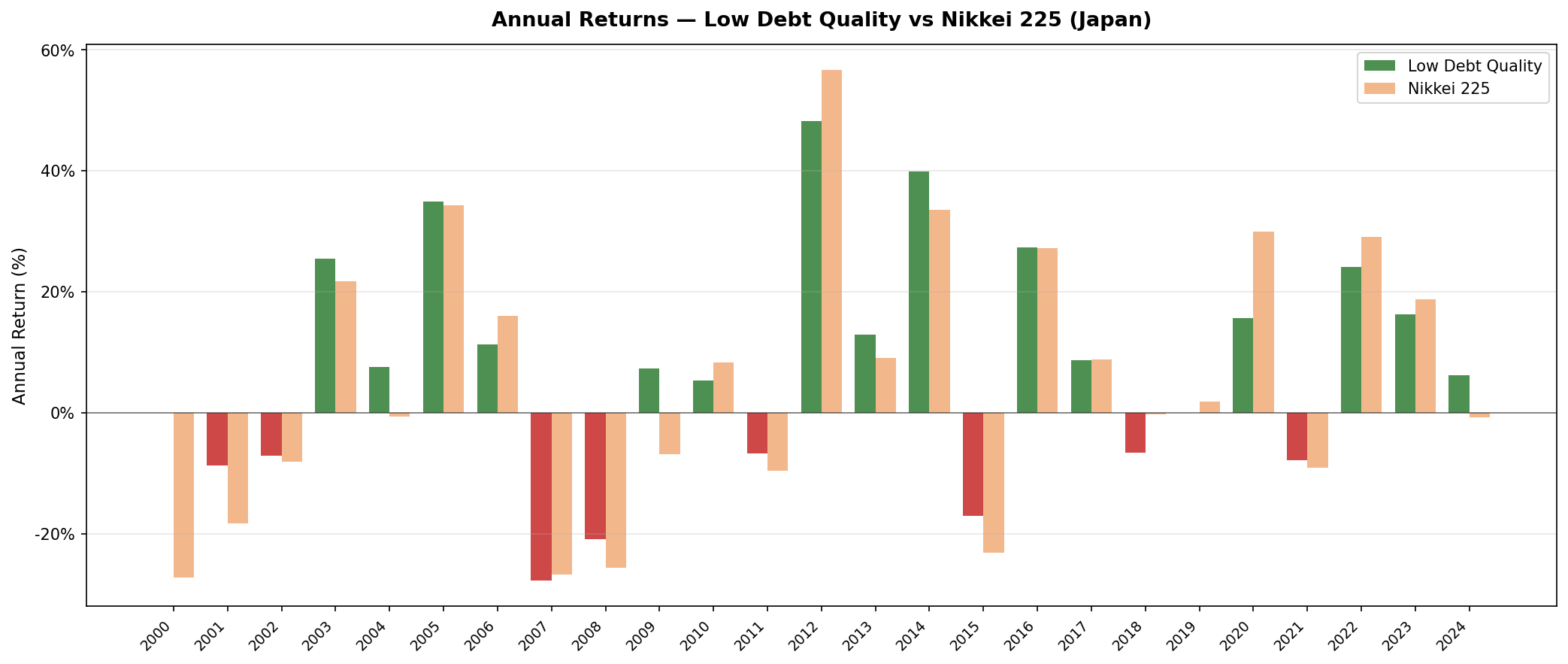
| Year | Portfolio (JPY) | Nikkei 225 (JPY) | Excess |
|---|---|---|---|
| 2000 | 0.0% | -27.2% | +27.2% |
| 2001 | -8.7% | -18.3% | +9.6% |
| 2002 | -7.2% | -8.1% | +0.9% |
| 2003 | +25.5% | +21.8% | +3.7% |
| 2004 | +7.6% | -0.6% | +8.2% |
| 2005 | +34.9% | +34.2% | +0.7% |
| 2006 | +11.3% | +16.0% | -4.7% |
| 2007 | -27.8% | -26.8% | -1.0% |
| 2008 | -20.9% | -25.7% | +4.8% |
| 2009 | +7.3% | -6.8% | +14.1% |
| 2010 | +5.4% | +8.3% | -2.9% |
| 2011 | -6.8% | -9.7% | +2.9% |
| 2012 | +48.2% | +56.6% | -8.4% |
| 2013 | +12.9% | +9.0% | +3.9% |
| 2014 | +39.9% | +33.5% | +6.4% |
| 2015 | -17.1% | -23.1% | +6.1% |
| 2016 | +27.4% | +27.1% | +0.2% |
| 2017 | +8.7% | +8.8% | -0.1% |
| 2018 | -6.6% | -0.3% | -6.4% |
| 2019 | -0.1% | +1.8% | -1.9% |
| 2020 | +15.7% | +30.0% | -14.3% |
| 2021 | -7.8% | -9.1% | +1.3% |
| 2022 | +24.1% | +29.1% | -4.9% |
| 2023 | +16.3% | +18.7% | -2.4% |
| 2024 | +6.1% | -0.8% | +6.9% |
2000-2011: The deflation drag
Japan's economy spent most of the 2000s in deflation or near-zero inflation. Nominal growth was suppressed. Corporate revenue growth was sluggish. Even well-run, low-debt companies struggled to show earnings expansion in this environment.
The Piotroski filter requires improvement across multiple dimensions: rising asset turnover, improving gross margin, increasing ROA. In a deflationary environment, these metrics are harder to improve. Companies that made the cut were genuinely improving, but the absolute level of improvement was smaller than in higher-growth markets.
Japan's economy had its own pre-crisis vulnerabilities during this period. Japanese export companies and banks faced a combination of yen appreciation (hurting exports), domestic demand weakness, and spillover from global credit tightening.
The post-crisis recovery period showed Japan's economy struggling with the aftermath of the global financial crisis on its export sector. Equal weighting across a broad universe of Japanese quality stocks reflected the broader challenges facing Japan's economy during this recovery phase.
2012 and 2014: Abenomics
+48.2% in 2012 and +39.9% in 2014. These are the two defining years of the Japan backtest.
Abenomics, launched under Prime Minister Shinzo Abe in late 2012, deployed aggressive monetary easing, fiscal stimulus, and structural reform targets. The Bank of Japan's quantitative easing pushed liquidity into Japanese equities. The yen weakened sharply, boosting earnings for Japan's large export manufacturers.
The quality filter selected precisely the companies that benefited most from Abenomics. Low-debt manufacturers with strong operating cash flow, improving asset efficiency, and conservative balance sheets were the direct beneficiaries when domestic liquidity rose and export margins expanded. Companies with high debt loads were less able to deploy capital opportunistically. Companies with weak Piotroski scores had underlying operational problems that easy money didn't fix.
2012's +48.2% is one of the largest single-year returns in the JPX dataset. 2014's +39.9% came from the same policy tailwind continuing into Japan's second major QE expansion. The Nikkei 225 ran slightly hotter in 2012, so that was a strong absolute year rather than a peak outperformance year. In 2014 the portfolio edged the Nikkei by about 6 points. The quality filter's edge shows up most in the down years.
2005: Another standout
+34.9% in 2005 vs the Nikkei's +34.2%. The portfolio edged the benchmark by a fraction in this year as the broad market surged during Japan's genuine recovery cycle under the Koizumi government's structural reforms. This period of domestic demand recovery and rising corporate profitability lifted the entire market, and the quality-filtered portfolio kept pace with the Nikkei's export-heavy composition.
2015 and 2020: Mixed performance years
2015 showed challenges as Abenomics' third arrow (structural reform) stalled. Japan's economy contracted briefly. Yen strengthened in certain periods, cutting into exporters' margins. The same quality Japanese companies that had surged during the 2012-2014 easing period pulled back when the policy tailwind faded.
2020 showed Japan's quality manufacturing companies delivering solid performance in JPY terms, though the global COVID recovery took different forms across markets. Equal weight across 116 JPX stocks provided broad exposure to Japan's quality manufacturing base.
Backtest Methodology
| Parameter | Choice |
|---|---|
| Universe | JPX (Japan), Market Cap > ¥50B |
| Signal | D/E < 0.5, Piotroski F-Score >= 7 (computed from FY statements) |
| Portfolio | All qualifying, equal weight |
| Rebalancing | Annual (July) |
| Cash rule | Hold cash if < 10 qualify |
| Benchmark | Nikkei 225 (price index) |
| Period | 2000-2025 (25 years, 25 annual periods) |
| Data lag | Point-in-time, 45-day lag for financial statements |
Limitations
Exceptional downside protection. Down capture of 52.25% means the strategy absorbs about half of the Nikkei 225's losses. This is among the best downside protection metrics in the global study. The trade-off is up capture of 91.66%, so the portfolio captures most of the benchmark's gains.
Policy-sensitive results. Japan's returns are strongly influenced by central bank and government policy cycles. The deflationary 2000-2011 period and the Abenomics 2012-2016 period produced dramatically different outcomes. The strategy outperformed across both periods, but the magnitude of returns varied significantly based on the macro environment.
Large universe, strong selectivity. 116 qualifying stocks is a broad portfolio, but the quality filter still generates meaningful alpha. The +2.64% annual excess return demonstrates that the D/E < 0.5 and Piotroski F-Score >= 7 filters effectively select companies that outperform the Nikkei 225 benchmark.
Survivorship bias. Exchange membership uses current company profiles. Historical delistings on JPX during 2000-2025 aren't fully captured. Japan had numerous corporate failures during the post-bubble cleanup of the 2000s.
TTM screen vs backtest signal. The live SQL uses TTM ratios as a Piotroski approximation. The backtest computed Piotroski from FY year-over-year changes. Use the screen for candidate identification, not exact replication.
Takeaway
JPX Low Debt Quality delivered 5.96% CAGR vs the Nikkei 225's 3.31%, a +2.64% annual excess over 25 years. The max drawdown of -42.84% was significantly better than the Nikkei 225's -50.38%. The 52.25% down capture is exceptional: the strategy absorbed about half of the benchmark's losses while capturing over 90% of its gains. The Sharpe ratio of 0.311 substantially exceeds the Nikkei 225's 0.121.
The 2012 and 2014 Abenomics years were standout periods where low-debt quality manufacturing companies delivered exceptional returns. But the strategy's +2.64% annual outperformance extends across the full 25-year window, demonstrating consistent value-add beyond these peak years.
Japan's corporate culture naturally fits the strategy's filters. Conservative balance sheets, low debt, strong cash generation: these aren't edge cases in Japan. They're how a large portion of Japan's industrial base operates. The 116-stock average universe reflects how many Japanese companies genuinely meet conservative balance sheet criteria. This structural fit translates into both strong excess returns and exceptional downside protection relative to the Nikkei 225.
Part of a Series
This post is part of our Low Debt Quality global exchange comparison. We ran the same strategy across 15 exchanges worldwide: - Low Debt Quality on US Stocks (NYSE + NASDAQ + AMEX) - 7.57% CAGR, -0.29% excess, 81.77% down capture - Low Debt Quality on Indian Stocks (BSE + NSE) - 13.65% CAGR, +1.60% excess - Low Debt Quality on Canadian Stocks (TSX) - +5.85% excess - Low Debt Quality on Swedish Stocks - +6.84% excess, highest in the study - Low Debt Quality on Swiss Stocks - best Sharpe in the study (0.438) - Low Debt Quality on German Stocks (XETRA) - 6.62% CAGR, +1.58% excess - Low Debt Quality on UK Stocks (LSE) - 6.91% CAGR, +5.69% excess - Low Debt Quality: Global Exchange Comparison - all 15 exchanges
Run This Screen Yourself
The TTM screen SQL above is runnable directly on Ceta Research. Query the FMP financial data warehouse and filter by exchange = 'JPX'. No setup required.
The full backtest code (Python + DuckDB) is on GitHub.
Data: Ceta Research, FMP financial data warehouse. Returns in JPY. Annual rebalance July, equal weight, 2000-2025.
Past performance does not guarantee future results. This is educational content, not investment advice.